
Ground Spiders
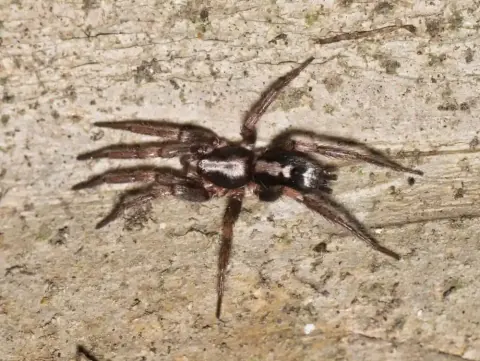
Ground spiders are the family Gnaphosidae, one of the largest in the order: dark, flattened, fast-running night hunters that build no capture web and spend the daylight hours sealed inside a silk cell under a stone. The single best field character is a pair of blunt, tube-like spinnerets projecting from the tip of the abdomen. None of the roughly 2,500 species is dangerous to people.
On this page
- Genera of the Ground Spiders
- Ground Spiders: species profiles
- What are ground spiders?
- How to identify a ground spider
- How ground spiders hunt
- Habitat and where people meet them
- Life cycle and reproduction
- Are ground spiders venomous or dangerous?
- Ground spider or look-alike?
- Did you know?
- Frequently asked questions
What are ground spiders?
Ground spiders are the family Gnaphosidae, and there are a great many of them: roughly 2,500 described species in more than 150 genera, which places the family among the half-dozen largest in the whole order. They occur on every continent except Antarctica, and in most temperate gardens they are among the commonest spiders present even though almost nobody notices them.
The reason for that invisibility is the way they live. A gnaphosid builds no capture web at all. It spends the day inside a closed cell of tough white silk under a stone, a log, a slab of loose bark or a piece of litter, and comes out after dark to run down prey on foot. Everything about the family follows from that: a low, flattened, streamlined body, plain dark colouring, no ornament and a turn of speed that is startling when you lift the stone.
Familiar members include Herpyllus, whose parson spider is one of the commonest spiders found indoors in North America; Drassodes, the big pale-grey species of European stone walls and hillsides; and Scotophaeus blackwalli, the velvety brown spider British householders call the mouse spider.
How to identify a ground spider
The spinnerets
This is the character that settles it. The front pair of spinnerets in a gnaphosid are cylindrical, blunt-ended, clearly separated and long enough to project beyond the tip of the abdomen like two little tubes, visible from above with a hand lens or in a sharp photograph. It separates a ground spider instantly from the ant-mimic sac spiders, whose front spinnerets are conical and tapered.
Eyes
Eight eyes in two rows of four. The useful detail is the back middle pair, which in most gnaphosids are not round but flattened and irregular — oval, angular or crescent-shaped — and often pale, silvery or faintly iridescent instead of black. Our guide to spider eyes explains why a night hunter ends up with reflective eyes rather than large ones.
Size, shape and colour
Body length runs from about 2 mm in the smallest Micaria and Zelotes to around 17 mm in the largest Drassodes, with most of what you meet in the 4–12 mm range. The carapace is low and oval, the abdomen soft and elongate, the legs sturdy and spined. Colours are muted: black, slate, chocolate, grey, dull red-brown, sometimes with a silky sheen. The clearest marking in the family is the parson spider's white stripe down the front of the abdomen.
How ground spiders hunt
Gnaphosids are pure pursuit hunters. They quarter the ground after dark, detecting prey by touch and vibration rather than sight, and close the last few centimetres in a rush. Small insects, springtails, other spiders and, in some genera, ants make up the diet described in our guide to what spiders eat.
The family has one trick that sets it apart, and the enlarged spinnerets are the reason. A gnaphosid facing awkward prey — an ant that can bite back, or another spider — circles it and flicks bands of exceptionally strong, gluey silk over its legs, tethering it to the ground before closing in. Callilepis takes this further and hunts ants almost exclusively, biting at the base of an antenna and retreating until the venom works.
Silk is otherwise used only for shelter: a flattened sac of dense white silk spun into a crevice or under a stone, where the spider rests by day, moults, and in cold climates overwinters as a juvenile — one of the strategies covered in where spiders go in winter. Nothing in the family spins a snare, as our overview of the spider web notes of the hunting families generally.
Habitat and where people meet them
Anywhere with cover at ground level: under stones, logs, boards, bark and paving slabs, in leaf litter, at the base of grass tussocks, in scree and desert gravel and on bare cultivated soil. The family is most diverse in warm, dry, open country, and deserts and Mediterranean scrub are full of gnaphosids.
They also wander indoors in late summer and autumn, which is when most people meet one. A parson spider running flat out across a wall at night is a common sight in North American homes, and Scotophaeus blackwalli fills the same role in Britain, as our overview of house spiders describes; in the warm southern states, Texas especially, gnaphosids are among the spiders most often swept up indoors. None can establish a population inside, so an indoor ground spider is a lost animal rather than an infestation.
Life cycle and reproduction
Males mature in late spring or summer, abandon their retreats and travel in search of females, which is why almost every ground spider found wandering in the open by day is a male. Courtship is brief and tactile.
The female lays her eggs inside a papery, thick-walled sac of white or pinkish silk, usually a flattened disc fixed to the underside of a stone or a piece of bark and slightly domed in the middle. She stays with it, often walling herself in alongside it, and defends it until the spiderlings emerge. After that the maternal care ends: the young disperse within days or after a first moult and fend for themselves from then on — they do not stay with her until maturity, as older accounts claim.
Most temperate species complete the cycle in a year or two, overwintering as part-grown juveniles in the silk cell and maturing the following season. Being small, soft-bodied and active on open ground makes them a staple food for spider-hunting wasps, centipedes, beetles, shrews, lizards and birds, the predators catalogued in what eats spiders.
Are ground spiders venomous or dangerous?
Every ground spider has venom and uses it — the old claim that their bites are "not venomous" is simply wrong — but the venom is tuned to insects, and no species in Gnaphosidae is medically significant anywhere. No antivenom exists and none appears among the most venomous spiders.
Bites do happen, more often than with most harmless families, because these spiders wander indoors at night and end up trapped against skin in bedding or clothing; the parson spider is the usual culprit in North America. The reported result is a sharp, wasp-like sting with local redness, swelling and sometimes itching, occasionally a stronger allergic reaction in sensitive people. It resolves without treatment, and there is no tissue destruction of the kind seen with a brown recluse.
Bitten? Wash the site with soap and water, apply a cold pack and take a simple painkiller if you need one. Do not cut, suck or burn the wound. Seek medical advice if you develop spreading redness, heat and increasing pain over the following days, which points to a skin infection, or if you have any breathing difficulty or widespread rash.
Genera of the Ground Spiders (Gnaphosidae)
Genera listed for this family on Spider Identifications — linked names have their own profile:
- Amazoromus
- Amusia
- Anagrina
- Apodrassodes
- Benoitodes
- Cabanadrassus
- Callilepis
- Canariognapha
- Diaphractus
- Drassodes
- Eilica
- Eleleis
- Homoeothele
- Herpyllus
- Intruda
- Kishidaia
- Laronius
- Leptodrassex
- Macarophaeus
- Moreno
- Nopyllus
- Odontodrassus
- Prodida
- Pseudodrassus
- Sanitubius
- Sanitubius
- Setaphis
- Synaphosus
- Theuma
- Titus
- Urozelotes
- Verita
- Wydundra
- Xerophaeus
- Xizangia
- Zelominor
Ground Spiders: species profiles
4 profiles in this family, each with identification photos, size, range, web, bite information and FAQ.
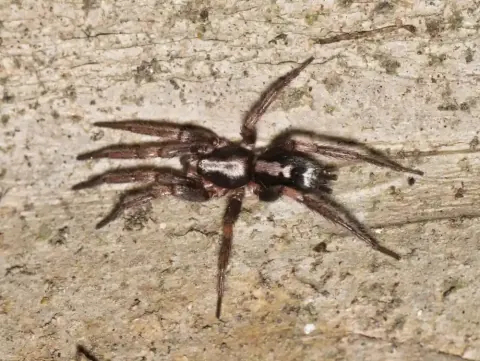 SpeciesParson (Herpyllus ecclesiasticus)Identify the eastern parson spider (Herpyllus ecclesiasticus): the cravat mark, size, speed, where it lives, and how much its bite really ma
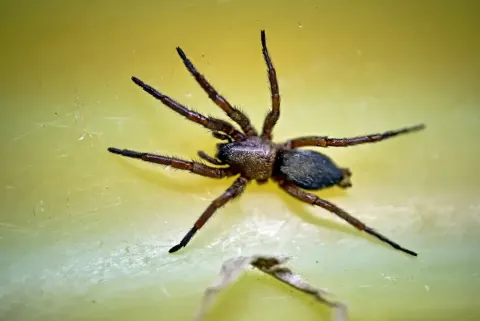 SpeciesScotophaeus blackwalliIdentify Scotophaeus blackwalli, the European mouse spider: velvety grey body, size, where it lives indoors, and why it is not the Australia
Genus profiles
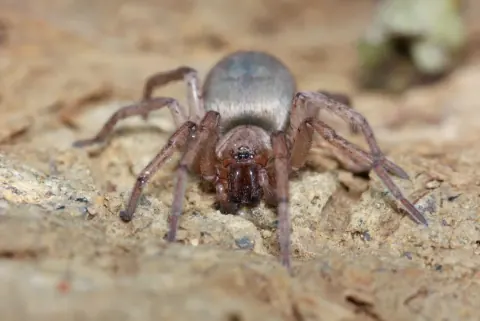 GenusDrassodesA guide to Drassodes ground spiders: how to identify the genus, the silk cell under a stone, where they live worldwide, and how serious a bi
 GenusHerpyllusA guide to Herpyllus ground spiders: how to identify the genus, the species you are likely to meet, where they live, and how much a Herpyllu
Ground spider or look-alike?
Corinnidae and Trachelidae are the commonest genuine confusion: similar size, similar dark colouring, same ground-running habits. Check the front spinnerets — blunt cylinders held apart in a gnaphosid, short cones in the others — and look for the flattened back middle eyes.
Yellow sac spiders share the habit of coming indoors at night and building a silk sleeping cell, but they are pale straw or greenish, climb walls and ceilings freely, and have far longer, thinner legs than any ground spider.
Brown recluse is the identification people most want ruled out. A recluse has six eyes in three pairs, uniformly pale legs with no spines and no pattern on the abdomen; a ground spider has eight eyes, spiny legs and those projecting spinnerets. Recluses also occur only in a limited part of the United States, as our page on the Sicariidae explains.
Wolf spiders are the other frequent mix-up and are easy to exclude: they have two very large forward-facing eyes that shine in torchlight, and females carry the egg sac attached to the spinnerets.
Did you know?
- Gnaphosidae is one of the half-dozen largest spider families in the world, and new species are named every year, mostly from arid regions.
- The parson spider owes its name to the pale stripe on its abdomen, which early naturalists thought resembled the white neck-cloth worn by clergymen in the eighteenth century.
- Ground spiders use their oversized spinnerets as a weapon, flicking bands of unusually strong, sticky silk over the legs of ants and rival spiders to pin them down before biting.
- The small, glossy, often iridescent Micaria are ant mimics, and run in the jerky, antenna-waving style of an ant rather than the fluid glide of the rest of the family.
- The spider British householders call the mouse spider is not a mouse spider at all but the gnaphosid Scotophaeus blackwalli, named for its velvety grey-brown coat.
Frequently asked questions
Are ground spiders dangerous to humans?
No. No member of Gnaphosidae is medically significant anywhere in the world and no antivenom exists. A bite feels like a sharp sting, leaves local redness and swelling and clears up on its own. There is no tissue destruction, and the venom is adapted to insects rather than to anything our size.
How do I identify a ground spider?
Look at the back end. Ground spiders have two blunt, cylindrical spinnerets that are widely separated and stick out beyond the abdomen like small tubes. Add a low, flattened dark body, spiny legs, eight eyes with the rear middle pair flattened and often pale, and no web, and the family is confirmed.
Do ground spiders build webs?
Not for catching prey. They spin a flattened cell of dense white silk under a stone, log or piece of bark and use it as a daytime retreat, a moulting chamber, an overwintering shelter and a nursery. Prey is chased down on foot after dark, never trapped in a snare.
What is a parson spider?
It is Herpyllus ecclesiasticus, a North American ground spider about 8 to 13 mm long, dark grey to black with a distinctive white or pale stripe on the front of the abdomen. It is one of the spiders most often found running across walls and floors inside houses in late summer and autumn.
Why do ground spiders come into houses?
They wander in through door gaps and air bricks while hunting, mainly in late summer and autumn and mostly at night. They cannot breed or overwinter successfully indoors because there is nothing for them to eat, so an indoor ground spider is a stray. Catching it in a glass and putting it outside is enough.
How can I tell a ground spider from a brown recluse?
Count the eyes. A recluse has six, arranged in three widely separated pairs, and its legs are smooth and unspined with no pattern on the abdomen. A ground spider has eight eyes, spiny legs and two obvious tube-like spinnerets projecting behind. Recluses are also restricted to a defined part of the United States.
What do ground spiders eat?
Small ground-living invertebrates hunted at night: flies, springtails, beetles, caterpillars, crickets and other spiders. Several genera specialise in ants, using strong silk flicked over the ant's legs to immobilise it first. Because they hunt actively rather than waiting in a web, their diet is wider than that of most web builders.
How long do ground spiders live?
Most temperate species live one to two years. They hatch in summer, overwinter as part-grown juveniles sealed inside a silk cell, and mature the following spring or summer. Males die within weeks of maturing and setting out to find a mate; females survive long enough to produce and guard at least one egg sac.
Are ground spiders aggressive?
No. They are fast and they run when disturbed, which is often mistaken for aggression, but their first response to a person is always escape. Bites occur almost exclusively when a spider is trapped against skin inside clothing, a shoe or bedding and has no route out.
Where do ground spiders live?
Everywhere except Antarctica, and most densely in warm, dry, open habitats. Typical shelters are the undersides of stones, logs, bark and boards, plus leaf litter, grass tussocks, desert gravel and cultivated soil. They are strictly ground-level animals and rarely climb vegetation, though they will cross a wall indoors.
4 species profiles · Last updated September 14, 2026