
Lynx Spiders
Lynx spiders are the family Oxyopidae: sharp-eyed, spiny-legged daytime hunters that stalk and pounce on insects among leaves and flowers instead of building a web. The best known is the big green lynx of the warm Americas, a spider that guards its egg sac fiercely and can squirt venom at an intruder — without being any real danger to people.
On this page
What are lynx spiders?
Lynx spiders make up the family Oxyopidae, erected by the Swedish arachnologist Tamerlan Thorell in 1870. It is a medium-sized family — more than 450 described species spread across nine genera — but a distinctive one, because almost every member hunts the same way: by walking, watching and pouncing on vegetation, in daylight, with no snare of any kind.
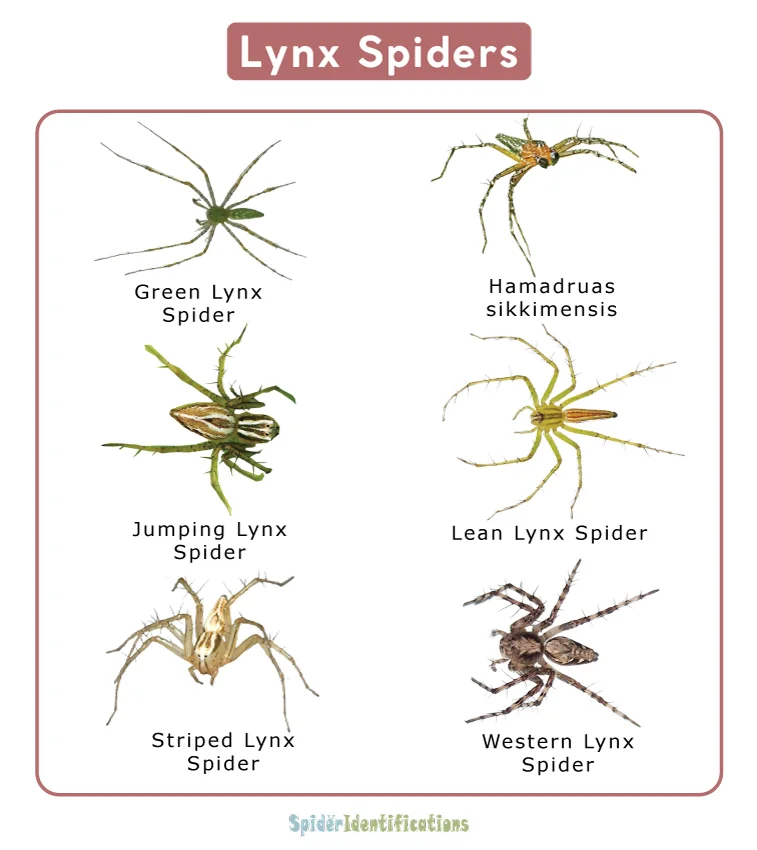
Two genera account for most of what people see. Peucetia holds the large green lynxes, including the American green lynx spider, while Oxyopes is by far the biggest genus, containing several hundred mostly small, streaky brown or grey species found on grass and crops worldwide. Hamataliwa, Hamadruas and Tapinillus make up much of the remainder.
The name fits: a lynx spider creeps along a stem, freezes, then covers the last few centimetres in a leap.
How to identify a lynx spider
Legs and body
The give-away is the legs: long, tapering and pale, studded with conspicuous erect black spines that stand out like bristles on a brush. When the spider seizes an insect the spined legs close around it in a basket that stops the prey kicking free. The abdomen is narrow and drawn out to a point at the rear, and the carapace is high and rounded in front.
Eyes
All eight eyes are present, and six of them sit in a distinct hexagon on the raised front of the head, with a smaller pair low down at the front. No other common family has quite this arrangement, and it is the quickest confirmation in a photograph. Vision is good but not in the jumping-spider class, as our guide to spider eyes explains.
Size and colour
Body length runs from about 3 mm in the smallest Oxyopes to roughly 23 mm in a large female Peucetia; most species fall between 5 and 15 mm, and females are larger than males. Colour is usually cryptic against foliage: bright leaf green in Peucetia, straw, grey or brown with dark stripes in Oxyopes, often with red or orange flecks around the eyes.
Hunting without a web
No lynx spider builds a capture web. Silk goes into the egg sac, into draglines and into the safety line a spider trails as it jumps, and that is all — our guide to the spider web covers the families that do things differently.
Instead a lynx hunts on the plant. It patrols stems and leaf edges, holds still when something moves, tracks the target with its forward eyes, and closes with a fast run or a short jump. Flowers are the favourite station, because flowers deliver prey: flies, moths, small wasps, bugs, beetles and — awkwardly — bees. Lynx spiders take honeybees and other pollinators alongside the pest insects they remove, so their value in a garden is genuinely mixed. In cotton and soybean fields the striped lynx Oxyopes salticus is often among the most abundant predators present. For the wider picture see what spiders eat.
Where lynx spiders live
Oxyopidae is a worldwide family, far richer in the tropics and subtropics than in cool temperate country. The green lynx is a fixture of shrubby ground across the southern United States, Mexico, Central America and the Caribbean, familiar in Texas and Florida; Oxyopes species are abundant across Africa, southern Europe, Australia and Asia, and lynx spiders are among the commonest spiders of rice and cotton fields in India.
The habitat is vegetation rather than ground: shrubs, herbs, tall grass, hedgerows, crops, scrub and the flowering heads of almost anything. They are not forest-floor or leaf-litter spiders, and they do not come into houses, so a spider found indoors is something else.
Egg sacs, maternal care and the annual cycle
Most lynx spiders live a single year. Adults appear in late summer and autumn, males court with leg-waving displays and die soon after mating, and the female turns to the one piece of construction she does undertake.
She spins a rounded, straw-coloured egg sac — knobbly rather than smooth — and fixes it among leaves or flower heads, often anchoring it with guy lines. Then she stands over it. Female Peucetia defend a sac aggressively, lunging at anything that touches it, and stay on guard until the spiderlings emerge. That maternal vigil is the reason most lynx spider bites on record happened: somebody picked the leaf the sac was on.
Spiderlings disperse, overwinter as juveniles in temperate regions and mature the following year, growing through the moults set out in our guide to the spider life cycle.
Are lynx spiders venomous or dangerous?
Lynx spiders have venom, like nearly every spider, and they use it on insects. None of the 450-odd species is medically significant: there is no antivenom for any oxyopid because none has ever been needed, and the family appears nowhere on our list of the most venomous spiders.
Bites are uncommon and almost always defensive, usually from a female guarding an egg sac. What is reported is a sharp sting at the moment of the bite, a red mark, sometimes a swollen area a few centimetres across, and soreness that fades within a day or two. There is no tissue damage and no systemic illness.
The green lynx does something unusual that is often misread as an attack: a disturbed female can eject a fine spray of venom from her fangs over a distance of several centimetres. It is defensive, aimed at a looming face or hand, and harmless on skin — but venom in an eye is an irritant, so do not lean close over a guarded sac.
Bitten? Wash with soap and water, apply a cold pack and take a simple painkiller if you need one. If venom is sprayed into an eye, flush the eye with clean water for several minutes. See a doctor only if the site becomes hot, spreading and increasingly painful over the following days — that is infection, not venom.
Genera of the Lynx Spiders (Oxyopidae)
The genus listed for this family on Spider Identifications — linked names have their own profile:
Lynx Spiders: species profiles
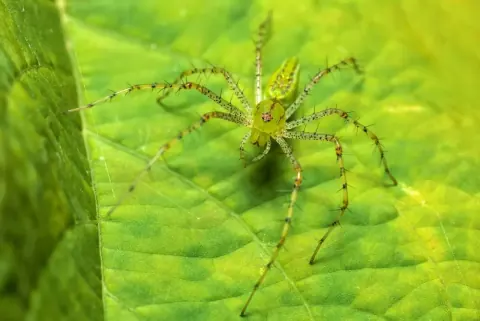
2 profiles in this family, each with identification photos, size, range, web, bite information and FAQ.
Genus profiles
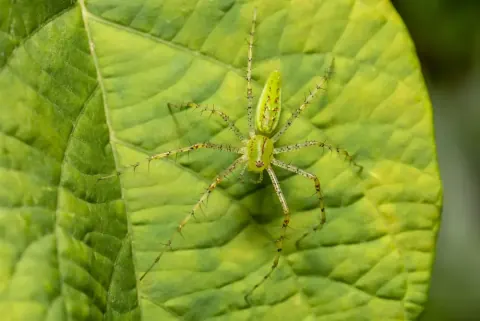
Lynx spider or look-alike?
Crab spiders are the usual confusion on a flower head. A goldenrod crab spider or flower crab spider sits flat and motionless with its enlarged front legs held out sideways, and it waits; a lynx stands tall on slender spiny legs and moves.
Jumping spiders share the daytime, sharp-eyed, pouncing habit, but they are compact and stubby with two huge forward-facing front eyes. A green jumper such as the magnolia green jumper is short-legged and blunt; a green lynx is long-legged and pointed at the rear.
Wolf spiders and nursery web spiders also hunt without a web, but they work at ground level or on waterside vegetation, are far more heavily built, and have a prominent pair of large rear eyes rather than a hexagon.
Did you know?
- Tamerlan Thorell, the Swedish arachnologist who named a great many of the world's spiders, established the family Oxyopidae in 1870 — the family, not a single species.
- A green lynx female can spray venom from her fangs at an intruder, one of very few spiders known to use venom at a distance rather than by biting.
- Lynx spiders are among the commonest predators in cotton and soybean fields, where the small striped Oxyopes salticus can reach very high densities.
- The spines on the legs are not decoration: closed around a struggling fly, they form a cage the insect cannot kick its way out of.
Frequently asked questions
Are lynx spiders dangerous to humans?
No. No species in Oxyopidae is medically significant and no antivenom exists for any of them. A bite stings at the moment it happens and may leave a red, slightly swollen spot that settles within a day or two. There is no tissue damage and no systemic illness of any kind.
Do lynx spiders build webs?
No capture web. They hunt by stalking and jumping on plants, and use silk only for draglines, safety lines and the egg sac. Any web you find a lynx spider sitting near almost certainly belongs to another spider; the family has no spinning behaviour beyond wrapping and anchoring its eggs.
How do I identify a lynx spider?
Look at the legs and the eyes. The legs are long, pale and covered in conspicuous erect black spines, and six of the eight eyes form a clear hexagon on the raised front of the head, with a smaller pair below. The abdomen usually tapers to a point at the rear.
Can a green lynx spider really spit venom?
Yes, in a limited way. A disturbed female, typically one guarding an egg sac, can eject a fine spray of venom from her fangs over a few centimetres. It is defensive, not a hunting method, and it is harmless on skin. Venom in the eye is irritating, so rinse it out with clean water.
What do lynx spiders eat?
Flying and plant-dwelling insects caught on the vegetation they patrol: flies, moths, small wasps, leafhoppers, bugs and beetles. Species that hunt on flowers also take bees and other pollinators, which is why their overall benefit in gardens is debated even though they remove large numbers of crop pests.
Are lynx spiders active at night?
Mostly not. Oxyopidae is a predominantly diurnal family that relies on eyesight to stalk and pounce, so activity peaks in daylight and warm sunshine. Older accounts describing them as nocturnal confuse them with the many web-building and ground-hunting spiders that really do work after dark.
How big do lynx spiders get?
Body length across the family ranges from about 3 mm to roughly 23 mm, with most species between 5 and 15 mm. Females are consistently larger than males. The biggest are green lynxes of the genus Peucetia, whose long legs make them look considerably larger than the body measurement suggests.
Where do lynx spiders live?
On vegetation, worldwide, with far greater diversity in tropical and subtropical regions. Shrubs, herbs, tall grasses, hedgerows and field crops are the typical habitat, and flower heads are a favourite hunting station. They are not litter or ground spiders and they do not establish themselves indoors.
How long do lynx spiders live?
About a year for most species. Spiderlings hatch in late summer or autumn, overwinter as juveniles in temperate regions, mature the following season, breed and die. Females usually outlive males by a few weeks because they remain on guard over the egg sac until the young have hatched and dispersed.
Do lynx spiders guard their eggs?
Yes, and vigorously. The female fixes a rounded, knobbly, straw-coloured egg sac among leaves or flower heads and stands over it, lunging at anything that disturbs it. She stays until the spiderlings emerge. Most recorded lynx spider bites happened to people who handled the plant carrying a guarded sac.
2 species profiles · Last updated September 14, 2026