Thin-legged Wolf (Pardosa)
Pardosa is the largest genus in the wolf spider family and one of the most species-rich anywhere: more than five hundred small, long-legged, sun-loving hunters found from tropical rice paddies to the gravel of the high Arctic. These are the little brown spiders that scatter ahead of your boots on a path in summer, and the green lens-shaped egg sac trailing behind a female is their signature.
 By Dr. James WatuwaPublished August 11, 2019Updated September 13, 2026✓ Reviewed by Dr Richard J. Pearce (PhD)

In this guide
Physical description and identification
Pardosa is a genus of small, agile, ground-living wolf spiders erected by the German arachnologist Carl Ludwig Koch in 1847. More than five hundred species are recognised, making it the largest genus in the family Lycosidae and one of the largest in the whole order. The date 1833 is sometimes quoted for the genus, but the accepted authority is Koch, 1847.
Adults
- Size: these are small spiders. Females generally measure about 4–9 mm in body length and males 3–7 mm, so even a large individual is shorter than a grain of rice. The long legs make them look bigger than they are.
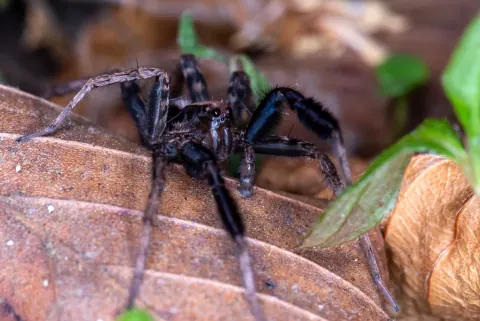
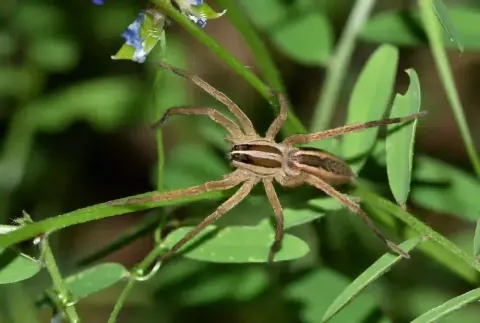
- Colour: most species are brown, grey or blackish, marked with a pale central band down the carapace and a pair of paler side bands, and with a lighter lance-shaped mark and faint chevrons on the abdomen. Males are frequently darker and more contrasty than females, with black-tipped or conspicuously pale pedipalps.
- Eyes: eight eyes in three rows — four small ones across the face, two large forward-facing eyes above them and two set wide on top of the head. The large pair carry a reflective tapetum, so the whole genus shows eyeshine in a torch beam. See our guide to spider eyes.
- Distinctive features: the legs are the giveaway. They are thin, long and armed with strong, obvious spines, quite unlike the thick, hairy legs of the big burrowing wolf spiders. Species-level identification almost always needs an adult and a microscope, because colour patterns overlap heavily.
Eggs and egg sac
The egg sac of this genus is unusually easy to recognise. It is lens-shaped rather than spherical, seamed around the rim, and often a distinct grey-green or bluish green when newly spun, fading to grey-brown as the eggs develop. The female fastens it to her spinnerets and tows it behind her while hunting. Incubation is not a mystery, as is sometimes claimed: depending on species and temperature the young normally hatch within about two to four weeks, faster in warm weather and slower in cool.
Spiderlings
The mother opens the sac when the young are ready and they climb onto the top of her abdomen, holding on to specialised hairs. They do not feed while riding, living on stored yolk, and after roughly a week they leave. Dispersal is often aerial: Pardosa spiderlings are well known for ballooning, climbing a grass stem, raising the abdomen and releasing silk until the drag carries them away. Most temperate species then mature within a single year.
Hunting instead of a web
No Pardosa builds a capture web. They are pursuit hunters that rely on vision and speed, and — unusually for wolf spiders — many are active in bright daylight, running and basking on open ground where their body temperature can rise. Silk is spun for draglines, for a shallow retreat under a stone and for the egg sac. Courtship happens in the open too: males wave and drum their pedipalps in front of a female in a display that is species-specific and can keep similar species apart.

Where thin-legged wolf spiders live
Pardosa is genuinely cosmopolitan. Species occur throughout Europe and Asia, across North and Central America, in Africa, South America, the Caribbean and parts of Oceania, with by far the greatest diversity in the northern hemisphere. The genus reaches further north than almost any other spider: Pardosa glacialis lives on Greenland and the Canadian high Arctic islands, and several species are among the commonest animals of the tundra. It is a familiar genus everywhere from Britain to Canada.
What unites the habitats is openness. Thin-legged wolf spiders prefer sunlit ground with low or patchy cover: gravel river shores and lake margins, salt marsh, grassland and meadows, heath and bog, alpine scree, arctic tundra, ploughed fields, lawns, garden paths and woodland clearings. Some are extreme specialists of stony shorelines, sphagnum bogs or high screes, while others are among the first colonisers of disturbed ground. See where spiders live.

Are thin-legged wolf spiders venomous?
Every Pardosa is venomous in the sense that it uses venom to subdue insects, and every Pardosa is harmless to people. The venom is tuned to small arthropods, the dose is minute, and there is no antivenom for any wolf spider because none has ever been required. No species in the genus is medically significant anywhere in its worldwide range.
Size alone settles most of the question. A 5 mm spider with correspondingly small fangs can rarely break human skin at all, and claims connecting wolf spider bites to spreading skin damage are misidentifications of other causes.
Can thin-legged wolf spiders bite?
In principle yes, in practice almost never. These spiders flee from anything as large as a human hand, and their speed makes escape a far better option than defence. The rare recorded bites involve a spider held between the fingers or trapped against skin.
Where a bite does happen the result is a brief sting, perhaps a pinprick mark and a little redness, gone within hours. Wash the spot with soap and water and apply a cold pack if it is uncomfortable; nothing else is needed. As with any small break in the skin, keep an eye out for signs of infection over the following days, and seek advice if you develop hives, swelling elsewhere on the body or difficulty breathing, which would point to an allergic reaction rather than the venom.
Scale matters: a thin-legged wolf spider is a few millimetres long with fine, spiny legs. If the spider you are looking at is thumb-sized, hairy and heavy-bodied, it is a different genus — most likely Hogna or another large lycosid — and still not dangerous, but the identification is worth getting right.

Ecological importance and behavior of Pardosa spiders
Few spiders matter more to agriculture. Pardosa species occur at very high densities in fields, grassland and paddy, and they eat a steady flow of aphids, springtails, flies, leafhoppers, small beetles, ants and other spiders. Pardosa pseudoannulata is one of the principal natural enemies of planthoppers in Asian rice, and Pardosa milvina is among the most intensively studied spiders in North American row-crop research. As a group they are a large, unpaid component of integrated pest management.
Natural predators: spider wasps and other hunting wasps, ground beetles, birds, lizards, frogs, shrews and larger wolf spiders all take them, and parasitoid wasps and flies attack both adults and egg sacs. Several studies have shown Pardosa shifting where and when it forages once the chemical traces of a larger wolf spider are present.
Prey-predator dynamics: small, abundant and quick to colonise disturbed ground, thin-legged wolf spiders sit in the middle of the food web rather than at the top, converting huge numbers of tiny insects into food for vertebrates.
Seasonal behavior: most temperate species are annual. Juveniles overwinter in litter or soil, mature in spring or early summer, and females carry egg sacs through the warm months, often producing more than one. In the Arctic the cycle stretches out and maturation may take two years or more, which is one reason northern Pardosa populations are used to track the effects of a warming climate.
Relationship with humans: entirely positive. They do not live in houses, they do not bite in any meaningful sense, and they are among the clearest examples of free pest control in a garden or field.

Species in the genus and similar spiders
| Spider | What sets it apart |
|---|---|
| Pardosa amentata | One of the commonest European species, found in gardens, damp meadows and waterside ground, and frequently photographed carrying its greenish egg sac. |
| Pardosa milvina | A small North American field species, abundant in crops and much used in research on how spiders respond to the scent of larger predators. |
| Pardosa pseudoannulata | The dominant wolf spider of Asian rice paddies and a key natural enemy of planthoppers and leafhoppers. |
| Pardosa glacialis and relatives | High Arctic species from Greenland and the Canadian islands, among the northernmost spiders known, with life cycles stretched over more than one season. |
| Arctosa | Another ground-living wolf spider genus, but stockier, with shorter and far less spiny legs, and many species burrow into sand or shingle. |
| Brush-legged wolf spiders (Schizocosa) | Similar size and litter habitat, but males carry conspicuous brushes of dark bristles on the front legs and court by drumming on leaves. |
| Beach wolf spiders | Coastal specialists of dunes and strandline, generally paler and sandier in colour and tied to a much narrower habitat. |
Quick facts
| Rank and authority | Genus Pardosa C. L. Koch, 1847; family Lycosidae. |
|---|---|
| Species | More than 500 described, the largest genus of wolf spiders. |
| Distribution | Worldwide — Europe, Asia, Africa, the Americas, the Caribbean and Oceania; richest in the northern hemisphere and reaching the high Arctic. |
| Habitat | Open sunlit ground: shorelines, grassland, bog, heath, scree, tundra, fields, lawns and paths. |
| Web type | None. Silk is used for draglines, shallow retreats, egg sacs and ballooning. |
| Diet | Aphids, springtails, flies, leafhoppers, small beetles, ants and other spiders. |
| Lifespan | About one to one and a half years in temperate regions; longer in the Arctic. |
| Predators | Hunting and parasitoid wasps, ground beetles, birds, lizards, frogs, shrews and larger wolf spiders. |
| IUCN status | Mostly not evaluated; a few narrow-range specialists are of concern. |

Did you know?
- The greenish tint of a fresh Pardosa egg sac is one of the quickest ways to recognise the genus in the field — no other common wolf spider group carries a lens-shaped sac of that colour.
- Many species are actively heliothermic: they bask to raise body temperature and can hunt at air temperatures that keep other spiders inactive, which is a large part of why the genus dominates cold climates.
- Arctic Pardosa populations have become model organisms for climate research, because their body size, brood size and timing all shift measurably as the season lengthens.
- A single hectare of grassland or arable field can hold tens of thousands of thin-legged wolf spiders.
In summary, Pardosa is the small, fast, sun-loving core of the wolf spider family: more than five hundred species, a lens-shaped green egg sac, spiny thin legs, and an ecological role out of all proportion to a body a few millimetres long.
Frequently asked questions about the thin-legged wolf
What is a thin-legged wolf spider?
It is any member of Pardosa, a genus of more than five hundred small wolf spiders in the family Lycosidae. They are ground hunters with long, slender, strongly spined legs that run down prey by sight and speed rather than trapping it, and they are among the most abundant spiders in open habitats worldwide.
How do you identify a Pardosa spider?
Look for a small brown or grey spider a few millimetres long, with long thin legs bearing obvious spines, a pale band down the middle of the carapace and eight eyes in three rows. A female towing a lens-shaped, often greenish egg sac behind her is close to conclusive for the genus.
How many species of Pardosa are there?
More than five hundred are currently described, and the total moves as taxonomists revise the group. That makes Pardosa the largest genus in the wolf spider family and one of the biggest in the entire order of spiders. Most species can only be separated by examining adult genitalia.
Are Pardosa spiders venomous to humans?
They carry venom for subduing insects but pose no danger to people. There is no antivenom for any wolf spider because none has ever been needed. Most species are so small that their fangs struggle to break human skin, and a bite that does land causes nothing more than a momentary sting.
Do thin-legged wolf spiders build webs?
No. They spin no capture web and catch everything by pursuit, relying on good vision and rapid running over open ground. Silk goes into the dragline they trail behind them, a shallow retreat under a stone, the egg sac, and the threads young spiders use to balloon away on the wind.
What do Pardosa spiders eat?
Small, abundant arthropods: aphids, springtails, flies, leafhoppers, small beetles, ants and other spiders. Because the genus occurs at very high densities in grassland and cropland, this diet makes it one of the more important natural controls on insect numbers in farmed and disturbed habitats.
Why is the Pardosa egg sac green?
Freshly spun sacs in this genus are often grey-green or bluish green and fade towards grey-brown as the eggs develop. The colour comes from the silk itself and the shape is distinctive too: flattened and lens-like with a seam around the rim, rather than spherical as in many other wolf spiders.
How long do Pardosa eggs take to hatch?
Usually about two to four weeks, depending on the species and on temperature, with warm weather shortening the period considerably. The female carries the sac attached to her spinnerets throughout and often positions herself in sunshine, which raises the temperature of the developing brood.
Where are thin-legged wolf spiders found?
Almost everywhere. The genus occurs across Europe, Asia, Africa, the Americas, the Caribbean and parts of Oceania, and is most diverse in the northern hemisphere, reaching Greenland and the Canadian high Arctic. They live on open sunlit ground: shorelines, grassland, bog, scree, tundra, fields, lawns and paths.
Are Pardosa spiders active during the day?
Many are, which sets them apart from most wolf spiders. Several species bask to raise their body temperature and hunt in bright sunshine, so they are the small brown spiders that scatter ahead of your feet on a path in summer. Others remain mainly nocturnal, especially in hot climates.
References
- World Spider Catalog (2026). Pardosa C. L. Koch, 1847. Natural History Museum Bern. wsc.nmbe.ch/genus-detail/2021/taxon
- Nyffeler, M. & Birkhofer, K. (2017). An estimated 400–800 million tons of prey are annually killed by the global spider community. The Science of Nature 104: 30. doi.org/10.1007/s00114-017-1440-1