
Spiders in Sydney
Sydney's sandstone gullies, damp gardens and brick suburbs give spiders shelter right up against the back door. Only two of the eight species profiled here are medically significant — the Sydney funnel-web and the redback — while the huntsman on the wall and the lacy web in the window frame belong to species that have never seriously hurt anyone.

On this page
- What spiders live in Sydney?
- Which Sydney spiders are actually dangerous?
- Where you meet them around Sydney
- Spider season in Sydney
- Commonly confused: funnel-webs, trapdoors and myths
- Common Spiders in Sydney
- Biggest Spider in Sydney
- Most Dangerous Spiders in Sydney
- Most Venomous Spiders in Sydney
- Less Venomous Spiders in Sydney
- Living with Sydney's spiders
- Frequently asked questions
What spiders live in Sydney?
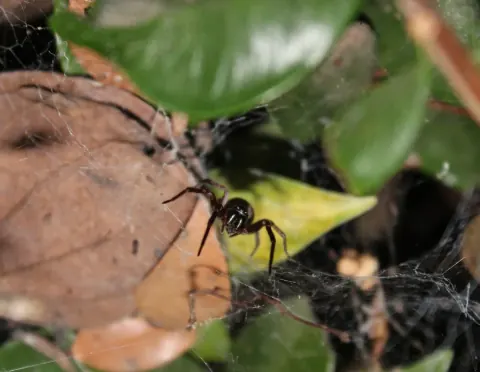
Sydney is built across sandstone ridges, moist shale gullies and a ring of bushland reserves, and that patchwork is why a city of five million shares its gardens with a rich spider fauna. The species profiled here fall into a few groups: cobweb spiders (Theridiidae), Australian funnel-webs (Atracidae), fast-running huntsman spiders, garden orb-weavers, white-tailed spiders (Lamponidae) and the two grey-brown Desidae house spiders that build the lacy webs on window frames.
One claim repeated about this city needs correcting straight away: its dangerous spiders do not live in the outback. There is no outback within hundreds of kilometres of the harbour. The Sydney funnel-web is a suburban animal, most abundant in the moist, shaded soils of the northern suburbs, the Hornsby plateau and the bushland fringe from the Hawkesbury towards the Illawarra. The redback is even more domestic: it thrives on the dry, sheltered surfaces people create, such as sheds, letterboxes, garden furniture and the rims of pot plants.
Which Sydney spiders are actually dangerous?
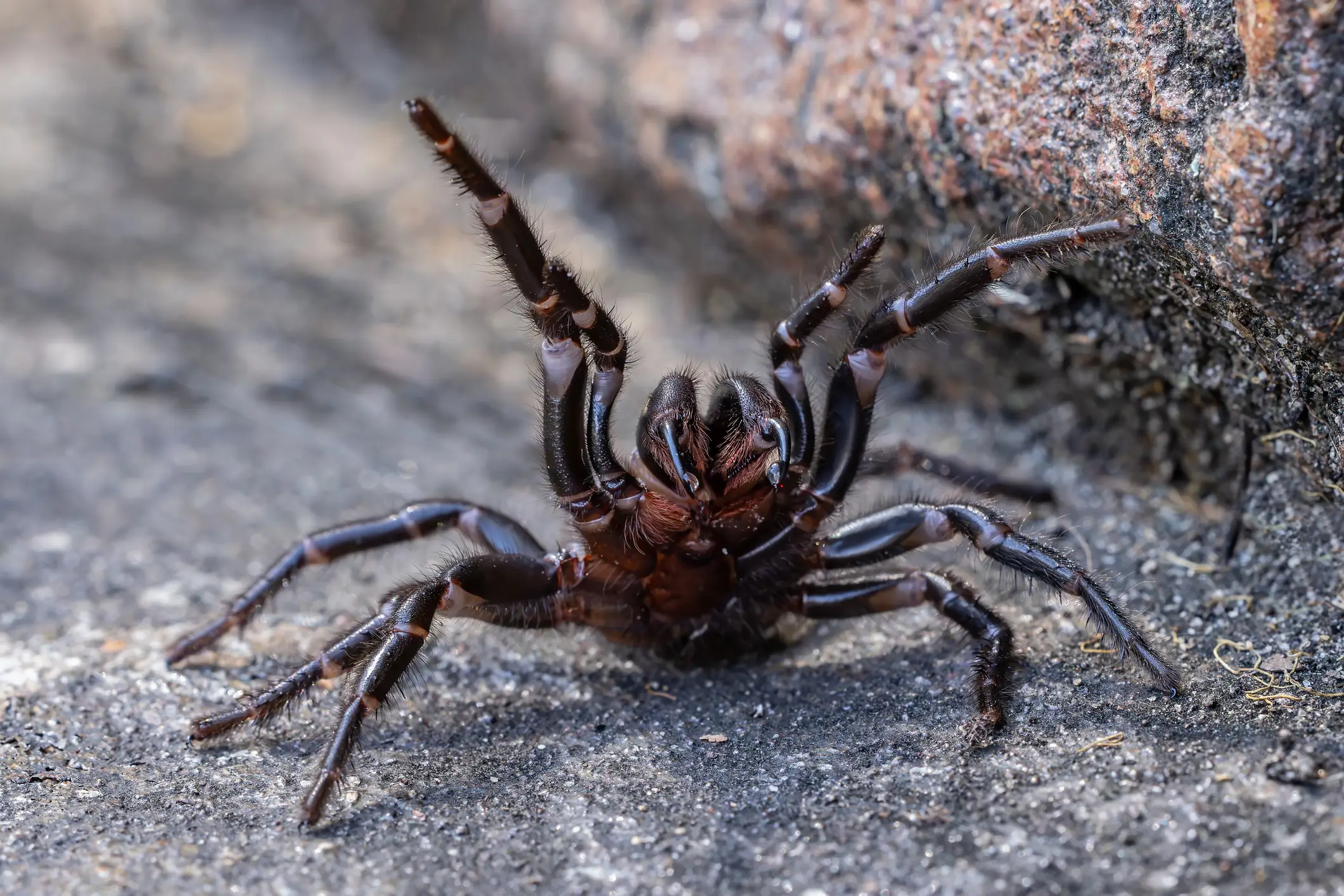
Two species carry venom of real medical importance. The Sydney funnel-web is a glossy black mygalomorph with a shiny, almost hairless carapace and large downward-striking fangs. Males are the risk: they leave their burrows on warm, humid nights to find females and end up in garages, shoes and swimming pools. Thirteen deaths were recorded before funnel-web antivenom arrived in 1981, and none since.

The redback is Australia's widow spider. A mature female has a pea-shaped, glossy black body about a centimetre long with a red or orange stripe along the top of the abdomen and a narrow hourglass beneath — the upper stripe, not the hourglass, is the mark most people actually see. Her bite produces latrodectism: pain that builds over hours, local sweating and nausea. It is rarely life-threatening, and no confirmed Australian death has occurred since antivenom arrived in 1956.
The eastern mouse spider (Missulena bradleyi, family Actinopodidae) is often lumped in with the funnel-webs. Funnel-web antivenom works against it, but serious envenomation is rare and most bites cause little more than local pain. Compare it with the other mouse spiders before assuming the worst.
Everything else on this page is painful at most. A bite from the black house spider can hurt sharply and cause local swelling and nausea, but it does not destroy tissue, and the belief that the white-tailed spider causes flesh-eating ulcers has been tested and rejected: a clinical study of 130 verified white-tail bites found no case of necrosis.
Bitten by a big black spider? For a suspected funnel-web or mouse spider, apply a pressure-immobilisation bandage firmly over the bite and along the whole limb, splint it, keep the person still and call 000. Do not use a pressure bandage for a redback — the venom moves slowly and compression makes the pain worse. Use a cold pack, keep still and go to an emergency department if pain escalates. If the spider can be photographed or trapped safely, bring it.
Where you meet them around Sydney
Inside the house
The spider on the bedroom wall at midnight is almost always a huntsman. Sydney's largest, Holconia immanis, spans roughly fifteen centimetres across the legs, holds them crab-like to the sides and bolts sideways when startled. It hunts cockroaches. In cupboards, subfloors and garages you will find the long-bodied cellar spider hanging in a loose tangle, and on outside walls and fences the grey house spider, a paler relative of the black house spider.

Gardens and verandas
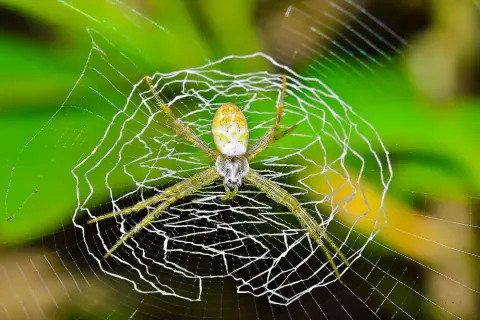
Garden orb weavers string a fresh wheel across paths each evening and take it down before dawn, which is why you walk face-first into silk that was not there yesterday. The St Andrew's cross spider is the daytime one, sitting head-down in an X of four zigzag silk bands. Redbacks hide in dry crevices nearby: under the barbecue lid, inside a rolled hose, beneath a chair nobody uses.
Bushland and sandstone
Funnel-webs dig silk-lined burrows under logs, rocks and moist leaf litter on shaded slopes, usually marked by irregular trip-lines rather than a neat trapdoor. Brown trapdoor spiders (Misgolas) share the same ground and are mistaken for them constantly; for the wider group see Australian funnel-web spiders.
Spider season in Sydney
The spider calendar here follows humidity more than temperature. Male funnel-webs wander mainly between November and March, and a warm night after summer rain produces the clusters of sightings that reach the news. Orb-weavers peak later: their webs go unnoticed in spring, and by late summer and autumn the females are heavy-bodied and the webs span whole doorways. Redbacks breed through the warm months but shelter in the same dry spots all year, so they are the one dangerous species you can meet in July.
Winter relocates spiders rather than removing them. Huntsmen move under bark and behind weatherboards, house spiders sit deeper in their funnels, and activity resumes with the first mild, damp week of spring — habits covered in our guide to where spiders live.
Commonly confused: funnel-webs, trapdoors and myths
Most reports of a funnel-web in the kitchen turn out to be something else. A funnel-web is glossy and almost hairless over the carapace, rears up with its front legs raised, and its fangs point straight down. A brown trapdoor spider is dull brown, hairier and bulkier, and does not rear the same way. A mouse spider has an oversized, shining head region and widely separated, bulging jaw bases. If you cannot tell, treat it as a funnel-web and keep your distance.
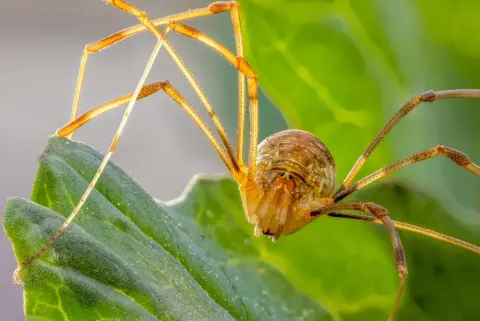
The other persistent confusion is medical. The white-tail ulcer story, the habit of calling every Australian spider the deadliest in the world, and the claim that the harmless cellar spider has the strongest venom of all are folklore; for the assessed ranking see the most venomous spiders. Harvestmen, with one fused body section and no silk, are not spiders at all, yet are reported as daddy long-legs every summer.
Common Spiders in Sydney
- Black House Spider
- Black House Spider
- Brown House Spider
Biggest Spider in Sydney
- Sydney Huntsman Spider
Most Dangerous Spiders in Sydney
- Sydney Funnel-web Spider
- Redback Spider
- Whitetailed Spider
- Eastern Mouse Spider
Most Venomous Spiders in Sydney
Comb-Footed Spiders
Australian Funnel-web Spiders
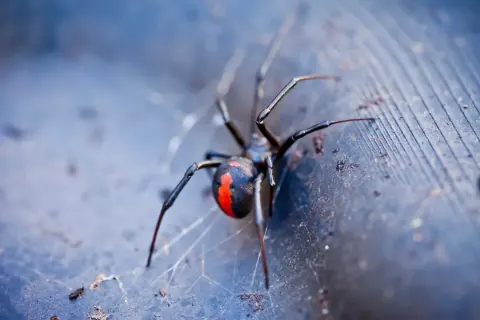 Cobweb SpidersRedback Spider (Latrodectus hasseltii)Identify the redback spider (Latrodectus hasseltii): the female's red stripe, the gum-footed web, where it lives, and how dangerous its bite
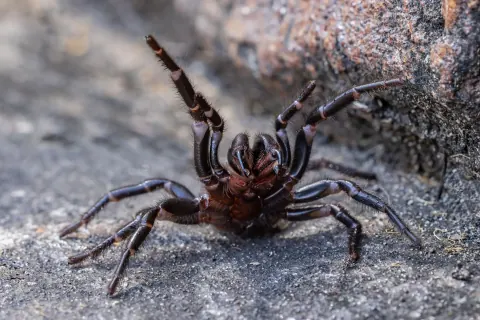 Australian Funnel-Web SpidersSydney Funnel-Web (Atrax robustus)Identify the Sydney funnel-web spider (Atrax robustus): size, colour, burrow, how dangerous the bite is, first aid and antivenom facts.
White‐Tailed Spiders
Orb-Weavers
 Lamponidae SpidersWhite-tailed (Lampona cylindrata & Lampona murina)Identify the white-tailed spider (Lampona cylindrata and L. murina), see where it lives, what it hunts, and why the flesh-eating bite claim
 Orb WeaversGarden Orb Weaver Spider (Eriophora pustulosa)Identify the garden or knobbled orb weaver (Eriophora pustulosa) of Australia and New Zealand: size, shoulder knobs, nightly web, bite and h
House Spiders
Less Venomous Spiders in Sydney
Cellar Spiders
House Spiders
Orb-Weaver Spiders
Living with Sydney's spiders
Nothing here calls for chemical warfare. A few habits remove almost all of the risk:
- Shake out shoes, gloves and washing left outside, especially in summer.
- Wear gloves when moving rocks, pots, timber or mulch, and never reach blindly into a cavity.
- Skim the pool before swimming: funnel-webs trap air among their body hairs and survive submerged for many hours, so a spider on the bottom may still be alive.
- Seal gaps under doors and fit flyscreens, because wandering males come in at ground level.
- Leave huntsmen and orb-weavers alone; knocking down a web only means it is rebuilt somewhere less convenient.
Nearby regions make useful comparisons: the fauna turns subtropical in Brisbane and cooler in Melbourne, while the indoor species are those covered in our guide to house spiders.
Frequently asked questions
What is the most dangerous spider in Sydney?
The Sydney funnel-web spider is the most dangerous. Its venom contains a toxin that disrupts the human nervous system, and untreated bites from males caused deaths in the past. Antivenom has been available since 1981 and no death has been recorded since. Any suspected bite is a medical emergency needing a pressure bandage and an ambulance.
Are huntsman spiders in Sydney dangerous?
No. Huntsman spiders are venomous in the sense that nearly all spiders are, but their venom has no serious effect on people. Bites are uncommon and usually happen when a spider is pressed against skin, causing brief local pain and swelling. The Sydney huntsman is a valuable predator of cockroaches and is best escorted outside rather than killed.
How do I identify a redback spider?
Look for a glossy black, pea-shaped female about one centimetre long with a red or orange stripe running along the top of the abdomen and a smaller hourglass mark underneath. She hangs upside down in a messy tangled web with sticky lines anchored to the ground, usually in a dry sheltered spot. Males are tiny, brownish and rarely noticed.
Where are Sydney funnel-web spiders usually found?
They favour cool, moist, shaded soil: under logs and rocks, in leaf litter, in rockeries and beneath houses, especially on the sandstone country of the northern suburbs and the bushland fringe. Females stay in silk-lined burrows their whole lives. Males wander on humid summer nights and are the ones found in garages, shoes and swimming pools.
What is the biggest spider in Sydney?
By leg span it is the Sydney huntsman, Holconia immanis, which reaches roughly fifteen centimetres across the legs. Female garden orb weavers are heavier in the body but much smaller overall. Despite its size and speed the huntsman is harmless to humans and hunts insects on walls, tree trunks and fences at night.
Do white-tailed spider bites cause flesh-eating ulcers?
No. A clinical study that followed 130 verified white-tailed spider bites found no case of ulceration or tissue death. Bites cause burning pain, redness and itching that settle within days. Ulcers blamed on white-tails usually turn out to be bacterial infections or other skin conditions, which is why an unexplained wound should be examined by a doctor.
What should I do if I find a mouse spider in my garden?
Do not handle it. The eastern mouse spider has potent venom and funnel-web antivenom is used for severe cases, although serious envenomation is rare. Males wander by day and may rear up defensively. Keep children and pets away, cover it with a container if it must be moved, and treat any bite the way you would treat a funnel-web bite.
What is the most common spider in Sydney houses?
Black and grey house spiders are the most abundant around buildings, weaving messy lacy webs with a funnel retreat in window frames, brickwork and fence corners. Indoors, long-bodied cellar spiders occupy ceilings and subfloors. Neither is dangerous, and both feed on the insects that would otherwise be sharing your kitchen.
Should I kill funnel-web spiders I find at home?
Killing one achieves little, since surrounding bushland holds many more. Keep people and pets away, and if it is safely reachable use a long spoon and a wide jar with a secure lid. Live male funnel-webs are also accepted by the venom-milking program run through the Australian Reptile Park, which supplies the venom used to make antivenom.
Published April 26, 2022 · Last updated September 14, 2026