
Spiders in New Brunswick
New Brunswick is one of the easiest provinces in Canada for anyone nervous about spiders: no widow, no recluse, nothing here whose venom is medically significant. What the province does have is a cool, damp, heavily forested landscape full of web builders, and one genuinely large hunter, the dark fishing spider, that regularly startles people at cottages and camps.

On this page
What spiders live in New Brunswick?
Older versions of this page explained New Brunswick's short spider list by claiming the province has a harsher climate than the rest of Canada. That is the wrong way round. New Brunswick's maritime climate is markedly milder than the Prairie winters of Manitoba or Saskatchewan, and its mix of Acadian forest, bog, salt marsh, river valley and farmland supports a spider fauna that runs to several hundred species. The short list below reflects which spiders get photographed and reported, not how many actually live here.
Most of that hidden diversity is made up of tiny sheet-web weavers in the leaf litter, money spiders drifting in on air currents, and small Pardosa wolf spiders that hunt on open ground without a web. The spiders people actually ask about are the large autumn web builders on the porch and the heavy-bodied fishing spider on the woodshed wall.
Are any New Brunswick spiders dangerous?
No. The province has no resident spider whose venom is medically significant to people. There is no established population of widow spiders in New Brunswick — the nearest, the northern black widow, is confined to a few warm, sandy pockets of southern Ontario and is not part of the Maritime fauna. There are no recluse spiders either; Loxosceles is not established anywhere in Canada, so a brown recluse bite diagnosed in Fredericton or Saint John is almost always a bacterial skin infection or another condition entirely.

Every spider on this page can technically bite, and a large dark fishing spider has fangs long enough to break skin if it is squeezed against you. What follows is a brief sharp pain, a red mark and perhaps some swelling for a day — the source page's comparison with a bee sting is a fair one. The venom itself does nothing of consequence to human tissue. The real medical risk is the ordinary one: any break in the skin can become infected, so wash a bite and watch it.
When to see a doctor: if the area becomes hot, spreading and increasingly painful over a day or two, if pus develops, or if you feel unwell. That pattern points to a skin infection needing antibiotics, not to venom. Sudden breathing difficulty or widespread hives after any bite or sting is an allergic emergency — call 911.
Where you meet them
Around the house and cottage
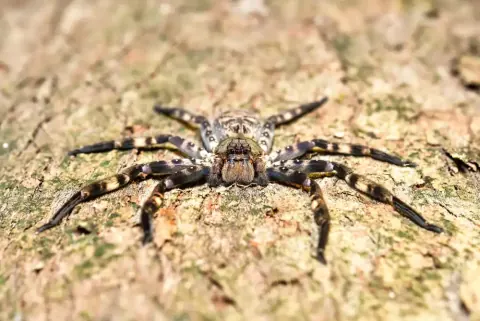
The dark fishing spider is the spider New Brunswickers report most often, and it is the reason for most of the panicked cottage phone calls. Despite the name it is frequently found well away from water, climbing tree trunks, woodpiles, shed walls and the outside of camp buildings, and it sometimes comes indoors. A large female can span a saucer. She is a nursery web spider: she carries her egg sac in her jaws and then builds a silk tent for the spiderlings, guarding it until they disperse, which is covered in our guide to nursery web spiders.

Gardens, fences and hedgerows
The cross orb weaver is the province's signature autumn spider — a stout, rust-to-cream European species, now thoroughly naturalised, with a cross of white dashes on the abdomen, hanging head-down in a wheel web across a doorway or gate. Native relatives such as the marbled orb weaver, whose orange-and-cream abdomen looks almost artificial, take over damp woodland edges and stream banks.
Open fields and coastal grassland
The banded garden spider works sunny, weedy fields, slinging a large orb low among goldenrod and grasses and adding a zigzag band of dense silk, the stabilimentum, down the middle. It is near the northern edge of its range in the Maritimes, so it is local rather than everywhere, and it is entirely harmless. Its showier southern cousin, the yellow garden spider, is scarce this far north.
Spider season in New Brunswick
Spring and early summer are quiet: most of the spiders that will impress you in September are a few millimetres long in June. They grow through the warm months on a diet of flies, mosquitoes and moths, and reach full size in August, so the annual "sudden invasion" of webs is really just the same animals becoming visible. Mature males then abandon their webs to wander, which is when they appear on porch ceilings, in garages and occasionally in the bath.
The province's first hard frosts end the adult season, usually in October. Orb weavers die after laying an overwintering egg sac; other species pass the winter as part-grown juveniles under bark, moss and leaf litter, insulated by snow and protected by natural antifreeze compounds. Our guide to where spiders go in the winter explains the different tactics, and how spider webs work covers why those big orbs are rebuilt so often.
Mistaken identities
The commonest error in the Maritimes is calling a dark fishing spider a wolf spider, or a tarantula. Fishing spiders have a flatter, longer body with chevron markings and banded legs, and they hold still; wolf spiders are stockier, have a distinctive large pair of forward eyes, and bolt when disturbed. Neither is dangerous.
Two non-spiders round out the mailbag. Harvestmen, or daddy longlegs, have one fused body section, no silk and no venom glands at all, and cannot bite people. Crane flies, the giant mosquito-like insects that drift indoors in autumn, have six legs and wings — count them before panicking.
Common Spider in New Brunswick
- Cross Orb-weaver Spider
Big Spider in New Brunswick
- Dark Fishing Spider
Less Venomous Spiders in New Brunswick
Orb-weaver Spiders
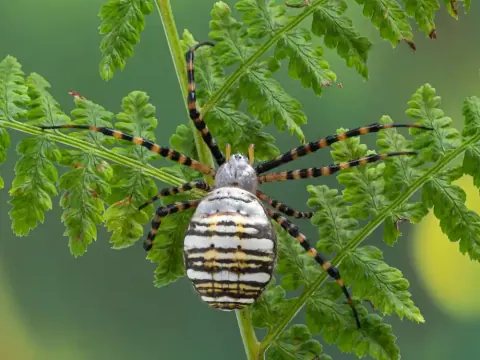 Orb WeaversBanded Garden (Argiope trifasciata)Identify the banded garden spider (Argiope trifasciata): silver banding, size, the zigzag in its web, egg sac, range, and whether its bite i
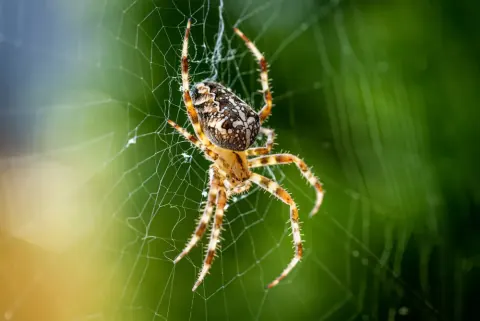 Orb WeaversCross Orb Weaver (Araneus diadematus)Identify the cross orb weaver (Araneus diadematus) by the white cross on its abdomen: size, colour, web, egg sac, range and whether the bite
Nursery Web Spiders
Living with New Brunswick's spiders
With nothing venomous to guard against, spider management here is purely about comfort:
- Fit door sweeps and screen repairs in late summer, when adult males wander.
- Vacuum webs and egg sacs rather than spraying; insecticide does little against spiders and less against the insects that attract them.
- Switch porch lights to warm or amber bulbs, which draw fewer moths and so fewer orb weavers.
- Move a fishing spider outdoors with a jar and a sheet of card instead of a shoe.
- Leave the webs on the garden side of the house — each one removes hundreds of blackflies and mosquitoes over a season.
Neighbouring lists are very similar: see Nova Scotia and Quebec, or the wider provincial overview in spiders in Canada.
Frequently asked questions
What are the most common spiders in New Brunswick?
By numbers, tiny sheet-web weavers in leaf litter and small wolf spiders on open ground. By sightings, the cross orb weaver on porches and fences in late summer, the dark fishing spider on sheds and tree trunks, and banded garden spiders in weedy fields. All of them are harmless to people and pets.
Are there dangerous or venomous spiders in New Brunswick?
No species in New Brunswick has venom of medical importance. Widow spiders are not established in the province and recluse spiders occur nowhere in Canada. Bites from local species cause brief pain, redness and mild swelling at most, roughly comparable to a bee sting, and serious reactions are essentially limited to rare allergies.
What is the largest spider in New Brunswick?
The dark fishing spider, with a leg span reaching about seven centimetres. It hunts insects at night, often far from water, on tree trunks, woodpiles and camp walls, and can run across the water surface or dive when alarmed. Its size is startling but its venom has no significant effect on humans.
Does the province really have fewer spiders than the rest of Canada?
No. That claim, repeated on older versions of this page, confuses a short photo list with real diversity. New Brunswick's maritime climate is milder than the Prairies, and its forests, bogs and marshes support several hundred spider species. Only a handful are big or conspicuous enough for people to report.
How painful is an orb weaver bite?
Comparable to a bee or wasp sting, and usually less. Orb weavers are reluctant to bite and normally drop from the web or play dead instead. If one does bite, expect a sharp pinch, a small red mark and mild swelling that fades within a day. Wash it and keep the area clean.
Are fishing spiders found in New Brunswick?
Yes. The dark fishing spider is widespread in the province and is its largest spider. It is frequently seen away from water, on buildings, woodpiles and trees, especially around camps and cottages. It hunts by ambush rather than with a web and retreats rather than confronting anyone who disturbs it.
Are nursery web spiders common here?
Yes. Nursery web spiders, the family that includes the dark fishing spider, are among the province's most conspicuous hunters. The female carries her egg sac in her jaws, then spins a silken tent among vegetation for the hatchlings and stands guard over it for several days until the spiderlings disperse.
When are spiders most noticeable in New Brunswick?
From August into early October. The spiders that hatched in spring only reach full size in late summer, so their webs suddenly become obvious, and adult males leave cover to search for mates, which is when they turn up indoors. The first hard frosts bring the adult season to an end.
Could a black widow turn up in New Brunswick?
There is no established widow population in the province. The northern black widow occurs in scattered warm, sandy sites in southern Ontario and does not extend to the Maritimes. Isolated individuals occasionally arrive in produce shipments anywhere in Canada, but they do not survive to form populations in this climate.
What is the zigzag band in some garden spider webs?
It is called a stabilimentum, a thick ribbon of silk that a banded garden spider adds down the centre of its orb. Its purpose is debated: it may make the web visible to birds so they do not fly through it, attract insects that respond to ultraviolet, or camouflage the spider sitting at the hub.
Published April 26, 2022 · Last updated September 14, 2026