
Spiders in Newfoundland
Newfoundland is about as safe as spider country gets. There are no widows, no recluses and no species on the island whose venom matters medically. What the island does have is a small, hardy fauna shaped by the sea: orb weavers on fences and fish stages, jumping spiders on sunlit rock, and wolf spiders running on barrens and dune sand.

On this page
What spiders live in Newfoundland?
Newfoundland's spider list really is short, but not for the reason usually given. The island is not too cold for spiders — they live well north of here, on the Labrador coast and into the Arctic. The limiting factor is that this is an island. Everything now living on it either survived the last glaciation at the margins, walked or ballooned across after the ice retreated fewer than twelve thousand years ago, or arrived by ship. That filter, plus cool summers, thin acid soils and vast areas of bog and barren, produces a fauna with fewer species than the mainland Maritimes, though it still runs well into the hundreds.
Most of those are small and easy to miss: sheet-web weavers and money spiders in the moss and low shrubs, and ground-hunting wolf spiders on dune sand and gravel. The spiders islanders actually notice are the big autumn orb webs and the jumpers that appear on sunny walls. A great many of them got here on their own thread — the ballooning behaviour described in our guide to spider ballooning is exactly how a spiderless island acquires spiders.
Are any Newfoundland spiders dangerous?
None of them. No spider on the island has venom of medical importance to people. The western black widow and its eastern relatives do not occur here, and Loxosceles recluses are not established anywhere in Canada, so a brown recluse bite diagnosed in St. John's or Corner Brook is almost certainly a bacterial skin infection or another condition.
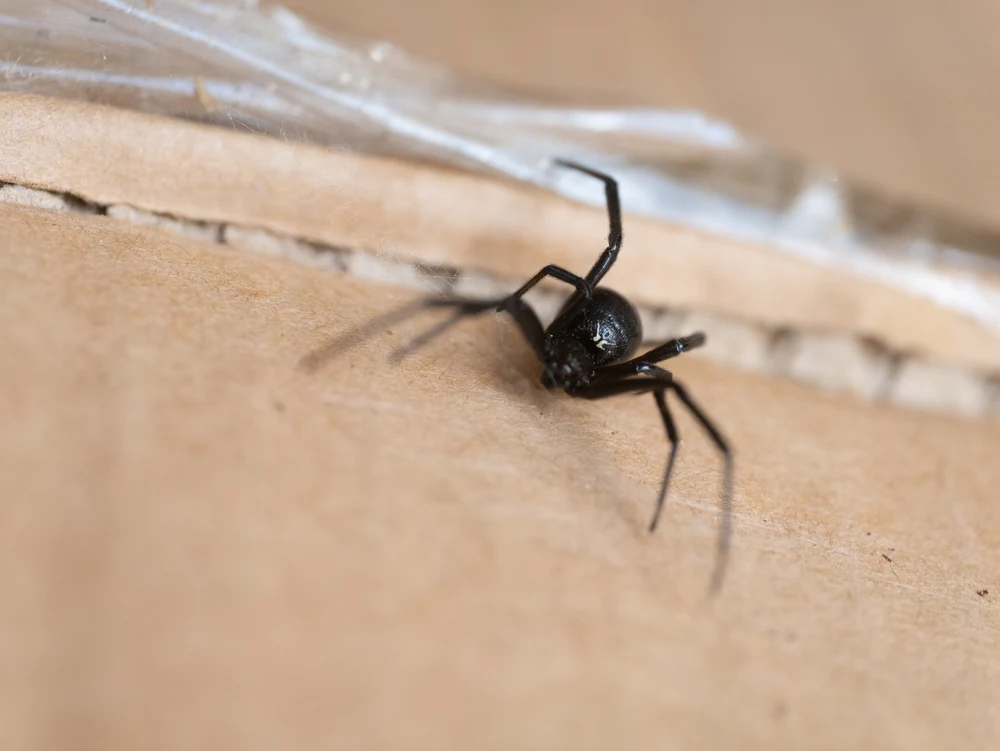
Older versions of this page named a "sand bear wolf spider" as the island's most venomous species. That needs two corrections. First, wolf spider venom is not notably potent; a bite from a large one feels like a pinprick with some local redness, and nothing more. Second, Arctosa perita is a European dune specialist with only scattered, localised records in North America, so the wolf spiders you meet on a Newfoundland beach or barren are far more likely to be native Pardosa and related genera. Either way, the medical answer is the same: not dangerous.
Bitten by something? Wash the area with soap and water, apply a cold pack and watch it. See a doctor if it becomes hot, spreading and more painful after a day or two, or if pus appears — that is infection, not venom. Sudden breathing trouble or widespread hives after any bite is an allergic emergency; call 911.
Where you meet them
Fences, sheds and porch lights
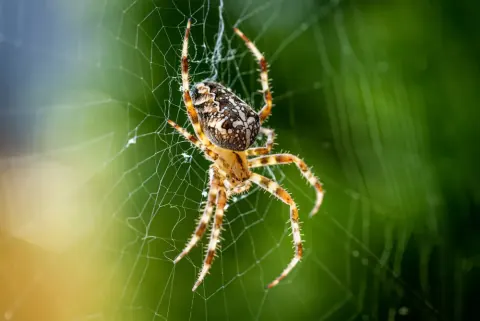
The cross orb weaver is the island's most-photographed spider and a European introduction that has taken to Newfoundland thoroughly. Stout, rust to cream, with a cross of white dashes on the abdomen, she hangs head-down at the hub of a wheel web strung between a fence rail and a shrub, across a doorway, or beside a porch light where moths gather. She rebuilds much of that web daily, eating the old silk, which is one of the more remarkable economies described in our guide to spider webs.

Sunny walls, rock and woodpiles
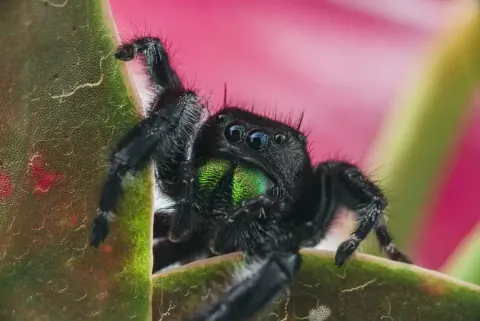
Jumping spiders hunt by daylight and eyesight rather than by web, stalking prey and pouncing with a silk safety line trailing behind. The bold jumping spider, black with a pale triangle on the abdomen and iridescent green jaws, is the best-known North American member of the family and reaches its north-eastern limit in Atlantic Canada, so island records are scarce; most of the salticids you see on a sunlit clapboard wall are smaller species. Their forward-facing principal eyes give them the sharpest vision of any spider, a subject covered in our guide to spider eyes, and more of the family is profiled under jumping spiders.
Damp woods, caves and stream banks
Cool, shaded and humid places belong to the long-jawed orb weavers, slender spiders that stretch their front legs along a grass stem or a root and become almost invisible. Their relatives hang loose, horizontal orbs in cave mouths, root cellars and under bridges — places that stay damp and dark all summer.
Spider season in Newfoundland
The island's cool, foggy summers make for a late, compressed season. Spiderlings emerge in spring at a millimetre or two and grow slowly, so nothing looks impressive until August. September and early October are peak: orb webs appear across every gateway, adult males abandon their retreats to search for females and wander indoors, and the mature females fatten before laying. The cycle ends with the first hard frosts, later on the Avalon than in the interior.
Winter is passed in place. Orb weavers leave an overwintering egg sac hidden under bark or siding and die; many other species spend the cold months as part-grown juveniles in moss, leaf litter and grass tussocks, protected by snow cover and by natural antifreeze compounds in their tissues. Our guide to where spiders go in the winter sets out how each strategy works, and why a mild, snowless winter can be harder on spiders than a cold one.
Mistaken identities
Most "strange spider" reports on the island turn out to be one of three things. Harvestmen, the long-legged daddy longlegs of woodpiles and outbuildings, are arachnids but not spiders: one fused body section, no silk, no venom glands, and no ability to bite a person. Crane flies, the giant mosquito-like insects of late summer, have six legs and a pair of wings. And ticks, which have become a genuine concern in Atlantic Canada, are flat, slow and eight-legged — worth learning to recognise, because unlike the island's spiders they do carry disease risk.
Among real spiders, the commonest confusion is between a plump autumn orb weaver and something exotic. Newfoundland's orb weavers vary enormously in colour, from cream through orange to dark brown, and a pale one is routinely reported as a species that does not occur in Canada at all.
Less Venomous Spiders in Newfoundland
Orb-weaver Spiders
Jumping Spider
Living with Newfoundland's spiders
With nothing venomous on the island, this is about comfort rather than safety:
- Fit door sweeps and repair screens in August, before wandering males start coming inside.
- Vacuum webs and egg sacs instead of spraying; insecticides do little to spiders and nothing about the insects that attract them.
- Use warm or amber outdoor bulbs, which attract fewer moths and therefore fewer orb weavers.
- Move a spider out with a jar and a piece of card rather than killing it.
- Leave the garden webs be — each orb weaver takes hundreds of flies, mosquitoes and moths over a season.
For comparison with the nearest mainland fauna, see Nova Scotia and New Brunswick, both of which share most of the island's species and add a number of larger ones, or the national overview in spiders in Canada. Common indoor species across the region are covered in our guide to house spiders.
Frequently asked questions
What are the most common spiders in Newfoundland?
Small sheet-web weavers and money spiders are the most numerous, though they are easy to overlook. The spiders people notice are cross orb weavers on fences, sheds and porch lights in late summer, wolf spiders running on barrens and beaches, and small jumping spiders hunting on sunlit walls. None of them is harmful.
Are there any dangerous venomous spiders in Newfoundland?
No. No spider on the island has venom of medical significance to humans. Widow spiders do not occur here and recluse spiders are not established anywhere in Canada. A bite from a local species produces at most brief pain, a red mark and mild swelling that clears within a day or two.
Is a sand bear wolf spider bite harmful?
No. Wolf spider venom is not potent to people, and a bite feels like a pinprick with local redness. It is also worth noting that Arctosa perita, the European dune species listed on older pages, has only scattered North American records; most Newfoundland wolf spiders are native Pardosa and related genera.
Why does Newfoundland have so few spider species?
Because it is an island. Its whole fauna had to recolonise after the last glaciation, by ballooning on silk, drifting on debris or arriving on ships, and that filter leaves fewer species than the neighbouring mainland. Cool summers, thin acidic soils and extensive bog and barren further limit which species can establish.
What kind of jumping spiders live in Newfoundland?
Mostly small species that hunt on sunlit walls, rocks and woodpiles, stalking prey and pouncing with a silk dragline trailing behind them. The large bold jumping spider is at its north-eastern limit in Atlantic Canada, so island records are few. All jumping spiders here are harmless and have exceptional eyesight for their size.
Are there orb weaver spiders in Newfoundland?
Yes, and they are the island's most conspicuous spiders. The introduced cross orb weaver is everywhere around buildings and gardens by late summer, and long-jawed orb weavers stretch out along grass stems near streams and in damp, shaded ground. Their wheel-shaped webs are rebuilt frequently, usually at dawn or dusk.
Are wolf spiders common on the island?
Yes. They are among Newfoundland's most abundant hunters, running on dune sand, gravel, barrens and lawns rather than building webs. The female carries her egg sac attached to her spinnerets, then carries the newly hatched spiderlings on her back for days. Their bite is medically trivial and they flee from people.
When are spiders most active in Newfoundland?
August into October, later on the Avalon Peninsula. The island's cool summers mean spiders grow slowly and only reach adult size late, so webs seem to appear all at once in September, and mature males wander in search of mates, which is when they come indoors. Hard frost ends the adult season.
Do any Newfoundland spiders come indoors in winter?
A few live indoors year-round, notably cobweb spiders in ceiling corners and cellar spiders in basements, which stay slowly active in heated buildings. Outdoor species do not move inside to escape the cold; they overwinter as eggs or juveniles in litter and under bark, insulated by snow and protected by antifreeze compounds.
Should I worry about ticks instead of spiders here?
Ticks deserve more attention than spiders in Atlantic Canada. They are flat, slow-moving eight-legged arachnids that attach to skin and can transmit disease, unlike the island's spiders. Check yourself and pets after walking in long grass and brush, and remove any attached tick promptly with fine-tipped tweezers, pulling straight out.
Published April 26, 2022 · Last updated September 14, 2026