
Spiders in Idaho
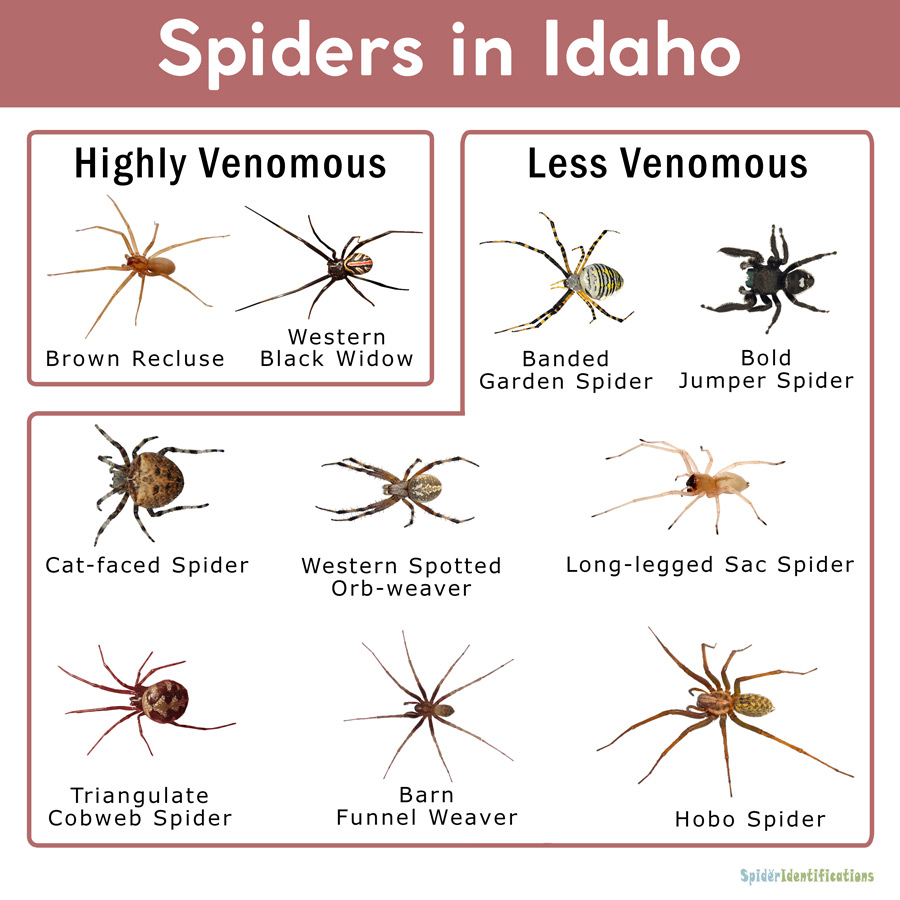
Idaho has hundreds of spider species and exactly one that matters medically: the western black widow. The nine species profiled below cover almost every encounter in the state, from the cat-faced spider on a porch light to the hobo spider that the CDC dropped from its venomous list in 2017. The brown recluse, despite its place on the original chart, is not established here.
On this page
- What spiders live in Idaho?
- Which Idaho spiders are actually dangerous?
- Where you meet them
- Spider season in Idaho
- Commonly misidentified in Idaho
- Common Spiders in Idaho
- Largest Spider in Idaho
- Highly Venomous Spiders in Idaho
- Less Venomous Spiders in Idaho
- Living with Idaho's spiders
- Frequently asked questions
What spiders live in Idaho?
Idaho is two states as far as spiders are concerned. The south is sagebrush steppe and lava desert along the Snake River Plain, hot and dry in summer and hard-frozen in winter, broken up by irrigated farmland and its shelterbelts and outbuildings. The Panhandle is the opposite: cedar and hemlock forest with enough rainfall to count as inland temperate rainforest. Between them lie mountain ranges, river canyons and high sage plateau.
The state has never been given a complete published checklist, but the fauna runs to several hundred species. The original version of this page claimed Idaho has twelve. That figure is far too low: a single irrigated valley supports more orb-weavers, jumping spiders, wolf spiders and crab spiders than that on its own. The nine species profiled here are the ones people notice and photograph.
Which Idaho spiders are actually dangerous?
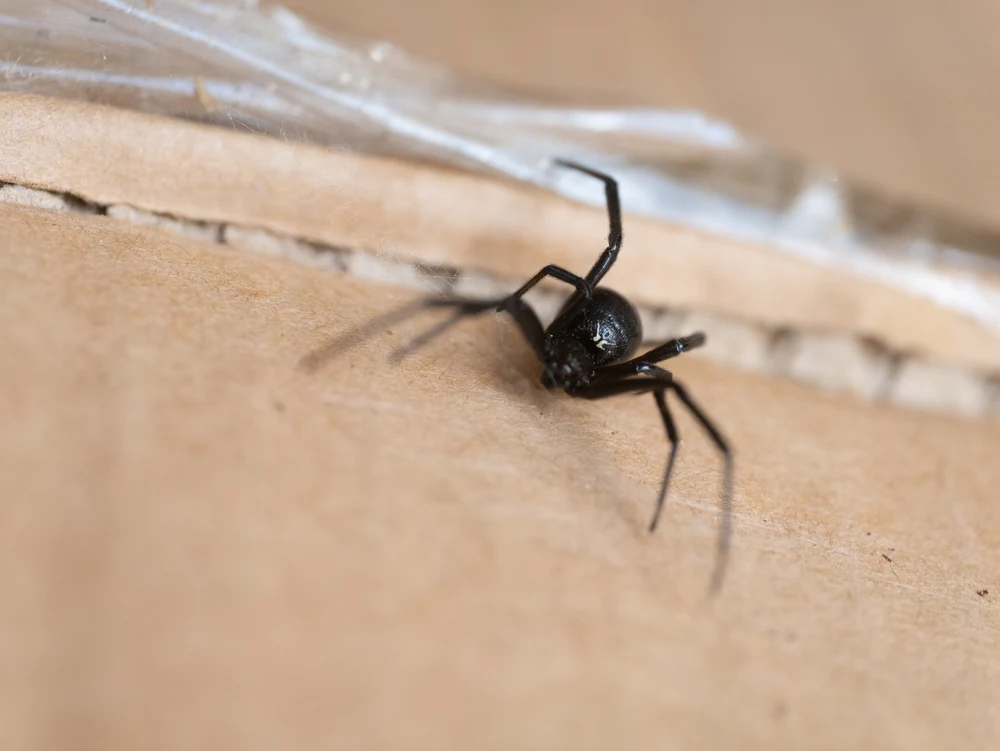
One. The western black widow is the only spider in Idaho with venom of genuine medical importance. Adult females are glossy black with a red hourglass on the underside of the abdomen and build a coarse, irregular web low down in dry, sheltered places: crawl spaces, window wells, rock piles, irrigation boxes, stacked lumber and the undersides of garden furniture. They are commonest in the warm southern half of the state. A bite causes pain that climbs over one to three hours, cramping in the abdomen and back, sweating and restlessness. Antivenom exists, severe cases are treated in hospital, and deaths in the United States are now essentially unheard of.
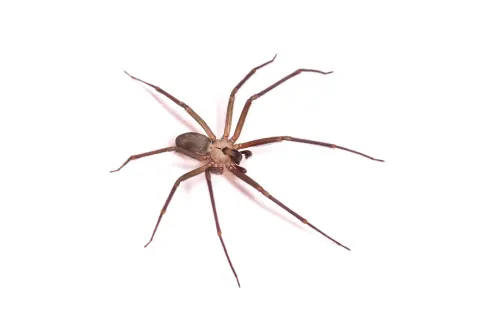
The brown recluse heads the original chart for Idaho, and that is an error worth stating plainly. Loxosceles reclusa is native to the south-central and midwestern states, roughly Kansas and Texas east to Tennessee. It is not established in Idaho, no breeding population has been documented here, and no native recluse species occurs in the state. Individual spiders occasionally arrive in freight, which is a very different thing from a resident population, and nearly every Idaho "recluse" report turns out to be a harmless hunting spider.
The hobo spider is the other reputation that needs adjusting. Introduced from Europe and long established across the Pacific Northwest, it was blamed for necrotic wounds for decades. The evidence did not hold up, and in 2017 the CDC removed it from its list of venomous spiders. Verified bites produce local pain and redness and heal without tissue loss.
Bitten? Wash the area with soap and water, apply a cold pack and keep the limb still. Go to an emergency department if pain spreads and intensifies, or if cramping, sweating or nausea develop, which suggests a widow bite. Photograph the spider if you safely can. Do not cut, suck or burn the wound, and do not apply a tourniquet.
Where you meet them
In and around the house
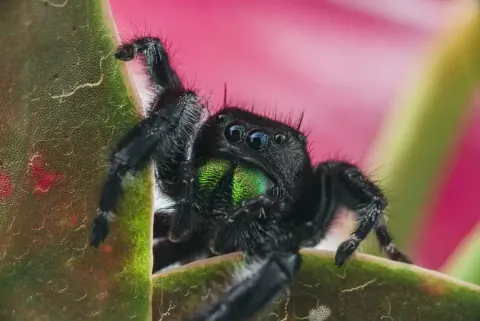
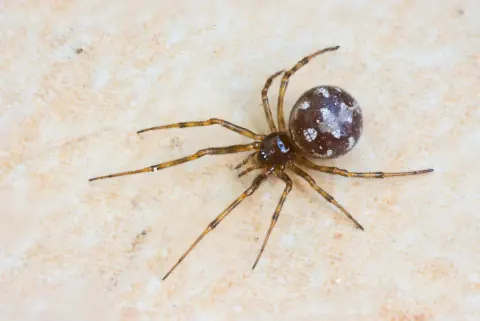
Two funnel weavers share Idaho basements and garages. The barn funnel weaver is a small, lifelong indoor resident, and the hobo spider is its larger relative; the two are separated reliably only with magnification, which is one reason hobo reports are so often wrong. In the north they are joined by the giant house spider, a bigger European import of the Pacific Northwest. The triangulate cobweb spider strings tangles in corners and window frames and preys on other spiders, including young widows. The bold jumping spider, black with a white triangle and iridescent green fangs, hunts on sunlit siding and fence rails.

Gardens, farmland and sagebrush
Late summer belongs to the orb-weavers. The cat-faced spider rebuilds a large wheel web on porches, eaves and outbuildings every evening and is the species most often reported as a monster in September, though it is entirely harmless. The banded garden spider sits in tall grass, alfalfa and canal banks, and the western spotted orbweaver favours irrigated ground and riverside vegetation. Out on the sage flats, wolf spiders hunt on open soil at night; a headlamp held at eye level picks up their eyeshine across bare ground.
Spider season in Idaho
Idaho's spider year is short and sharply peaked. Almost nothing is conspicuous before July. Orb-weavers hatched in spring reach full size in August, so their webs are at their largest and most obvious through September, and the first hard frosts in October end most of them. Widows are active from spring through autumn but stay hidden, which is why bites usually happen when someone reaches into a stored box or moves a woodpile rather than when the spider is seen.
Autumn is also when male funnel weavers, hobo spiders included, abandon their webs and wander in search of females. That is the wandering that gets mistaken for an invasion; the spiders were in the crawl space and the wood stack all along. Through the state's long, cold winter most species survive as eggs or part-grown juveniles under bark, litter and stones, the pattern described in our guide to where spiders go in the winter.
Commonly misidentified in Idaho
Sun spiders, also called windscorpions or solifuges, are abundant on the Snake River Plain and terrify people every summer. They are fast, tan and jawed like pliers, and they are not spiders: no silk, no venom glands and ten apparent legs rather than eight. They cannot hurt you.
Among true spiders, almost any brown spider with a darker patch on the front body gets called a brown recluse. A real recluse has six eyes in three pairs, uniformly pale legs with no banding or spines, and a violin mark that narrows toward the abdomen; the state's common brown spiders are funnel weaver, ground and wolf spiders, all eight-eyed. The triangulate cobweb spider is regularly mistaken for a young widow, but it is patterned in cream and purple-brown and has no hourglass. For the genuinely dangerous spiders of the world, see our list of the most venomous spiders.
Common Spiders in Idaho
Largest Spider in Idaho
- Hobo (Eratigena agrestis)
Highly Venomous Spiders in Idaho
Sicariidae
Cobweb (Theridiidae)

Less Venomous Spiders in Idaho
Orb-weaver (Araneidae)
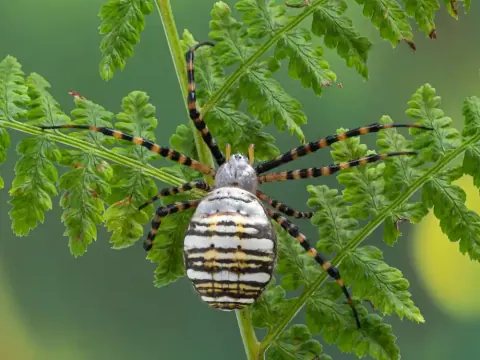 Orb WeaversBanded Garden (Argiope trifasciata)Identify the banded garden spider (Argiope trifasciata): silver banding, size, the zigzag in its web, egg sac, range, and whether its bite i
 Orb WeaversWestern Spotted Orbweaver Spider (Neoscona oaxacensis)Identify the western spotted orbweaver (Neoscona oaxacensis): size, mottled black-and-white abdomen, its nightly orb web, range and whether
 Orb WeaversCat-Faced (Araneus gemmoides)Identify the cat-faced spider (Araneus gemmoides): the two abdominal horns, size, colour range, its nightly orb web, where it lives and whet
Jumping (Salticidae)
Cobweb (Theridiidae)
Funnel Weaver (Agelenidae)
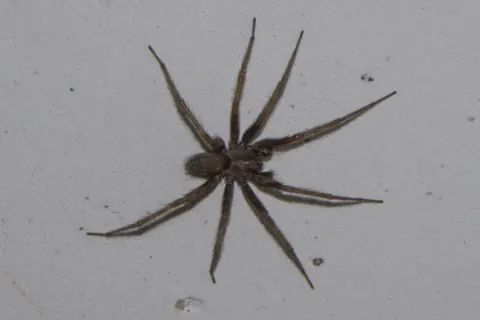 Funnel Weaver SpidersBarn Funnel Weaver (Tegenaria domestica)Identify the barn funnel weaver (Tegenaria domestica): size, banded legs, its flat funnel web, where it lives indoors, and whether the bite
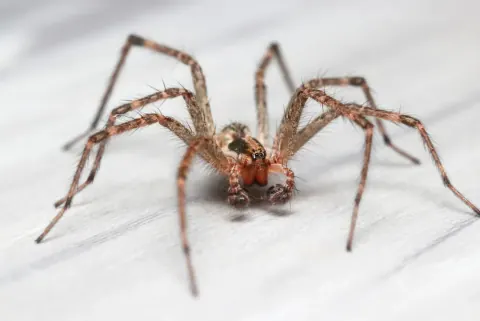 Funnel Weaver SpidersHobo (Eratigena agrestis)Identify the hobo spider (Eratigena agrestis): size, chevron abdomen, funnel web, where it lives, and why its bite is not considered necroti
Living with Idaho's spiders
Only the widow calls for real caution, and that means handling storage rather than killing spiders. Everything else on this page is a useful predator of flies, mosquitoes, moths and crop pests.
- Wear gloves for firewood, irrigation boxes, crawl spaces, window wells and long-stored boxes. This prevents the great majority of widow bites.
- Shake out boots, gloves and outdoor clothing left in a shed or garage.
- Keep stacked lumber and rock piles off the ground and away from house walls.
- Vacuum webs and egg sacs in basements and garages instead of spraying; it works better and leaves no residue.
- Turn off or shield porch lights in late summer. Fewer moths means fewer orb webs across the doorway.
Identification help for indoor species is in our guide to house spiders, and neighbouring states share most of this fauna: see Washington for the same funnel weavers and Montana for the same widows and orb-weavers.
Frequently asked questions
What is the most dangerous spider in Idaho?
The western black widow, and it is the only one of real medical concern. The glossy black female with a red hourglass underneath hides in crawl spaces, window wells, rock piles and stored materials. Its bite brings rising pain, muscle cramping and sweating over a few hours, and severe cases are treated in hospital.
Are brown recluse spiders found in Idaho?
No established population exists in Idaho. The brown recluse is native to the south-central and midwestern states and no native recluse species occurs here. Individual spiders occasionally arrive in freight or moving boxes, but nearly every Idaho "recluse" report turns out to be a funnel weaver, ground spider or wolf spider.
Is the hobo spider dangerous in Idaho?
Not in the way it was long claimed to be. The CDC removed the hobo spider from its list of venomous spiders in 2017 after the evidence for necrotic bites failed to hold up. Verified bites cause local pain and redness and heal normally. The spider is common in Idaho basements and woodpiles.
What is the largest spider in Idaho?
Not the hobo spider, despite the older claim. Hobos reach a leg span of roughly four centimetres. Large wolf spiders of the genus Hogna are bigger and heavier, the giant house spider of northern Idaho outspans them, and female cat-faced spiders outweigh them all in late summer.
What are the most common spiders in Idaho homes?
Funnel weavers dominate: the small barn funnel weaver and the larger hobo spider, joined in the north by the giant house spider. The triangulate cobweb spider builds tangles in corners and window frames, and bold jumping spiders come indoors through open doors in summer. None of them is medically significant.
How can I tell a hobo spider from a giant house spider?
Not easily by eye. Both are brown funnel weavers with a herringbone pattern on the abdomen, and reliable separation needs magnification of the palps or epigyne. Size helps a little: giant house spiders are noticeably larger and hairier-legged. Since neither is medically significant, precise identification matters less than it once seemed to.
What is the big spider on my porch in September?
Almost certainly a cat-faced spider, Araneus gemmoides. Females swell to the size of a grape by late summer and rebuild a wheel web across a porch, eave or window every evening, then hide in a crevice by day. They are harmless and remove large numbers of flying insects.
Are those big fast tan creatures in southern Idaho spiders?
Usually sun spiders, also called windscorpions or solifuges. They are arachnids but not spiders: they produce no silk, have no venom glands and appear to have ten legs because the front pair of pedipalps is used like legs. They are harmless to people despite their speed and large jaws.
Do jumping spiders in Idaho bite?
Rarely, and harmlessly. The bold jumping spider is the common large species, black with a white abdominal triangle and metallic green fangs. It has excellent eyesight, stalks prey in short rushes and prefers to retreat or jump away from people. A defensive bite feels like a pinprick and needs no treatment.
Published February 13, 2020 · Last updated September 14, 2026