
Spiders in Wisconsin
Wisconsin is one of the safest states in the country for spiders. Only one species here is medically significant — the northern black widow — and it is genuinely rare, confined to a handful of warm bluff-country counties. The brown recluse is not established anywhere in Wisconsin. The twenty-nine species below are the ones most often photographed and sent in for identification, and every one of them apart from the widow is harmless.

On this page
- What spiders live in Wisconsin?
- Which Wisconsin spiders are actually dangerous?
- There are no brown recluses in Wisconsin
- Where you meet them, Driftless bluffs to the Northwoods
- Spider season in Wisconsin
- Common mix-ups in Wisconsin
- Common Spiders in Wisconsin
- Largest Spiders in Wisconsin
- Highly Venomous Spiders in Wisconsin
- Less Venomous Spiders in Wisconsin
- Living with Wisconsin's spiders
- Frequently asked questions
What spiders live in Wisconsin?
Wisconsin's spiders are shaped by glaciers and water. The unglaciated Driftless bluffs in the southwest hold warm, dry, south-facing rock faces found nowhere else in the state; the north is boreal forest, bog and lake; between them lie prairie remnants, oak savanna and dairy farmland. Several hundred species are documented statewide, most of them small and easily overlooked.
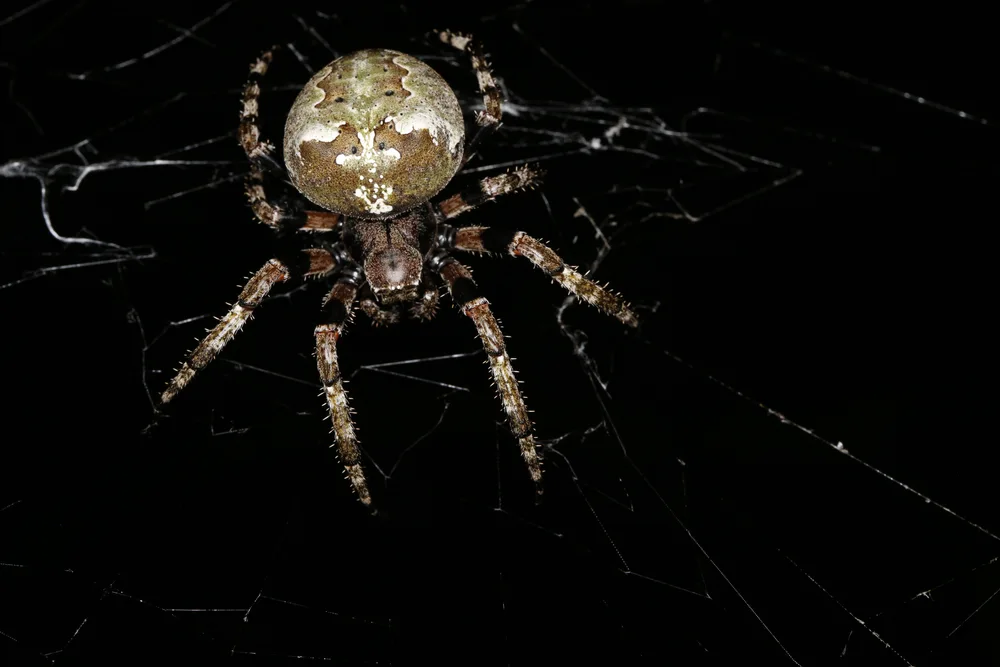
The orb weavers are the family everyone notices, and Wisconsin has some spectacular ones. The giant lichen orb weaver slings a web nearly a metre across between trees in damp woodland, the yellow garden spider writes its zigzag silk band into meadow webs, and the gray cross spider — the bridge spider — masses in hundreds on lit railings and steelwork beside the lakes and rivers.
The hunters are just as familiar. Dark fishing spiders hold station on trunks and dock pilings and are the bulkiest spiders in the state; wolf spiders run lawns, prairie and leaf litter after dark; bold jumping spiders stalk sunlit siding and deck rails by day. Indoors the regulars are the common house spider in ceiling corners and the barn funnel weaver in basements and sheds, the pattern described in our guide to house spiders.
Which Wisconsin spiders are actually dangerous?
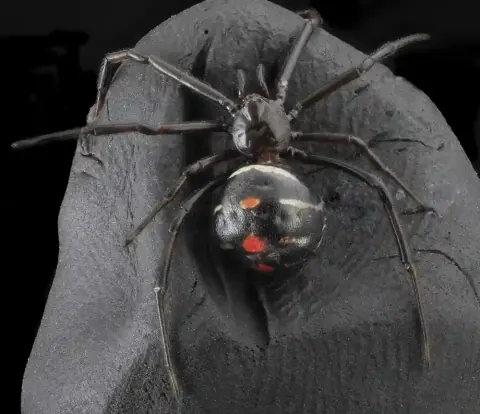
One, and it is scarce. The northern black widow (Latrodectus variolus) reaches the northern edge of its range in Wisconsin and is confined to warm, dry, south-facing rock outcrops and bluffs, mostly in the Driftless counties of the southwest. It is glossy black, with the hourglass split into two separate red marks and a row of red spots along the top of the abdomen. Its venom is neurotoxic: a bite produces cramping pain that spreads from the site into the abdomen and back over one to three hours, often with sweating and nausea. It is treatable, and with modern care widow bites are not fatal. Most Wisconsin residents will never see one.

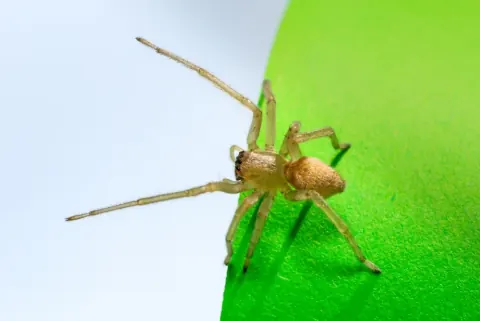
Older versions of this page listed two more species as highly venomous, and both entries were wrong. The northern yellow sac spider is genuinely common indoors here and does bite when trapped in bedding or clothing, but the bite stings and reddens like a wasp sting and nothing more — the claim that it causes necrotic ulcers has not survived scrutiny, and reviews of verified bites found no tissue death. Everything else on this page, including the big fishing spiders and every orb weaver, is harmless.
Bitten? Wash with soap and water, apply a cold pack and keep the limb still. Photograph the spider if you can do so safely. Seek medical care for spreading cramping pain, sweating or vomiting, for any wound that keeps enlarging over several days, and for a suspected widow bite in a child or an older adult. Do not cut, suck or apply a tourniquet.
There are no brown recluses in Wisconsin
This is the single most persistent spider myth in the state, and the answer is straightforward: the brown recluse (Loxosceles reclusa) is not established in Wisconsin. Its core range stops well to the south, in Missouri, Iowa's southern tier, Illinois and the mid-South. Individuals occasionally arrive in freight, furniture or luggage, and very occasionally one survives long enough inside a heated building to be found — but no free-living population persists outdoors, and surveys have never produced one.

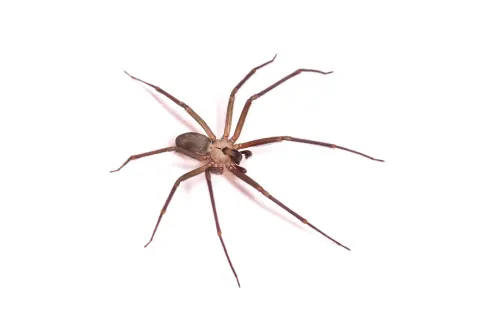
The practical consequence is that a spreading skin wound in Wisconsin is almost never a recluse bite. Resistant staphylococcal infection is the classic impostor, and diabetic ulcers, chemical burns, tick-borne lesions and shingles all get the same label. If there is no spider, ask what else it might be. For identification, the recluse has six eyes in three widely spaced pairs, plain sandy-tan legs with no bands and no heavy spines, and a backward-pointing violin on the front body section.
Where you meet them, Driftless bluffs to the Northwoods
Southern and southwestern Wisconsin
The warmest, most species-rich part of the state. Prairie remnants, oak savanna and the Driftless bluffs carry the heaviest orb-weaver and ground-hunter traffic, and the sun-baked rock faces here are the only real widow habitat in Wisconsin.
Lakeshores, rivers and cities
Bridge spiders in their thousands on lit steelwork, fishing spiders on docks and boathouses, and long-jawed orb weavers strung over the water. Milwaukee and the Fox Valley produce most of the state's urban spider reports.
The Northwoods
Shorter seasons and fewer species overall, but a rich, inconspicuous fauna of sheet-web weavers and litter hunters in the bogs, conifer forest and lake margins. The giant house spider and other introduced funnel weavers turn up mostly in buildings rather than in the woods.
Spider season in Wisconsin
Wisconsin's season is compressed. Spiders are barely visible until June, build through the summer, and surge from late August until the first hard frost. That is when the spring generation reaches adult size, webs hit full diameter, and adult males of nearly every family wander in search of females — which is exactly how they end up in garages, basements and bathtubs in September. Frost clears the outdoor webs abruptly, usually in October in the north. Indoor species carry on in heated buildings all winter, as our guide to where spiders go in the winter explains.
Common mix-ups in Wisconsin
Brown spiders indoors are submitted as recluses constantly. Grass spiders along foundations, young fishing spiders in basements and wolf spiders on the floor at night are the usual candidates, and all three have eight eyes and banded or spiny legs. Any glossy dark spider indoors with no red hourglass is a Steatoda false widow — the northern cobweb spider is a common one in Wisconsin cellars. Reports of "giant house spiders" deserve a second look too: most large brown funnel weavers in Wisconsin buildings are barn funnel weavers or grass spiders.
Two familiar animals are not spiders. Harvestmen — the long-legged daddy longlegs on shaded walls and under decks — have a single fused body and no venom glands. Ticks, sometimes submitted as "baby spiders", carry far more disease risk in Wisconsin than any spider does.
Common Spiders in Wisconsin
- Common House (Parasteatoda tepidariorum)
- Giant House (Eratigena atrica)
- Northern Yellow Sac (Cheiracanthium mildei)
Largest Spiders in Wisconsin
- Giant House (Eratigena atrica)
- Giant Lichen Orb-weaver (Araneus bicentenarius)
- Fishing (Dolomedes) spiders
- Wolf (Lycosidae) spiders
Highly Venomous Spiders in Wisconsin
Cobweb (Theridiidae)
Sicariidae
Cheiracanthiidae
Less Venomous Spiders in Wisconsin
Orb-weaver (Araneidae)
 Long-Jawed SpidersMabel's Orchard Orb Weaver Spider (Leucauge argyrobapta)Identify Mabel's orchard orb weaver (Leucauge argyrobapta): size, silver and green colouring, its horizontal web, range, and how it differs
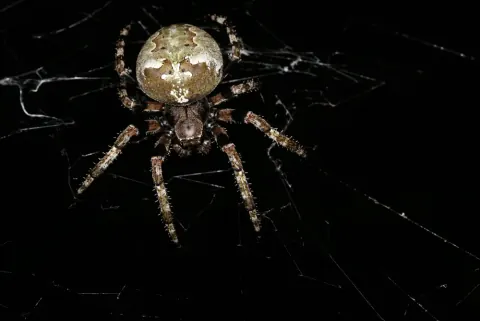 Orb WeaversGiant Lichen Orb Weaver (Araneus bicentenarius)Identify the giant lichen orb weaver (Araneus bicentenarius): size, lichen camouflage, its huge night orb web, range, and whether its bite i
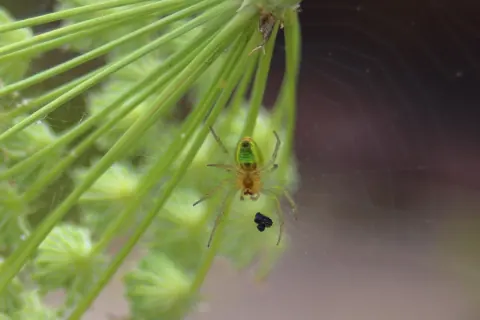 Orb WeaversAraneus cingulatusIdentify Araneus cingulatus, the tiny red-spotted orb weaver of eastern US woodland: size, green and red markings, its small high orb, range
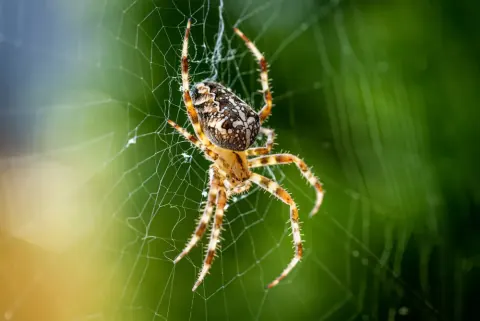 Orb WeaversCross Orb Weaver (Araneus diadematus)Identify the cross orb weaver (Araneus diadematus) by the white cross on its abdomen: size, colour, web, egg sac, range and whether the bite
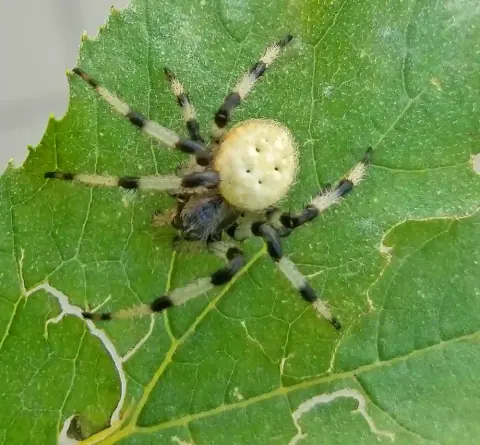 Orb WeaversShamrock Orb Weaver (Araneus trifolium)Identify the shamrock orb weaver (Araneus trifolium): size, the white-dotted globe abdomen, banded legs, its web and retreat, range, season
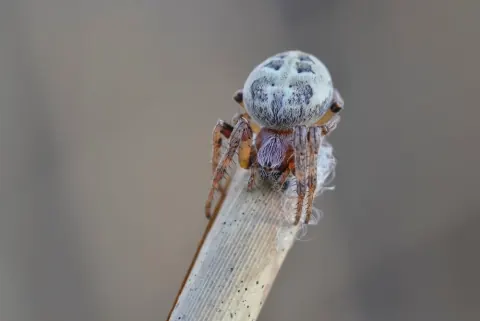 Orb WeaversFurrow (Larinioides cornutus)Identify the furrow spider (Larinioides cornutus): the foliate abdomen mark, its nightly orb web beside water, range, diet and whether the b
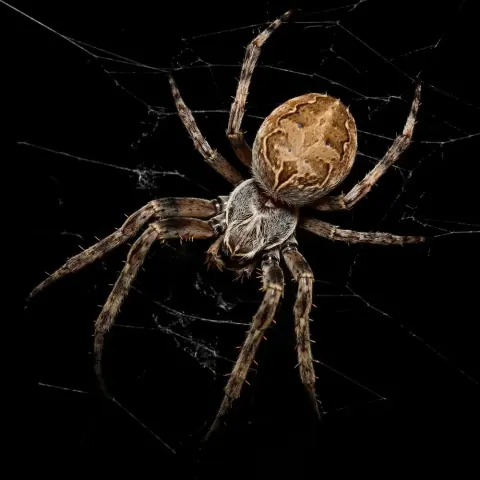 Orb WeaversGray Cross Spider (Larinioides sclopetarius)Identify the gray cross spider or bridge spider (Larinioides sclopetarius): size, silver-edged pattern, its lamp-lit webs on steel bridges,
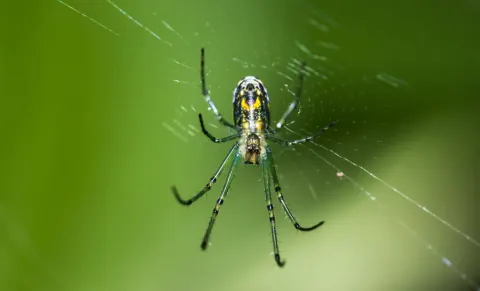 Long-Jawed SpidersOrchard Orbweaver (Leucauge venusta)Identify the orchard orbweaver (Leucauge venusta): size, silver and green colours, its horizontal orb web, where it lives and whether the bi
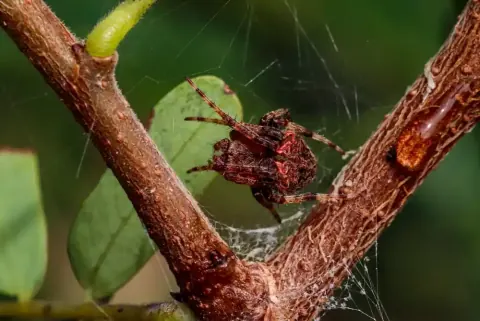 Orb WeaversSpotted Orb Weaver (Neoscona crucifera)Identify the spotted orb weaver (Neoscona crucifera): rusty hairy body, ringed legs, size, the web it rebuilds nightly, range and whether it
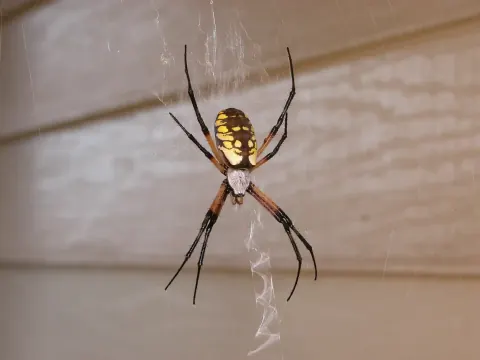 Orb WeaversYellow Garden (Argiope aurantia)Identify the yellow garden spider (Argiope aurantia): black and yellow markings, size, the zigzag stabilimentum, egg sacs, range and whether
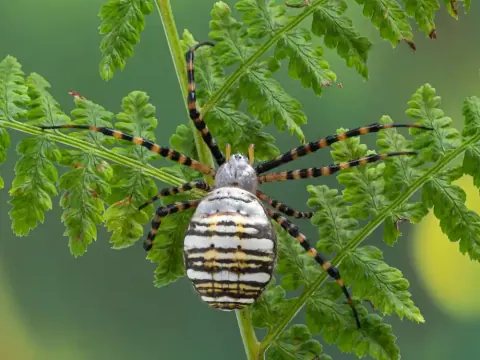 Orb WeaversBanded Garden (Argiope trifasciata)Identify the banded garden spider (Argiope trifasciata): silver banding, size, the zigzag in its web, egg sac, range, and whether its bite i
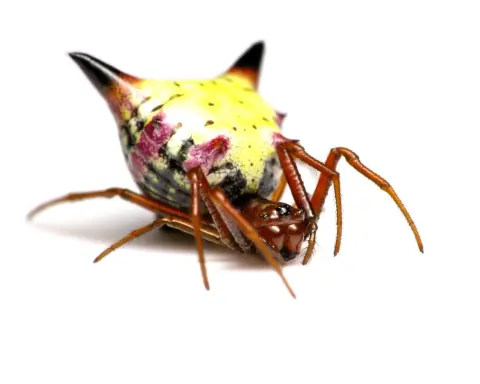 Orb WeaversArrow-shaped Micrathena (Micrathena sagittata)Identify the arrow-shaped micrathena (Micrathena sagittata): the yellow arrowhead abdomen, its two long rear spines, web, range, season and
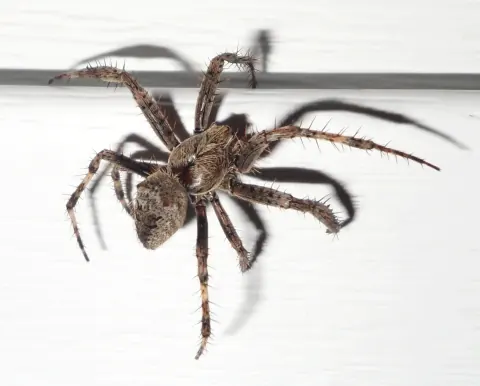 Orb WeaversFierce Orbweaver Spider (Araneus saevus)Identify the fierce orbweaver (Araneus saevus): a dark, humped orb weaver of northern spruce forest. Size, web, range, season and how danger
Jumping (Salticidae)
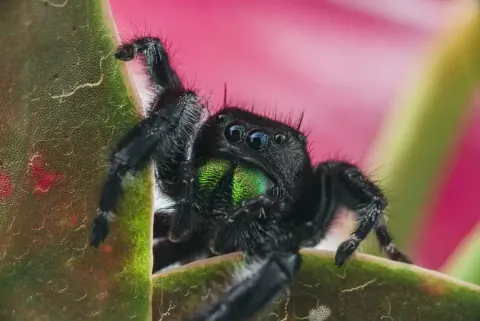 Jumping SpidersBold Jumping (Phidippus audax)Identify the bold jumping spider (Phidippus audax): size, the white triangle, green jaws, how it hunts without a web, and whether its bite i
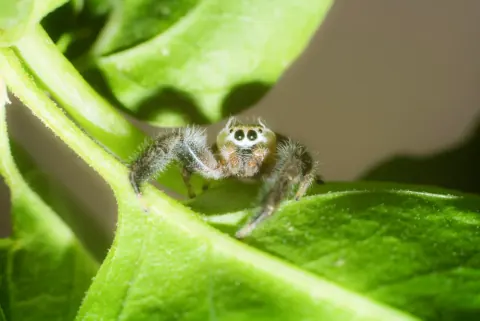 Jumping SpidersTan Jumping (Platycryptus undatus)Identify the tan jumping spider (Platycryptus undatus): flattened body, wavy abdominal pattern, size, where it lives and whether its bite is
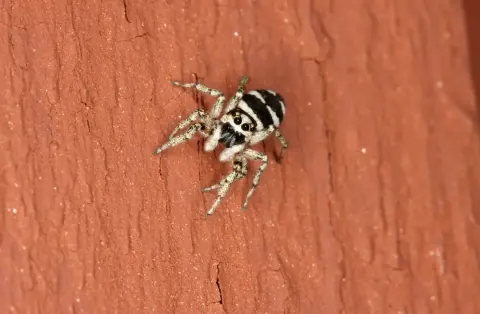 Jumping SpidersZebra (Salticus scenicus)Identify the zebra spider (Salticus scenicus): the black and white bars, the male's oversized jaws, how it hunts without a web, and whether
Nursery Web (Pisauridae)
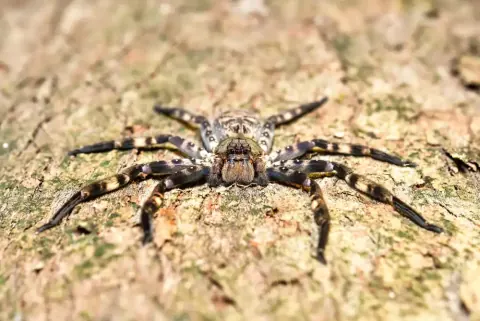 Nursery Web SpidersDark Fishing (Dolomedes tenebrosus)Identify the dark fishing spider (Dolomedes tenebrosus): size, chevron markings, where it lives in North America, and whether its bite is da
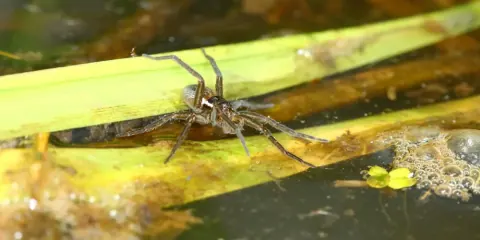 Nursery Web SpidersSix-spotted Fishing (Dolomedes triton)Identify the six-spotted fishing spider (Dolomedes triton): size, stripes, how it walks on water, its range, and whether its bite is dangero
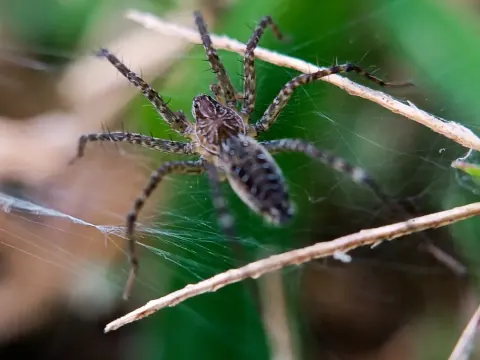 Nursery Web SpidersStriped Fishing (Dolomedes scriptus)Identify the striped fishing spider (Dolomedes scriptus): size, pale side stripes, stream-bank habitat, how it hunts on water and whether it
Cobweb (Theridiidae)
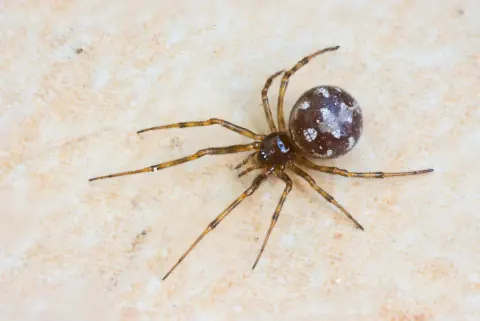 Cobweb SpidersTriangulate Cobweb (Steatoda triangulosa)Identify the triangulate cobweb spider (Steatoda triangulosa): the purple zigzag pattern, yellow legs, its tangle web, and whether the bite
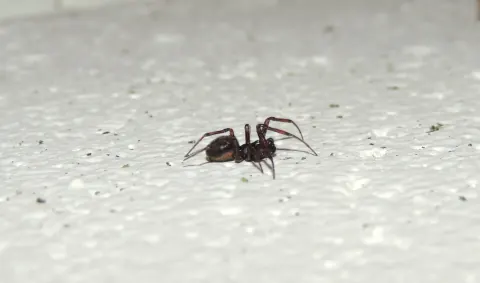 Cobweb SpidersSteatoda borealisIdentify Steatoda borealis, the northern false widow: pale T-shaped mark, glossy brown body, tangle web under bark and in basements, range a
Amaurobiidae
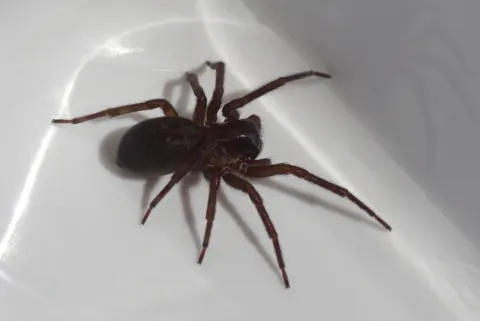
Funnel Weaver (Agelenidae)
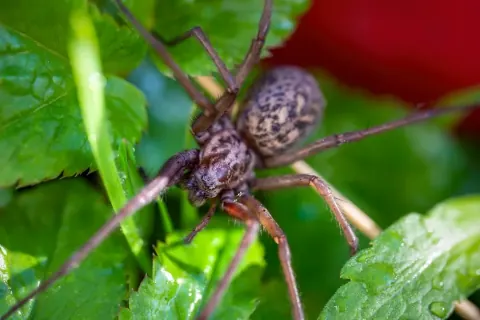 Funnel Weaver SpidersGiant House (Eratigena atrica)Identify the giant house spider (Eratigena atrica): size, banded legs, funnel web, why it appears in autumn, and whether its bite is dangero
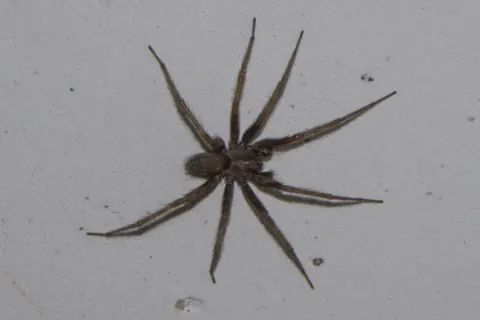 Funnel Weaver SpidersBarn Funnel Weaver (Tegenaria domestica)Identify the barn funnel weaver (Tegenaria domestica): size, banded legs, its flat funnel web, where it lives indoors, and whether the bite
Ground (Gnaphosidae)
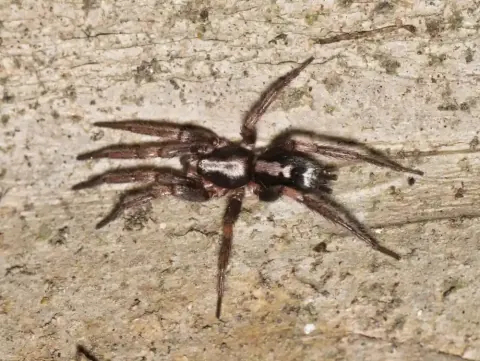
Tangle Web (Theridiidae)
Living with Wisconsin's spiders
With one rare widow and no recluse, Wisconsin needs very little spider management:
- Wear gloves when working sun-baked rock outcrops, retaining walls and woodpiles in the southwestern bluff country.
- Shake out boots, gloves and stored clothing left in a garage, barn or cabin over winter.
- Fit door sweeps and repair screens in July, before the wandering season starts.
- Vacuum webs and egg sacs rather than spraying; take away the insects and the spiders leave with them.
- Leave the big autumn orb webs alone where you can — they are removing mosquitoes and flies for free.
- Ask about bacterial infection before accepting any "recluse bite" diagnosed without a spider.
Neighbouring Minnesota shares nearly the whole of this fauna.
Frequently asked questions
What is the most venomous spider in Wisconsin?
The northern black widow, and it is the only medically significant spider in the state. Its neurotoxic venom causes cramping pain that spreads from the bite into the abdomen and back, often with sweating and nausea. Bites are treatable and not fatal with modern care, and encounters are genuinely rare.
Are there brown recluse spiders in Wisconsin?
No. The brown recluse is not established in Wisconsin; its range stops well to the south. Individuals occasionally arrive in freight or furniture and may survive briefly inside a heated building, but no free-living population exists in the state and surveys have never found one.
How common are black widows in Wisconsin?
Rare. The northern black widow reaches the northern limit of its range here and is restricted to warm, dry, south-facing rock outcrops and bluffs in a small number of southwestern counties. It is not found in northern Wisconsin and poses no widespread risk. Most residents will never encounter one.
What is the largest spider in Wisconsin?
The dark fishing spider has the greatest leg span, reaching roughly nine centimetres, and is often found on dock pilings, tree trunks and basement walls. The giant lichen orb weaver is the heaviest-bodied, with a web that can span nearly a metre. Neither is medically significant to people.
Are northern yellow sac spiders in Wisconsin dangerous?
No. They are common indoors and will bite when trapped against skin in bedding or clothing, producing a sting, redness and itching for a day or two. The old claim that their bite causes necrotic ulcers has not held up: reviews of verified bites found local irritation only, with no tissue death.
What spiders are found inside Wisconsin homes?
The common house spider in ceiling corners, the triangulate cobweb spider along baseboards, the barn funnel weaver in basements and sheds, and the northern yellow sac spider on walls and ceilings at night. In autumn, wandering male wolf and fishing spiders come in under doors. None of them is dangerous.
Are orb-weaver spiders in Wisconsin poisonous?
They are venomous rather than poisonous, and none is medically significant. Orb weavers use venom to subdue insects, and they bite people only when trapped against skin. The result is brief pain and redness comparable to a bee sting. They are extremely efficient predators of garden and crop pests.
Do giant house spiders live in Wisconsin?
Rarely and locally at best. The giant house spider is an introduced European funnel weaver whose North American strongholds are the Pacific Northwest and parts of the Northeast. Most large brown funnel weavers reported in Wisconsin buildings turn out to be barn funnel weavers or grass spiders on closer inspection.
When is spider season in Wisconsin?
Late August until the first hard frost. The season here is short: spiders are inconspicuous until June, build through summer, then surge as the spring generation matures and adult males wander in search of mates. That wandering is why indoor sightings spike in September and stop abruptly in October.
How do Wisconsin spiders survive the winter?
Most do not survive as adults. Many species pass the winter as eggs in a silk sac or as half-grown spiderlings sheltering in leaf litter, under bark or below the frost line, protected by snow cover and by antifreeze compounds in their body fluids. Indoor species simply remain active year-round.
Published February 22, 2020 · Last updated September 14, 2026