
Spiders in Alberta
Alberta's spider list is short on danger and long on garden species. The western black widow, restricted to the warm, dry south of the province, is the only spider here whose bite needs medical attention. The other eight species profiled on this page, from orb weavers to fishing spiders, are harmless hunters of insects.

On this page
- What spiders live in Alberta?
- Which Alberta spiders are dangerous?
- Where you meet them
- Spider season in Alberta
- Easy mix-ups in Alberta
- Common Spiders in Alberta
- Big Spiders in Alberta
- Dangerous Spiders in Alberta
- Most Venomous Spiders in Alberta
- Less Venomous Spiders in Alberta
- Living with Alberta's spiders
- Frequently asked questions
What spiders live in Alberta?
Alberta runs from short-grass prairie and badlands in the south-east to boreal forest and the Rocky Mountain front in the north and west, and its spiders sort themselves along that gradient. Sheet-web weavers and small wolf spiders of the genus Pardosa are the most abundant animals on the ground almost everywhere, while the species people actually notice are the large, late-summer orb weavers and the hunters that come indoors when nights cool.

Contrary to the idea that spiders avoid the cities, Calgary and Edmonton are full of them. The cross orb weaver, a European import also called the garden spider, is one of the commonest large spiders on Alberta porches and fences, and the native shamrock orb weaver turns up in gardens and hedgerows with an abdomen that ranges from cream through orange to deep purple-brown.
Which Alberta spiders are dangerous?
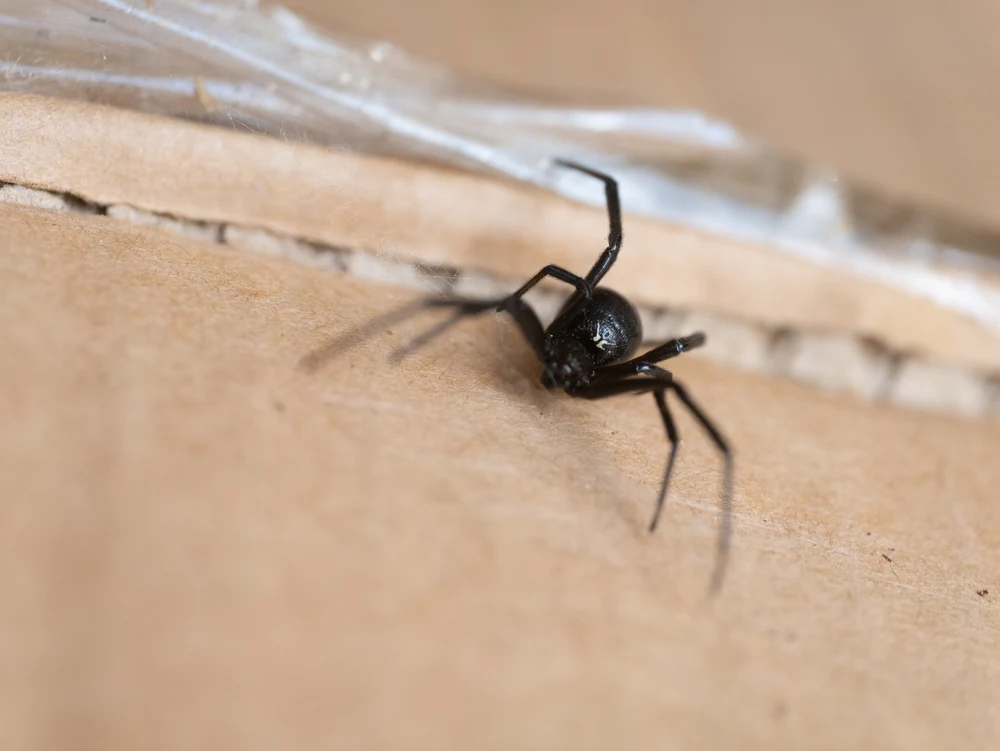
One species, and only in part of the province. The western black widow lives in the hot, dry south: the badlands around Drumheller and Dinosaur Provincial Park, the Medicine Hat and Lethbridge districts and the coulees of the Milk River country. The mature female is glossy black with a red hourglass on the underside of the abdomen and hangs in a strong, irregular web close to the ground, inside rodent burrows, rock cracks, junk piles, culverts and the undersides of farm equipment. Her bite can cause severe muscle cramps, sweating, abdominal pain and hypertension. Antivenom exists but is rarely needed, and deaths are extremely unlikely with modern care.
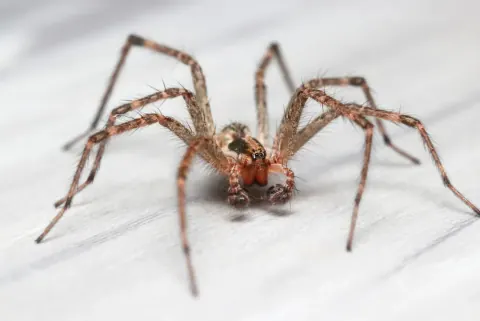
The hobo spider is listed as dangerous on most older Alberta pages, and that reputation has collapsed under scrutiny. The evidence linking it to necrotic wounds was never reproduced, and the US Centers for Disease Control removed it from its list of venomous spiders of concern in 2017. It is an introduced European funnel weaver, most firmly established in British Columbia and the Pacific Northwest, and it cannot be told apart from harmless relatives without a microscope.
There are no recluse spiders in Alberta. Loxosceles is not established anywhere in Canada, so a brown recluse diagnosis in Edmonton or Calgary almost always turns out to be a bacterial skin infection or another medical condition.
Bitten by a black widow? Wash the bite, apply a cold pack and keep the limb still, then go to an emergency department, especially for a child, an older adult or anyone whose pain spreads to the abdomen or back. Do not cut, suck or apply heat. Photograph the spider if you can do so safely, because identification changes treatment.
Where you meet them
In and around buildings
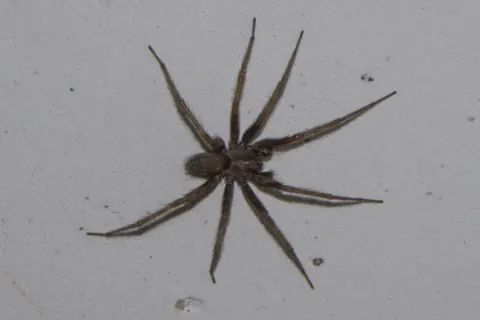
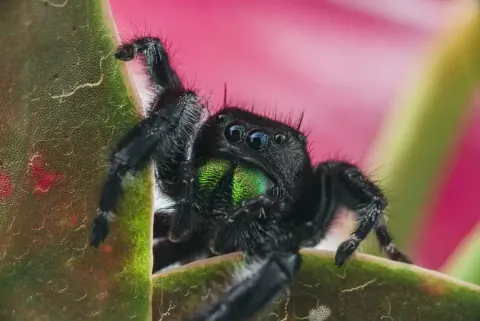
The barn funnel weaver is the classic Alberta indoor spider, spinning a flat sheet with a funnel retreat in basements, garages, sheds and window wells; it is harmless and is the species most often mistaken for the hobo. Cellar spiders occupy corners, and the bold jumping spider, black with a bright abdominal triangle and iridescent green jaws, hunts by daylight on sunny walls, fence rails and deck boards in the south of the province.

Water edges
Alberta's largest spiders live beside ponds, sloughs and slow rivers. The striped fishing spider waits at the waterline with its front legs on the surface film, reading vibrations, and can run across the water or dive under it. The dark fishing spider is largely an eastern species that lives further from water, so most big Dolomedes photographed in Alberta are the striped fishing spider or the six-spotted fishing spider of marsh margins.
Grassland and gardens
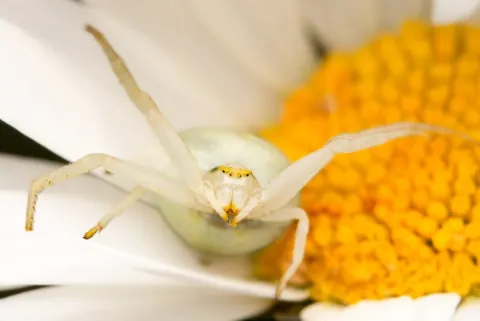
The goldenrod crab spider ambushes bees and flies on flower heads, and the female can switch between white and yellow to match the bloom, a change that takes days rather than seconds. Wolf spiders patrol open soil at night; a headlamp held level with your eyes lights up their eyeshine across a lawn, which is covered in our guide to wolf spiders.
Spider season in Alberta
The original version of this page said Alberta spiders are at their most noticeable in spring. In practice the peak is at the other end of the season. Spiders hatch or emerge small, feed all summer and reach full size in August and September, which is when orb-weaver webs suddenly appear across doorways and when wandering males come indoors looking for mates. The first hard frosts end it.
Winter is survived rather than escaped. Many species overwinter as eggs or part-grown juveniles under leaf litter, bark and snow, accumulating cryoprotectant compounds that stop ice forming inside their tissues; a stable snowpack is far better insulation than a bare cold snap. The strategies are described in our guide to where spiders go in the winter. Bites of any kind are rare here, and most reported spider bites in the province turn out to have another cause.
Easy mix-ups in Alberta
The most consequential one is the false black widow and its Steatoda relatives, which are dark, glossy and round-bodied like a widow but lack the red hourglass, showing at most a pale crescent at the front of the abdomen. They are harmless, and they are found far more widely across Alberta than true widows.
The second is funnel weaver against funnel weaver: barn funnel weavers, grass spiders and hobo spiders all build the same sheet-and-funnel web, and no photograph settles the question. The third is not a spider at all. Harvestmen, with one fused body section, no silk and no venom, are reported as spiders every autumn, and so are the leggy crane flies that drift through open doors in September.
Common Spiders in Alberta
- Cross Orb-weaver Spider
- Bold Jumping Spider
Big Spiders in Alberta
- Striped Fishing Spider
- Dark Fishing Spider
Dangerous Spiders in Alberta
- Western Black Widow Spider
- Hobo Spider
Most Venomous Spiders in Alberta
Comb-footed Spiders

Funnel Weaver Spiders
Less Venomous Spiders in Alberta
Orb-weaver Spiders
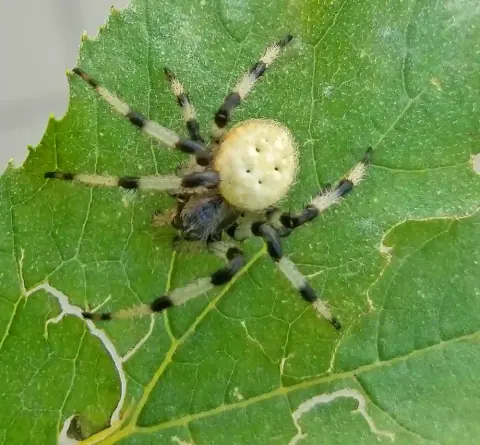 Orb WeaversShamrock Orb Weaver (Araneus trifolium)Identify the shamrock orb weaver (Araneus trifolium): size, the white-dotted globe abdomen, banded legs, its web and retreat, range, season
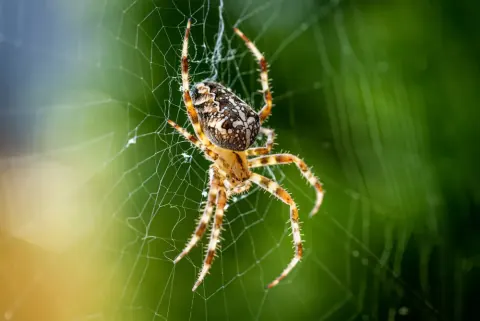 Orb WeaversCross Orb Weaver (Araneus diadematus)Identify the cross orb weaver (Araneus diadematus) by the white cross on its abdomen: size, colour, web, egg sac, range and whether the bite
Crab Spiders
Funnel Weaver Spiders
Nursery Web Spiders
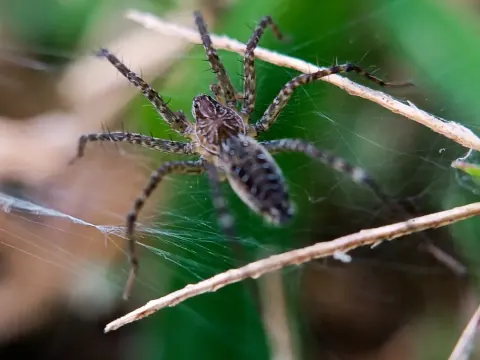 Nursery Web SpidersStriped Fishing (Dolomedes scriptus)Identify the striped fishing spider (Dolomedes scriptus): size, pale side stripes, stream-bank habitat, how it hunts on water and whether it
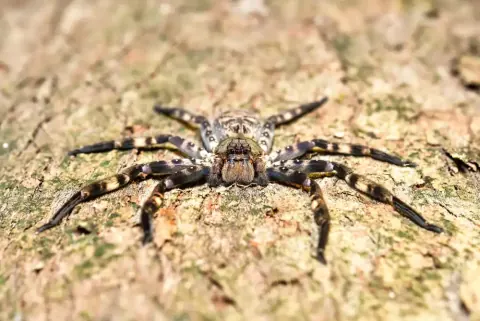 Nursery Web SpidersDark Fishing (Dolomedes tenebrosus)Identify the dark fishing spider (Dolomedes tenebrosus): size, chevron markings, where it lives in North America, and whether its bite is da
Jumping Spider
Living with Alberta's spiders
A few habits cover nearly all of the risk in the province:
- Wear gloves when moving woodpiles, rocks, farm machinery or stored materials in southern Alberta, where widows shelter.
- Clear window wells and check boots and gloves left in an unheated garage.
- Seal gaps around basement windows and doors in late summer, when males wander indoors.
- Vacuum webs rather than spraying; removing the web and the insects that feed it works better than insecticide.
- Leave orb weavers on the porch until the frost takes them; each one eats hundreds of mosquitoes and flies.
For comparison with neighbouring provinces, see British Columbia, where the hobo spider is genuinely common, and Saskatchewan, which shares the prairie fauna almost species for species.
Frequently asked questions
What are the most common spiders in Alberta?
Small sheet-web weavers and Pardosa wolf spiders are the most numerous, though they go largely unnoticed. The ones people see are cross orb weavers and shamrock orb weavers on porches and in gardens, bold jumping spiders on sunny walls, and barn funnel weavers indoors. None of these is harmful to people or pets.
Are there venomous spiders in Alberta?
The western black widow is the only Alberta spider whose venom is medically significant, and it is confined to the warm, dry southern part of the province. Every other species here has venom too weak to matter to humans. Bites of any kind are rare, since these spiders retreat rather than confront people.
Where in Alberta do black widows live?
In the south: the badlands along the Red Deer River, the Drumheller and Dinosaur Provincial Park country, the Medicine Hat and Lethbridge regions and the southern coulees. They choose sheltered, undisturbed cavities close to the ground, such as rodent burrows, rock cracks, culverts, junk piles and the underside of stored equipment.
Is the hobo spider dangerous in Alberta?
Current evidence says no. Studies failed to reproduce the necrotic wounds once blamed on hobo spiders, and the US Centers for Disease Control removed the species from its list of spiders of concern in 2017. It is also uncommon in Alberta compared with British Columbia, and it cannot be identified reliably from a photograph.
What is the biggest spider in Alberta?
Fishing spiders of the genus Dolomedes have the largest leg span, reaching roughly seven centimetres. They live at the edges of ponds, sloughs and slow streams, hunt insects and occasionally small fish or tadpoles, and can run across the water surface. They are shy, and their bite is not medically significant.
When are spiders most active in Alberta?
Late summer and early autumn, roughly August to early October. Spiders that hatched in spring reach full size then, so webs suddenly seem to appear everywhere and mature males wander in search of females, which is when they come indoors. Activity ends abruptly with the first hard frosts.
Are there brown recluse spiders in Alberta?
No. Recluse spiders are not established anywhere in Canada, and Alberta's climate is far outside their range. Wounds diagnosed as recluse bites here are almost always bacterial infections, including staph infections, or other skin conditions. A sore that grows or does not heal should be assessed by a doctor.
How do I tell a black widow from a look-alike?
Check the underside. A mature female western black widow is glossy jet black with a red hourglass beneath the abdomen and hangs upside down in a strong, irregular web. False widows of the genus Steatoda are dark and round-bodied but lack the hourglass, often showing a pale band or crescent at the front of the abdomen.
Do fishing spiders bite people?
Very rarely, and only when trapped against skin. The fangs are large enough to break skin, so a bite can be sharply painful, but the venom has no significant effect on humans. Fishing spiders normally escape by running across the water surface or diving beneath it rather than standing their ground.
Published April 26, 2022 · Last updated September 14, 2026