
Wolf Spiders
Wolf spiders are the ground-hunting spiders of the family Lycosidae — no capture web, superb night vision, and an eye arrangement nothing else shares: four small eyes in a low front row, two large ones staring forward above them, two more set back on top of the head. More than 2,400 species live on every continent except Antarctica. The mother carries her egg sac clamped to her spinnerets and then ferries the spiderlings on her back, and the bite is painful rather than dangerous.

On this page
What are wolf spiders?
Wolf spiders are the members of Lycosidae, one of the largest spider families on earth: more than 2,400 described species in roughly 130 genera. They earn the name honestly — a lycosid does not wait in a web for dinner to arrive. It stalks prey and runs it down on foot, guided by the sharpest eyesight of any spider outside the jumping spiders.
The family reaches every continent except Antarctica and almost every habitat that holds insects: dunes, salt marsh, lawns, rainforest litter, ploughed fields and Arctic tundra, where Pardosa species are among the commonest ground predators of the far north. A few have specialised into rarity — the Kauaʻi cave wolf spider lives in a handful of lava tubes on one Hawaiian island and has lost its eyes entirely.
Two traits define the family. Eight eyes in three rows, two of them large and forward-facing, give a lycosid genuine image-forming vision; and the female fastens her egg sac to her spinnerets, drags it everywhere, then carries the hatched young on her abdomen. No other family does both.
How to identify a wolf spider
Most wolf spiders are stout, hairy and brown or grey, with a plump abdomen and strong running legs. That also describes a dozen unrelated spiders, so the identification hinges on the eyes.
The eye pattern
Seen head-on, the bottom row holds four small eyes in a line. Above them sit two very large forward-facing eyes, and behind those, on top of the head, two more medium eyes set wide apart. Four–two–two, in three rows, is the lycosid signature, and it separates the family at a glance from the two-row arrangements of almost everything else on the ground — compare the layouts on our guide to spider eyes. The large rear eyes carry a reflective tapetum, so a torch held level with your own eyes turns a lawn into a field of green-white sparks.
Size, colour and legs
Body length runs from about 3 mm in the smallest Pardosa to roughly 35 mm in the largest Hogna; the frequently repeated claim that wolf spiders start at 10 mm omits most of the family. Colour is cryptic — browns, greys, fawn and black, usually with a pale stripe down the middle of the carapace and chevrons on the abdomen, and the beach wolf spider is mottled to vanish against bare sand. Leg build tracks lifestyle: burrowers such as Hogna and the turret-building Geolycosa are heavy and spiny, the thin-legged wolf spiders are light sprinters. Mature males are slimmer with swollen pedipalps; the male brush-legged wolf spider wears black brushes on his front tibiae, and the Carolina wolf spider shows the family plan at its heaviest.
How wolf spiders hunt and where you meet them
No wolf spider builds a snare. Silk still matters — a dragline, a burrow lining, a retreat under a stone, the egg sac itself — but none of it is spun to catch anything, which is the clean split between this family and the builders described in our guide to the spider web.
Three strategies run through the family: wanderers that patrol open ground, freeze, orient with the big eyes and finish with a short pounce; burrowers that dig a vertical shaft and wait at its mouth; and retreat-holders that shelter under bark and logs by day and hunt after dark. Prey means crickets, flies, beetles, ants, cockroaches and other spiders, with the largest species occasionally taking a small frog or lizard. Because they hunt so heavily in fields and orchards, lycosids are among the most valuable insect predators in farmland.
People meet them outdoors after dark, and indoors in autumn, when wandering males and females seeking a dry overwintering crevice walk in under doors. They do not colonise buildings the way the species on our house spiders page do — one on a bedroom carpet is lost rather than resident. They feature heavily in the roundup for Texas.
Life cycle: the egg sac and the spiderling ride
Courtship is visual and vibratory. The male drums his pedipalps on dry leaves and semaphores with his front legs, and the female — who can see him properly — either answers or drives him off. The signals are species-specific, which keeps related lycosids sharing one field from interbreeding.
The female then spins a silk disc, lays her eggs on it, works the edges into a tight sphere and fastens the sac to her spinnerets, carrying it with her abdomen tilted upward. She basks with it angled at the sun to speed development, and if it is knocked loose she hunts until she finds it. Clutches range from a few dozen eggs to several hundred.
When the young are ready she opens the sac for them. They climb onto her abdomen, grip specialised knobbed hairs in several layers and ride there for days or weeks without feeding while she hunts normally. Then they disperse, on foot or on a silk line carried by the wind. Most species finish the cycle in about a year, overwintering as part-grown juveniles; larger Hogna and Tigrosa females live two or three years and produce several sacs. The spider life cycle sets out the stages in full.
Are wolf spiders dangerous?
They are venomous, like almost every spider; they are not dangerous. No species of Lycosidae is medically significant, no antivenom exists for one anywhere in the world, and none appears on our list of the most venomous spiders. The venom is tuned to insects.
Bites happen when a spider is trapped — a hand pushed under a stone, a spider inside clothing, a female defending a sac she cannot flee with. The result is a sharp pain roughly like a wasp sting, redness, mild swelling and itching, normally gone in a day or two.
One myth deserves killing. Older South American accounts blamed wolf spiders for necrotic skin ulcers, and the claim was copied for decades. Re-examination attributed those lesions to bacterial infection and to bites by the brown recluse and its relatives, whose venom genuinely does destroy tissue. A verified wolf spider bite does not produce an expanding ulcer.
Bitten? Wash the site with soap and water, apply a cold pack and take a simple painkiller if you need one. Do not cut, suck or apply heat. Seek medical care if the pain keeps worsening after a day, if the area spreads, blisters or discharges, or if you develop a fever — and photograph the spider if you can.
Genera of the Wolf Spiders (Lycosidae)
Genera listed for this family on Spider Identifications — linked names have their own profile:
Wolf Spiders: species profiles
19 profiles in this family, each with identification photos, size, range, web, bite information and FAQ.
 SpeciesBeach Wolf (Arctosa littoralis)Identify the beach wolf spider (Arctosa littoralis): size, sand camouflage, burrows, eyeshine, where it lives, and whether its bite is dange
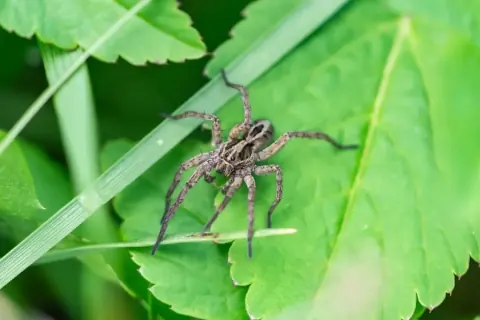 SpeciesBrush Legged Wolf (Schizocosa ocreata)Identify the brush legged wolf spider (Schizocosa ocreata): the male's black leg tufts, its size, its drumming courtship dance, range, habit
 SpeciesCarolina Wolf (Hogna carolinensis)Identify the Carolina wolf spider (Hogna carolinensis): size, black underside, burrow, eyeshine, range, and how dangerous its bite really is
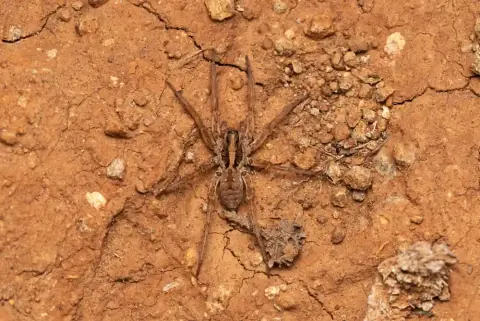 SpeciesHogna antelucanaIdentify Hogna antelucana, a tan North American wolf spider: its size, eye pattern, where it lives, how it hunts, and whether its bite is da
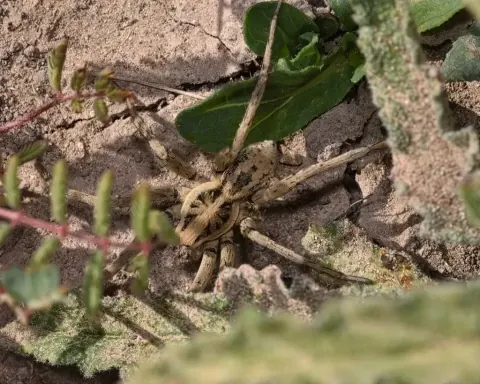 SpeciesHogna coloradensisIdentify Hogna coloradensis, the Colorado wolf spider: straw colour, striped carapace, desert burrows, range across the Southwest and how ri
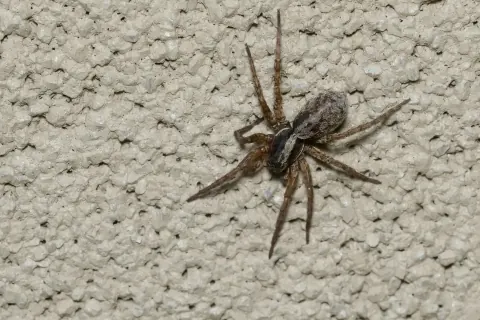 SpeciesHogna frondicolaIdentify Hogna frondicola, a small dark wolf spider of northern fields and woodland edges: size, pale stripe, range across Canada and the US
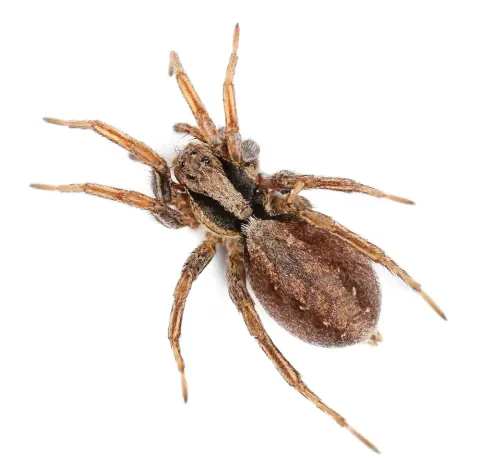 SpeciesHogna lentaIdentify Hogna lenta, a large grey-brown wolf spider of the southeastern US: size, eye pattern, egg-sac carrying, habitat and whether its bi
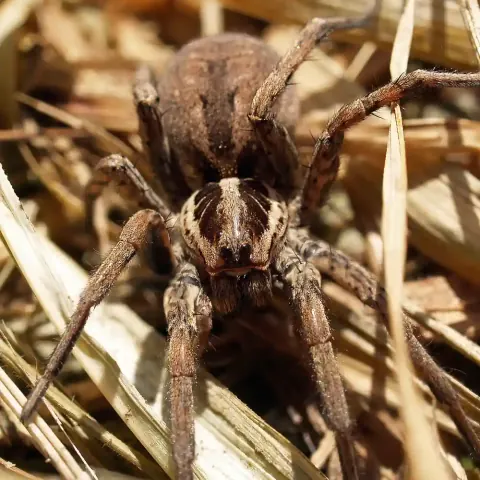 SpeciesHogna radiataIdentify Hogna radiata, the big Mediterranean wolf spider: size, the radiating carapace pattern, where it lives, its burrow and how serious
 SpeciesMediterranean Spiny False Wolf (Zoropsis spinimana)Identify the Mediterranean spiny false wolf spider (Zoropsis spinimana): eye rows, mask-like abdomen pattern, why it enters houses in autumn
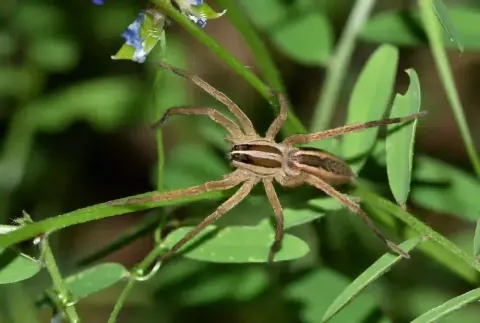 SpeciesRabid Wolf (Rabidosa rabida)Identify the rabid wolf spider (Rabidosa rabida) by its stripes and size, and learn about its egg sac, range in the eastern US and its harml
 SpeciesStone Spider (Pardosa lapidicina)Identify the stone spider (Pardosa lapidicina): size, granite-grey markings, wolf spider eyes, where it lives on rock and stream banks, and
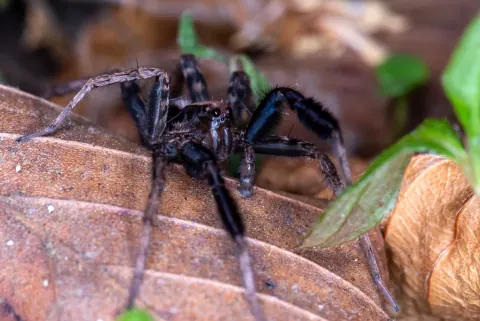 SpeciesTigrosa GeorgicolaIdentify Tigrosa georgicola, a dark wolf spider of southeastern US woodland floors: size, stripe, egg sac, hunting behaviour and how harmles
Genus profiles
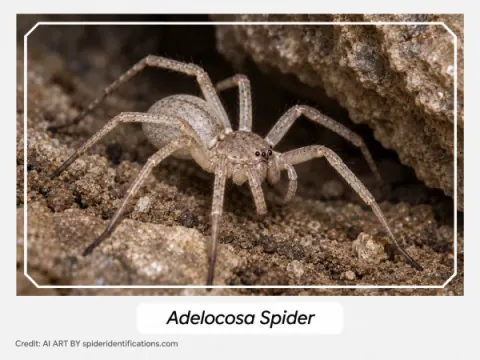 GenusAdelocosaAdelocosa is a one-species Hawaiian genus: the eyeless Kauaʻi cave wolf spider. Its identification, cave habitat, diet, bite and endangered
 GenusArctosaA guide to Arctosa spiders: how to identify the genus, the sandy shores and burrows they live in, the species you may meet, and how harmless
 GenusHognaA guide to Hogna spiders, the giant wolf spiders: how to identify the genus, the burrows they dig, where they live, and how dangerous a Hogn
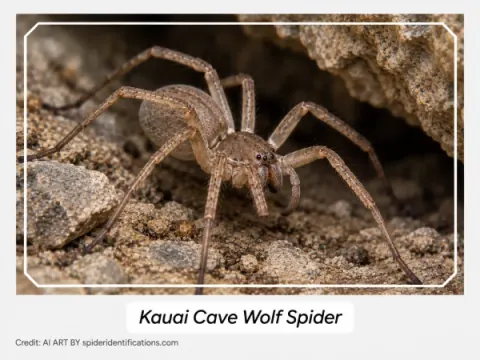 GenusKauaʻi Cave Wolf Spider (Adelocosa anops)
 GenusRabidosaA guide to Rabidosa spiders: the five striped North American wolf spiders, how to identify them, where they hunt, and how harmless their bit
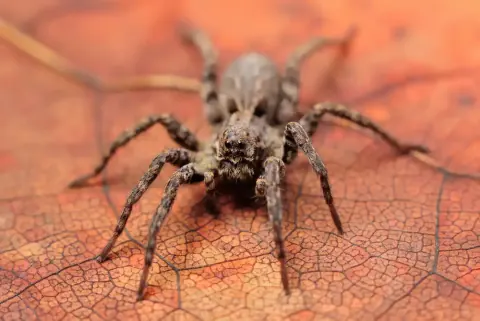 GenusThin-legged Wolf (Pardosa)A guide to Pardosa, the thin-legged wolf spiders: identifying the genus, its green lens-shaped egg sac, where the species live and whether t
 GenusTigrosaA guide to Tigrosa wolf spiders: how to identify the genus, its five North American species, where they live, and whether a Tigrosa bite is
Wolf spider or look-alike?
Almost every large brown ground spider gets called a wolf spider; the eye rows settle most arguments.
Nursery web and fishing spiders (Pisauridae) are the closest confusion and the source of a persistent error: they have eight eyes in two rows, not the four eyes often claimed for them. Behaviour separates them faster — a pisaurid mother carries her egg sac in her jaws and finally builds a silk nursery tent instead of letting the young ride on her back. See nursery web spiders.
Grass spiders are the other regular mix-up, being striped, fast and at home in lawns. They are funnel weavers: look for two long, finger-like spinnerets projecting past the abdomen and the sheet web with its funnel retreat that no wolf spider ever builds.
False wolf spiders are the trickiest. The Mediterranean spiny false wolf spider, now established in California and much of Europe, is patterned like a lycosid and routinely filed with them, but belongs to the family Zoropsidae and carries its eight eyes in two rows. The identification people most want ruled out is the easiest: a brown recluse has six eyes in three widely separated pairs, smooth unspined legs and no abdominal pattern at all.
Did you know?
- The Carolina wolf spider has been the official state spider of South Carolina since 2000 — the first state spider designated anywhere in the United States, after a campaign by a third-grade class.
- It is also the largest lycosid in North America, with big females reaching about 35 mm in the body. Its global rival is Hogna ingens, confined to one valley on Deserta Grande in the Madeira archipelago and critically endangered.
- Carrying an egg sac is not unique to this family — cellar spiders hold theirs in the jaws — but attaching it to the spinnerets and then ferrying the hatched spiderlings on the abdomen is found in no other family.
- Wolf spiders pounce, but they do not jump in the salticid sense: there is no specialised leaping mechanism, and the strike is a short lunge rather than a silk-tethered jump.
- Members of the genus Geolycosa dig shafts up to half a metre deep in sand and rim the entrance with a turret of silk-bound grains.
- The Kauaʻi cave wolf spider has no eyes at all. It hunts blind in total darkness, lays only 15 to 30 unusually large eggs, and is protected under the US Endangered Species Act.
Frequently asked questions
Do wolf spiders bite?
Only when they cannot escape — pressed against skin inside clothing, grabbed, or when a female is guarding her egg sac. The bite feels like a wasp sting, leaves redness and mild swelling and usually fades within a day. There is no venom of medical importance in this family and no antivenom has ever been needed.
Are wolf spiders poisonous?
No. Poisonous means dangerous to eat or touch; wolf spiders are venomous, meaning they inject venom through fangs to subdue insects. That venom has no serious effect on people. Old reports blaming wolf spiders for necrotic skin ulcers have been re-examined and attributed to infections and to recluse spider bites instead.
How do I tell a wolf spider from a brown recluse?
Count the eyes. A wolf spider has eight in three rows, including two large forward-facing lenses that shine in torchlight. A brown recluse has six, arranged in three widely separated pairs. Wolf spiders are hairy, stout and patterned; recluses are smooth, uniformly tan, long-legged and carry no markings on the abdomen.
How big do wolf spiders get?
Body length ranges from about 3 mm in the smallest Pardosa species to roughly 35 mm in the largest Hogna. Legs add a great deal to the apparent size, so a big Carolina wolf spider can span a human palm. Most species found in gardens and lawns have bodies between 8 and 20 mm.
Do wolf spiders build webs?
No. They are hunters that chase prey down on foot and never spin a snare. They still use silk heavily: a dragline behind them, a lining for a burrow, a retreat under bark or a stone, and the egg sac itself. Any spider sitting in a sheet or funnel web belongs to a different family.
Why does my wolf spider have babies on its back?
That is the family's signature behaviour. The female carries her egg sac attached to her spinnerets, then opens it and lets the spiderlings climb onto her abdomen, where they grip special knobbed hairs in several layers. She hunts normally with the whole brood aboard for days or weeks before they disperse.
Why do I find wolf spiders in my house?
They are visitors rather than residents. Mature males wander widely in late summer and autumn looking for mates, and cooling weather pushes both sexes towards sheltered crevices, so they walk in under doors and through garage gaps. They do not breed indoors in numbers and usually leave or die within days.
What do wolf spiders eat?
Mainly ground-living insects and other arthropods: crickets, flies, beetles, ants, cockroaches, caterpillars and smaller spiders. The largest species will take small frogs, toads and lizards when the chance arises. Because they hunt so heavily in fields and orchards, wolf spiders are among the most important insect predators in farmland.
How long do wolf spiders live?
Most species complete their lives in about a year: eggs in summer, juveniles overwintering, adults the following season. Larger species live longer, with Hogna and Tigrosa females often surviving two to three years and producing several egg sacs. Males generally die soon after the mating season that follows their final moult.
What are the glowing eyes I see in my lawn at night?
Almost certainly wolf spiders. Their two large rear eyes have a reflective layer behind the retina that bounces light straight back at its source, so a torch held beside your own eyes turns them into green-white pinpoints. Walk towards one and you will usually find a stout brown spider on the grass.
19 species profiles · Last updated September 14, 2026