
Spiders in French Polynesia
French Polynesia has no spider whose bite is a medical emergency. The islands are far enough out in the Pacific that their spider fauna is small and patchy: a handful of ancient endemics, a scatter of widespread Indo-Pacific web-builders, and a set of tramp species that arrived in cargo. The only widow here, the brown widow, is an introduction, and even its bite is usually a local, short-lived affair rather than a hospital case.

On this page
- What spiders live in French Polynesia?
- Are any spiders in French Polynesia dangerous?
- Where you meet spiders in the islands
- Is there a spider season in French Polynesia?
- Species often listed for French Polynesia that do not live here
- Common Spiders in French Polynesia
- Biggest Spiders in French Polynesia
- Most Venomous Spiders in French Polynesia
- Less Venomous Spiders in French Polynesia
- Living with spiders on the islands
- Frequently asked questions
What spiders live in French Polynesia?
French Polynesia is not one place but 118 islands and atolls spread across five archipelagos and an expanse of ocean the size of Europe. Nothing walked here. Every spider on Tahiti, Moorea, Bora Bora, Raiatea or Nuku Hiva is descended from an animal that drifted in on a storm, rafted on floating vegetation, ballooned on a silk thread, or hitched a ride in someone's cargo. That history explains the fauna better than any species list: it is small, uneven from island to island, and dominated by good travellers.
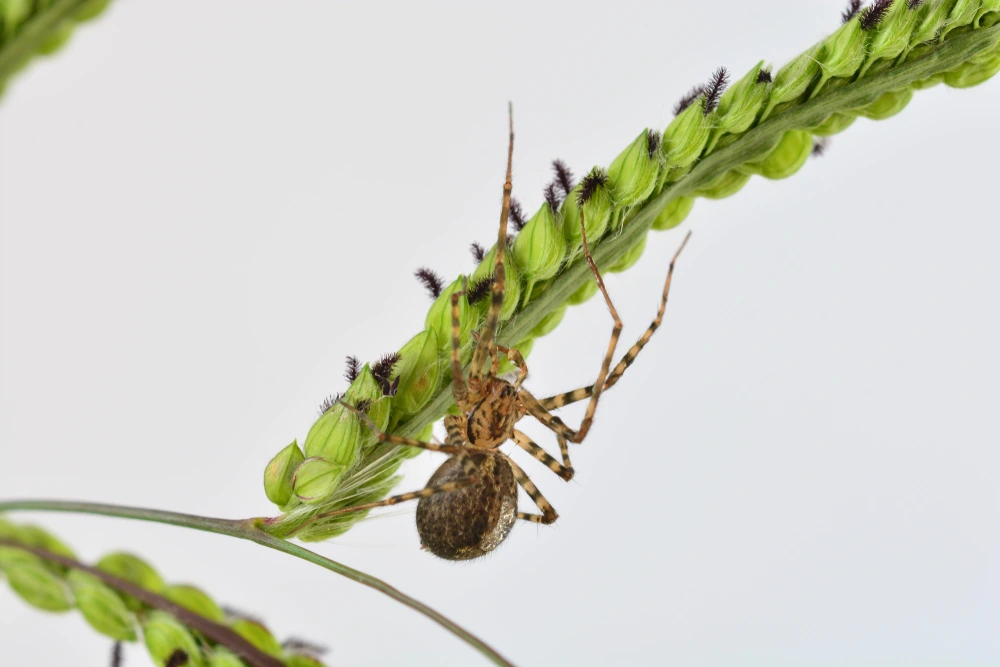
There are two broad layers. The older one is made of endemics that arrived long ago and then diverged in isolation, of which Nukuhiva adamsoni — named for the Marquesan island of Nuku Hiva — is the example on this page. Such species keep to native forest on the high volcanic islands and are almost never seen.
The newer layer is the one you actually meet. It is made of pantropical species that colonise ports and gardens everywhere in the tropics: the common house spider in verandas and storerooms, the flattened, fast-moving pantropical huntsman on walls at night, the hard-shelled double-spotted spiny spider Thelacantha brevispina in small wheel webs, and the long-legged long-bodied cellar spider in bathrooms and under eaves. Jumping spiders patrol sunlit woodwork and hibiscus leaves. That short cast covers the great majority of sightings across the islands.
Are any spiders in French Polynesia dangerous?
No native French Polynesian spider is medically significant. The territory has no recluse, no funnel-web, no wandering spider, and no native widow. That is a genuinely unusual situation, and it is worth stating plainly rather than hedging: a spider bite here is a painful nuisance, not a poisoning.

The one species worth knowing by name is the brown widow, Latrodectus geometricus, which is not native anywhere in the Pacific and has spread through the tropics with human trade. It is mottled tan to dark brown, with an orange or yellow hourglass underneath and a distinctive egg sac covered in silk spikes — that spiky sac is often the first clue. Brown widows build low tangle webs under garden furniture, plant pots, boat trailers and meter boxes. They are timid, and their venom generally produces pain and redness confined to the bite area rather than the body-wide cramping caused by black widows.
Everything else you can meet is harmless to people. Huntsman spiders look alarming because of their size and speed but have weak venom and prefer to run; cellar spiders can barely break skin; orb-weavers and jumping spiders are no threat at all. Our guide to the world's most venomous spiders puts the Pacific islands at the quiet end of the scale.
Bitten? Wash the bite with soap and water, apply a cold pack and keep the limb still. Photograph the spider if you can do so safely. Seek medical care at a dispensary or hospital if pain spreads beyond the bite, if sweating, nausea or muscle cramps follow, or for any bite on a small child. Do not cut, suck or burn the wound.
Where you meet spiders in the islands
Houses, fare and verandas
Open-sided living is the rule here, so the boundary between indoors and outdoors barely exists. Cellar spiders hang upside down in shower corners, tangle-web spiders take ceiling angles and the backs of cupboards, and the pantropical huntsman appears after dark on walls and mosquito screens, hunting the cockroaches and geckos' leftovers. Our house spiders guide covers this indoor group in detail; none of it needs a pest controller.
Gardens, plantations and hotel grounds
Hibiscus hedges, coconut and banana plantations and vanilla shade houses hold the wheel-web builders. Small orb webs strung between leaves at head height catch fruit flies and mosquitoes, and this is where the double-spotted spiny spider is easiest to find — a tiny, hard, shiny abdomen with blunt spines, sitting motionless in the hub.
Native forest and valleys
The wet interior valleys of the high islands, with their tree ferns and constant cloud, hold the endemic species — small, cryptic animals in leaf litter, moss and under bark. Several Pacific island spider lineages are squeezed by introduced ants and rats, a far more realistic worry here than anything involving venom.
Is there a spider season in French Polynesia?
Not in the way temperate countries have one. There is no cold season to shut the fauna down, so spiders breed through the year and numbers shift with rainfall rather than temperature. The hot, humid season from November to April brings a surge in insects and therefore in web-builders; the drier months from May to October are noticeably quieter.
Cyclone season has its own effect: a passing system strips webs from vegetation and buildings, and the rebuild in the following calm week can make gardens look suddenly full of spiders. Nothing has arrived; the same animals have started over.
Species often listed for French Polynesia that do not live here
Island spider lists circulate widely and pick up errors along the way. Three names on the original version of this page belong somewhere else entirely.
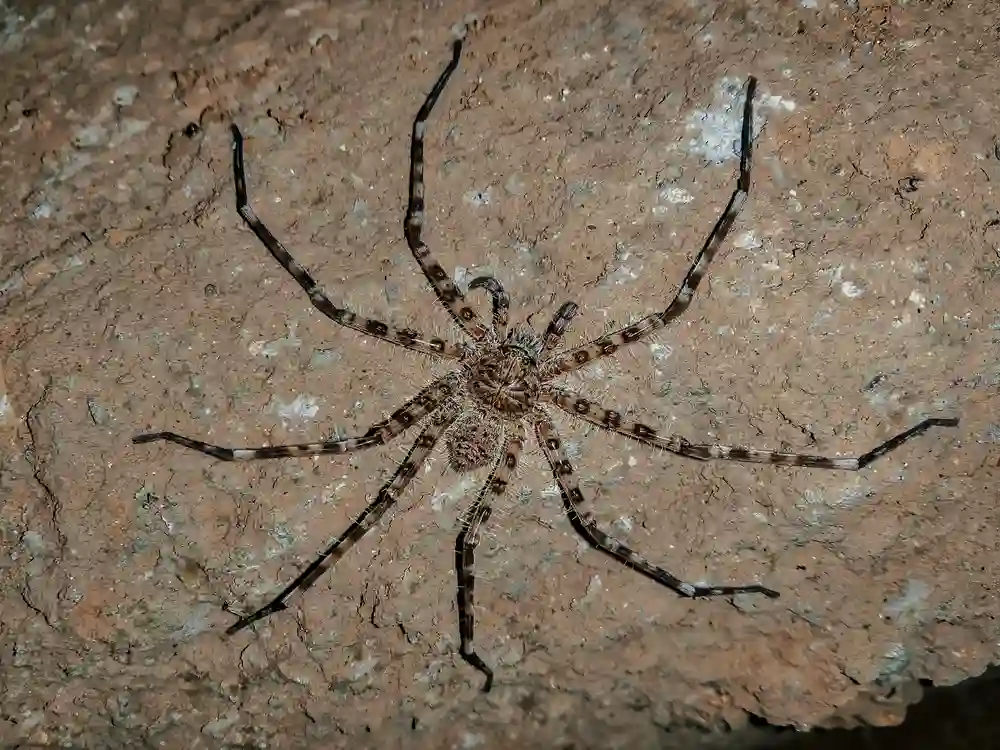
The giant huntsman, Heteropoda maxima, is known only from caves in Laos in mainland Southeast Asia. The huntsman you will actually meet in Tahiti is its far smaller relative, the pantropical huntsman. The cobalt blue tarantula is a burrowing species from Myanmar and Thailand — there are no native tarantulas anywhere in French Polynesia, and no theraphosid has established itself here. The red widow, Latrodectus bishopi, is endemic to the sand scrub of central and southern Florida and occurs nowhere else on earth.
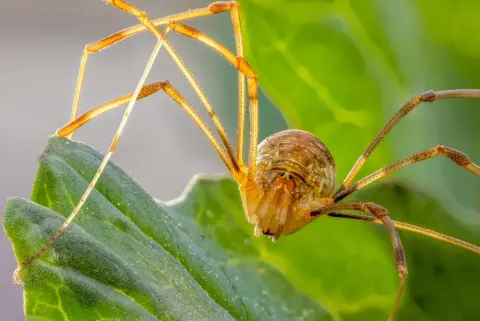
Two harmless animals also get reported as spiders: harvestmen, which have a single oval body, no silk and no venom glands, and whip scorpions, which have no venom either despite the pincers and the tail.
Common Spiders in French Polynesia
- Nukuhiva adamsoni
- Double spotted spiny spider (Thelacantha brevispina)
- Common House Spider (Parasteatoda tepidariorum)
Biggest Spiders in French Polynesia
- Pantropical Huntsman Spider (Heteropoda venatoria)
- Giant Huntsman Spider (Heteropoda maxima)
Most Venomous Spiders in French Polynesia
Cobweb Spiders/Tangle Web Spiders (Theridiidae)
 Cobweb SpidersBrown Widow (Latrodectus geometricus)Identify the brown widow (Latrodectus geometricus) by its orange hourglass and spiky egg sac, and learn how its bite compares with a black w
 Cobweb SpidersWidow (Latrodectus)A guide to the widow spiders (Latrodectus): how to identify the genus, the species you may meet, the gumfoot web, and how serious a widow bi
 Cobweb SpidersRed Widow (Latrodectus bishopi)Identify the red widow spider (Latrodectus bishopi): orange-red legs, spotted black abdomen, its Florida scrub palmetto webs, and how danger
Less Venomous Spiders in French Polynesia
Huntsman Spiders (Sparassidae Family)
Tarantulas
 Huntsman SpidersGiant Huntsman (Heteropoda maxima)Identify the giant huntsman spider (Heteropoda maxima): the world's longest leg span, its cave habitat in Laos, diet, and whether its bite i
 TarantulasCobalt Blue Tarantula (Cyriopagopus lividus)Identify the cobalt blue tarantula (Cyriopagopus lividus): iridescent blue legs, deep burrows in Myanmar and Thailand, and a bite that cause
Cellar Spiders
Living with spiders on the islands
In a climate this warm and wet, the spiders around a house are doing free mosquito control — no small thing where dengue and chikungunya circulate. Spraying clears a corner for a fortnight and achieves nothing else.
- Wear gloves when you move plant pots, stacked chairs, tarpaulins or boat gear that has sat still — that is exactly where a brown widow builds.
- Knock down the tangle under outdoor furniture rather than treating the whole terrace.
- Shake out shoes, towels and folded clothes left outside overnight.
- Move an indoor spider out with a glass and a card; a huntsman will usually walk onto a sheet of paper on its own.
For comparison with other Pacific island faunas, see our guides to the spiders of Fiji and Hawaii, which share many of the same travelling species — and our explainer on how a spider web is built, since almost everything you see here is a web rather than a spider.
Frequently asked questions
Are there dangerous spiders in French Polynesia?
No. French Polynesia has no native spider whose bite is medically significant, and no recluse, funnel-web or wandering spider. The only widow present is the introduced brown widow, whose bite usually causes localised pain and redness. A bite from any island spider is best treated as a painful nuisance rather than an emergency.
What is the biggest spider in French Polynesia?
The pantropical huntsman, Heteropoda venatoria, with a legspan of roughly eight to ten centimetres. It is flat, tan and very fast, and it hunts insects on walls after dark. Despite its size it has weak venom and runs from people. The giant huntsman sometimes listed for the islands lives only in Laos.
Are there tarantulas in French Polynesia?
No. There are no native tarantulas in French Polynesia and no theraphosid species has become established there. Lists that include the cobalt blue tarantula are repeating an error — that species burrows in the forests of Myanmar and Thailand. The largest spiders in the islands are huntsman spiders, which are not tarantulas.
What are the most common spiders in French Polynesia?
The common house spider, Parasteatoda tepidariorum, in verandas and storerooms; the long-bodied cellar spider in bathrooms; the pantropical huntsman on walls at night; the double-spotted spiny spider, Thelacantha brevispina, in small wheel webs in gardens; and various jumping spiders on sunlit woodwork. Endemic species such as Nukuhiva adamsoni stay in native forest.
Is the brown widow really in French Polynesia?
Yes, but as an introduction rather than a native. The brown widow has spread through the tropics with shipping and gardening. Look for a mottled tan spider in a low tangle web under garden furniture, plant pots or meter boxes, and for its unmistakable egg sac covered in silk spikes. It is shy and bites only when trapped.
Do huntsman spiders in French Polynesia bite?
Rarely, and only if pressed against skin. The pantropical huntsman would far rather sprint away than confront anything large. A bite feels like a sharp pinch and leaves redness that fades in a day or so. There is no necrosis, no systemic illness and no reason to treat it beyond washing it and using a cold pack.
Why does French Polynesia have so few spider species?
Because everything had to cross thousands of kilometres of open ocean to get there. Oceanic islands accumulate only species that can balloon on silk, raft on debris or travel with people, so the fauna is far smaller than a continental one of the same area, with a high proportion of endemics on the older high islands.
When are spiders most active in French Polynesia?
All year, with a clear peak in the hot, humid season from November to April, when insect numbers rise and webs are rebuilt nightly. The drier months from May to October are quieter. After a cyclone strips webs from gardens, the rebuilding week can make it look as though spiders have suddenly multiplied.
What should I do if a spider bites me in Tahiti?
Wash the site with soap and water, apply a cold pack and rest the limb. Photograph the spider if that is safe. Go to a dispensary or hospital if pain spreads beyond the bite, if cramping, sweating or vomiting follow, or for any bite on a young child. Do not cut, suck or burn the wound.
Published December 5, 2023 · Last updated September 14, 2026