
Spiders in Cambodia
Cambodia has no deadly spider. The country's fauna is typical of tropical Southeast Asia: giant golden orb-weavers spanning gaps between trees, huntsman spiders on house walls, burrowing tarantulas in dry forest soil, and jumping spiders everywhere in the sun. The only species of any medical interest is the introduced brown widow, and there is no established recluse.

On this page
- What spiders live in Cambodia?
- Are there dangerous spiders in Cambodia?
- Three species that do not belong on a Cambodia list
- A-ping: the tarantulas of Skuon
- Where you meet them
- Spider season and the monsoon
- Common Spiders in Cambodia
- Biggest Spiders in Cambodia
- Most Venomous Spiders
- Less Venomous Spiders in Cambodia
- Living with spiders in Cambodia
- Frequently asked questions
What spiders live in Cambodia?
Cambodia sits in the monsoon tropics, with dry dipterocarp forest across the plains, evergreen forest in the Cardamom and Dâmrei mountains, seasonally flooded forest around the Tonlé Sap and dense cultivation everywhere in between. Its spider fauna is the standard Southeast Asian set, shared with Thailand, Laos and Vietnam, and it is far better represented by what you see than by any species list.

In practice that means orb-weavers spanning wide gaps in forest and orchard, led by the giant golden orb-weaver, whose yellow silk is strong enough to stop a small bird. Spiny spiders of the genus Gasteracantha hang like enamelled shells in low webs, jumping spiders such as the grey wall jumper patrol sunlit masonry, huntsman spiders occupy walls and tree bark after dark, and burrowing tarantulas hold silk-lined tubes in the dry forest floor.
Are there dangerous spiders in Cambodia?
No Cambodian spider is known to have killed anyone, and none is medically significant in the way that recluses, widows or wandering spiders are elsewhere. The only species worth knowing is the brown widow, Latrodectus geometricus, an introduced tropical cobweb spider now widespread in Southeast Asian towns, which tangles its web under garden furniture, in meter boxes and along fence rails. Its bite gives local pain, redness and a cramping ache that usually settles in a day or two. There is no established recluse population in Cambodia, so slow-healing sores here are infections rather than spider bites.

Tarantulas are the other common worry, and it is misplaced. Asian burrowing theraphosids, including the zebra-leg tarantula, can be defensive and have large fangs, so a bite hurts mechanically and may produce hours of throbbing pain, swelling and occasional muscle cramps. That is not the same as dangerous: no Asian tarantula has caused a documented human death and no antivenom is needed. Huntsman spiders, orb-weavers and jumping spiders are all harmless, and nothing on our most venomous spiders shortlist lives here.
Bitten? Wash with soap and water, apply a cold pack and take a simple painkiller. Photograph the spider if you safely can. Seek medical care for a bite on a small child, for spreading cramps, sweating or vomiting, or if the wound becomes hot, swollen and weeping after two days, which points to bacterial infection rather than venom.
Three species that do not belong on a Cambodia list
The older version of this page, like most others, mixes in animals from other continents. The Goliath birdeater is South American, restricted to the Guiana shield and the northern Amazon; it has never lived in Asia. The grey cross spider is a Holarctic orb-weaver of European and North American bridges and waterside railings, not a tropical species. The giant huntsman, Heteropoda maxima, is genuinely the largest spider in the world by legspan, but it was described from cave entrances in Khammouane in Laos and is known from that limestone region rather than from Cambodia; the huntsman people actually meet here is the widespread pantropical species Heteropoda venatoria.

One more correction matters more than the others. The two-striped jumping spider Telamonia dimidiata, listed by many sites among Cambodia's most venomous spiders, owes that reputation entirely to a chain email from 1999 claiming a deadly spider lurked under aircraft and restaurant toilet seats. The story was invented. The spider is a small, harmless, brightly marked jumper of vegetation and house walls.
A-ping: the tarantulas of Skuon
Cambodia is one of the few countries where the best-known spider is a food. In Skuon, on the road between Phnom Penh and Kampong Cham, fried tarantulas called a-ping are sold by the basket at the roadside. The species is the zebra-leg tarantula, a stocky brown burrower with pale bands on the legs, dug out of sandy forest soil, then marinated with garlic, salt and sugar and deep fried until the abdomen is crisp.
The trade is usually said to have grown during the food shortages of the Khmer Rouge years and to have persisted as a delicacy and a tourist draw. It carries a conservation cost: collectors report travelling further each year, and deforestation has removed much of the sandy dry-forest habitat the spiders need.
Where you meet them
In and around buildings
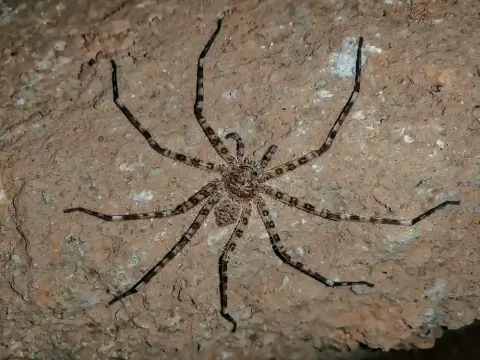
Huntsman spiders are the flat, fast, long-legged spiders on bedroom walls at night, and they are welcome residents that hunt cockroaches; they run rather than fight. Daddy-long-legs cellar spiders hold bathroom corners, small cobweb spiders take ceiling angles, and jumping spiders work sunlit window frames and verandas. Our house spiders guide covers the same indoor cast worldwide.
Gardens, paddy and orchard
Field margins and orchards carry the heaviest web traffic, with golden orb-weavers strung between trees, spiny spiders in low shrubs and lynx spiders hunting on foliage. Rice paddy is important spider habitat in its own right: wolf spiders and lynx spiders there are significant predators of planthoppers and stem borers, which is why Cambodian integrated pest management encourages leaving them alone.
Forest and temple ruins
Evergreen forest and the stonework at Angkor hold the richest fauna, including big orb webs across gaps, burrowing tarantulas in dry sandy ground, and the hermit spiders that build a web against a trunk with a retreat inside a curled leaf.
Spider season and the monsoon
Cambodia is warm all year, so spiders breed continuously and nothing overwinters. The wet season from roughly May to October drives the cycle: insect numbers explode, webs get larger, and orb-weavers reach full adult size in the second half of it, which is when the giant golden orb webs across forest paths are most impressive.
The dry season from November to April thins the vegetation and concentrates spiders around irrigated gardens, water tanks and lit verandas where insects still gather. Heavy rain also produces short pulses of indoor sightings as ground-living spiders and tarantulas are flooded out of burrows and leaf litter for a few days.
Common Spiders in Cambodia
- Banded Phintella (Phintella vittate)
- Common Housefly Catcher (Plexippus petersi)
- Black and White Spiny Spider (Gasteracantha kuhli)
- Multi-colored Phintella (Phintelloides versicolor)
- Hasselt’s Spiny Spider (Macracantha hasselti)
- Abandoned-web Orb-Weaver (Parawixia dehaani)
- Long-horned Orb Weaver (Macracantha arcuate)
- Asian Hermit Spider (Nephilengys malabarensis)
Biggest Spiders in Cambodia
- Thai Zebra Leg Tarantula (Haplopelma albostriatum)
- Goliath Bird Eating Tarantula (Theraphosa blondi)
- Pantropical Huntsman Spider (Heteropoda venatoria)
- Giant Huntsman Spider (Heteropoda maxima)
- Giant Golden Orb Weaver (Nephila pilipes)
Most Venomous Spiders
- Thailand Black Tarantula - Cyriopagopus minax
- Two-striped Telamonia Spiders - Telamonia dimidiate
Less Venomous Spiders in Cambodia
Tarantulas
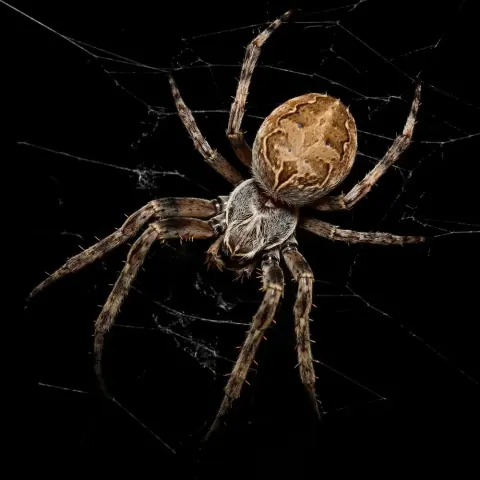 Orb WeaversGray Cross Spider (Larinioides sclopetarius)Identify the gray cross spider or bridge spider (Larinioides sclopetarius): size, silver-edged pattern, its lamp-lit webs on steel bridges,
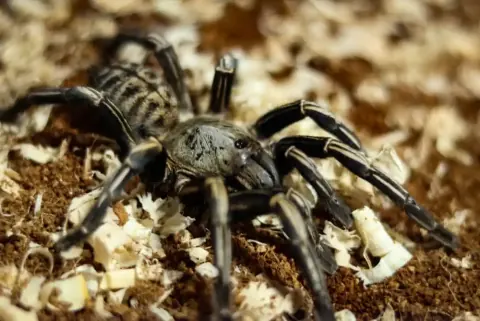 TarantulasThailand Zebra Leg Tarantula (Cyriopagopus albostriatus)Identify the Thailand zebra leg tarantula (Cyriopagopus albostriatus): striped legs, burrow life in Thailand and Cambodia, and its painful O
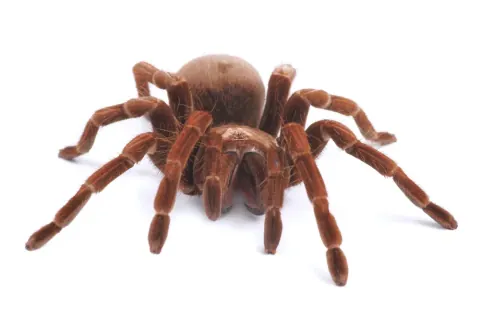 TarantulasGoliath Birdeater (Theraphosa blondi)Identify the Goliath birdeater (Theraphosa blondi): true size and weight, urticating hairs, burrow, range in the Guianas, and how bad its bi
Jumping Spiders

Orb Weavers

Huntsman Spiders (Sparassidae Family)
Living with spiders in Cambodia
The spiders sharing a Cambodian house are unpaid mosquito and cockroach control, which is worth more here than almost anywhere. Removing them does nothing lasting while the insects remain, and the huntsman on the bedroom wall is the single most useful animal in the building.
- Wear gloves and closed shoes when moving firewood, bricks, stacked timber and garden pots, where brown widows shelter.
- Shake out shoes, bags and clothing left on the floor overnight, especially in rural housing.
- Never reach blind into a burrow or a hole in dry forest soil; use a stick if you need to look.
- Brush webs off window frames and furniture undersides rather than spraying insecticide indoors.
- Leave garden and orchard webs alone; in paddy and orchard, spiders are a working part of pest control.
For the surrounding region see our guides to Thailand and Vietnam, and to understand how those huge trailside webs are engineered, read how spider webs work.
Frequently asked questions
Are there dangerously venomous spiders in Cambodia?
No. Cambodia has no spider with venom that threatens a healthy person, and no local antivenom is needed or produced. The introduced brown widow can give a painful bite with a cramping ache that settles within a day or two, and tarantula bites hurt mechanically, but neither is life-threatening.
Is the giant huntsman spider found in Cambodia?
Not as far as records show. Heteropoda maxima, the world's largest spider by legspan, was described from cave entrances in Khammouane province in Laos and is known from that limestone region. The huntsman you meet in Cambodian houses is the widespread pantropical Heteropoda venatoria, a large but harmless wall hunter.
Do Goliath birdeaters live in Cambodia?
No. The Goliath birdeater is a South American tarantula found in the Guiana shield and the northern Amazon, and it occurs nowhere in Asia. Cambodia's large tarantulas are burrowing Asian species, chiefly the zebra-leg tarantula, which is much smaller and lives in silk-lined tubes in sandy dry-forest soil.
What is the biggest spider in Cambodia?
The giant golden orb-weaver has the largest body of any Cambodian spider, with females several centimetres long hanging in webs that can span the gap between trees. Huntsman spiders have the widest legspan you are likely to see indoors. Both are harmless, and neither approaches the dimensions claimed by most lists.
Can you eat tarantulas in Cambodia?
Yes. Fried tarantulas, known as a-ping, are a speciality of Skuon between Phnom Penh and Kampong Cham. The species used is the zebra-leg tarantula, marinated with garlic, salt and sugar and deep fried. The trade is under pressure from over-collection and loss of the sandy dry forest where the spiders burrow.
How do I identify a zebra-leg tarantula?
Look for a stocky, dark greyish-brown tarantula with pale bands across the leg segments, usually at the mouth of a silk-lined burrow in bare sandy soil. It is a ground dweller rather than a climber, and it is most often seen after heavy rain floods the burrows or when collectors dig them out.
Is the two-striped Telamonia spider deadly?
No, and the story is a hoax. A chain email circulated from 1999 claimed a deadly Telamonia spider hid under aircraft and restaurant toilet seats. It was fabricated. Telamonia dimidiata is a small, harmless, brightly marked jumping spider of vegetation and walls, with fangs far too small to matter to a person.
Are jumping spiders in Cambodia harmful?
No. Jumping spiders carry venom for their insect prey, but it has no significance for people and their fangs are tiny. Bites are rare and amount to a brief itch. They are among the most watchable spiders in the country, hunting by sight on sunlit walls and leaves rather than building webs.
Where do orb-weaver spiders build webs in Cambodia?
In gardens, orchards, paddy margins, forest clearings and around temple ruins, wherever there is a gap for a web and flying insects to cross it. Giant golden orb-weavers span the widest openings between trees, while spiny spiders build small webs in low shrubs and hedges near houses.
Which spiders live in Cambodian houses?
Huntsman spiders on walls and ceilings, cellar spiders in bathroom corners, small cobweb spiders in ceiling angles and jumping spiders on sunlit window frames. All are harmless and all live on the insects already in the building. The huntsman in particular is an effective cockroach predator worth leaving in place.
Published December 6, 2023 · Last updated September 14, 2026