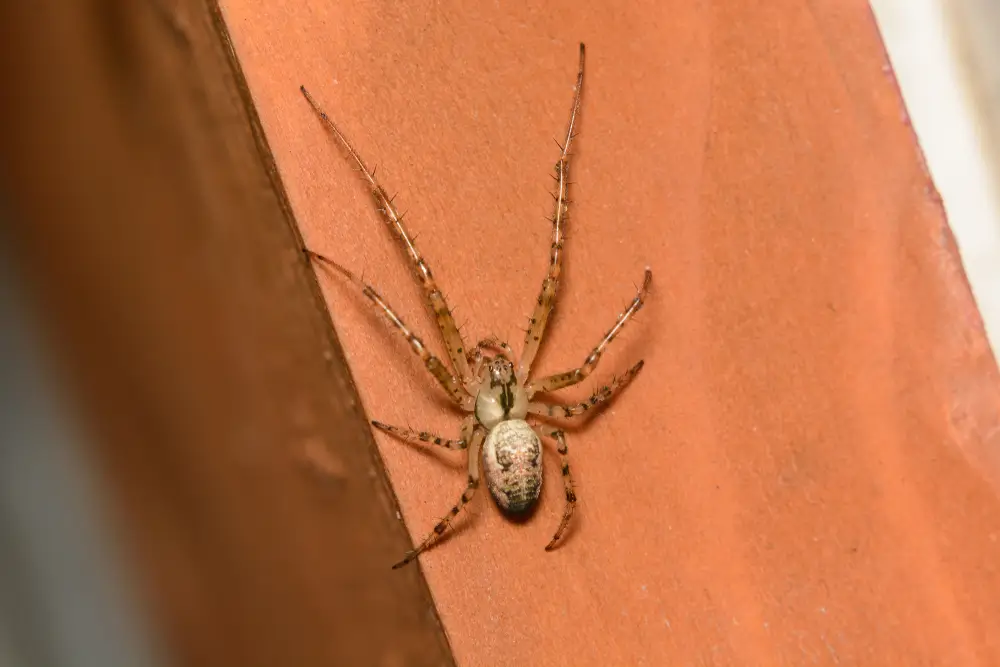
Giant Wood Spider (Nephila pilipes)
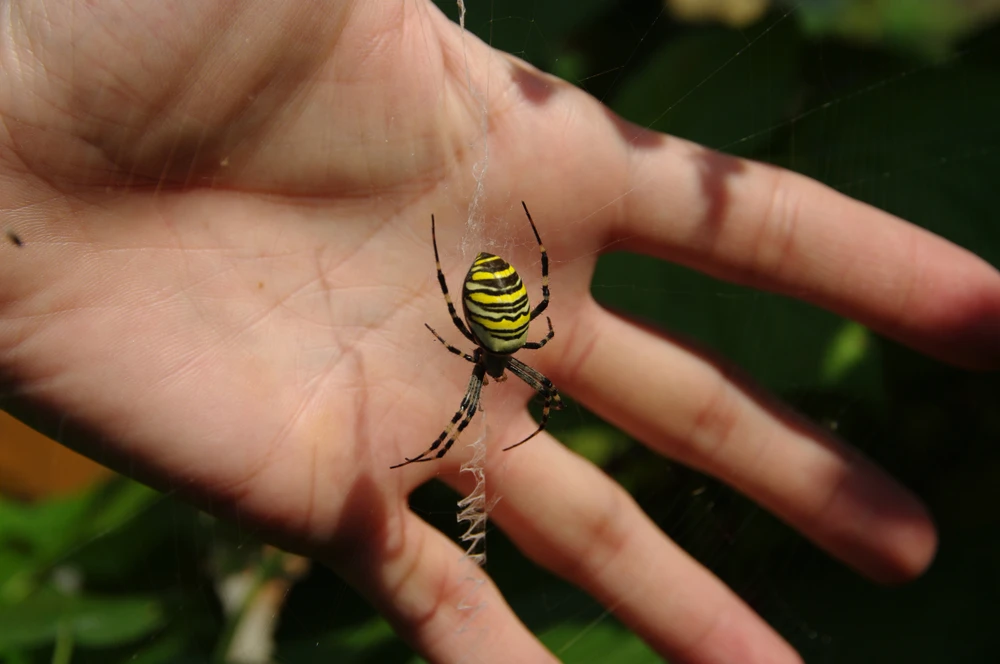
The giant wood spider is the largest of the true golden orb-weavers and one of the biggest web-building spiders on earth. A mature female can span a dinner plate with her legs and hangs in a golden web strung between trees, while the males sharing that web are barely the size of a grain of rice. For all her size she is slow, shy and harmless to people.
 By Dr Richard J. Pearce (PhD)Published May 20, 2019Updated September 13, 2026✓ Reviewed by Dr. James Watuwa
In this guide
Physical description and identification
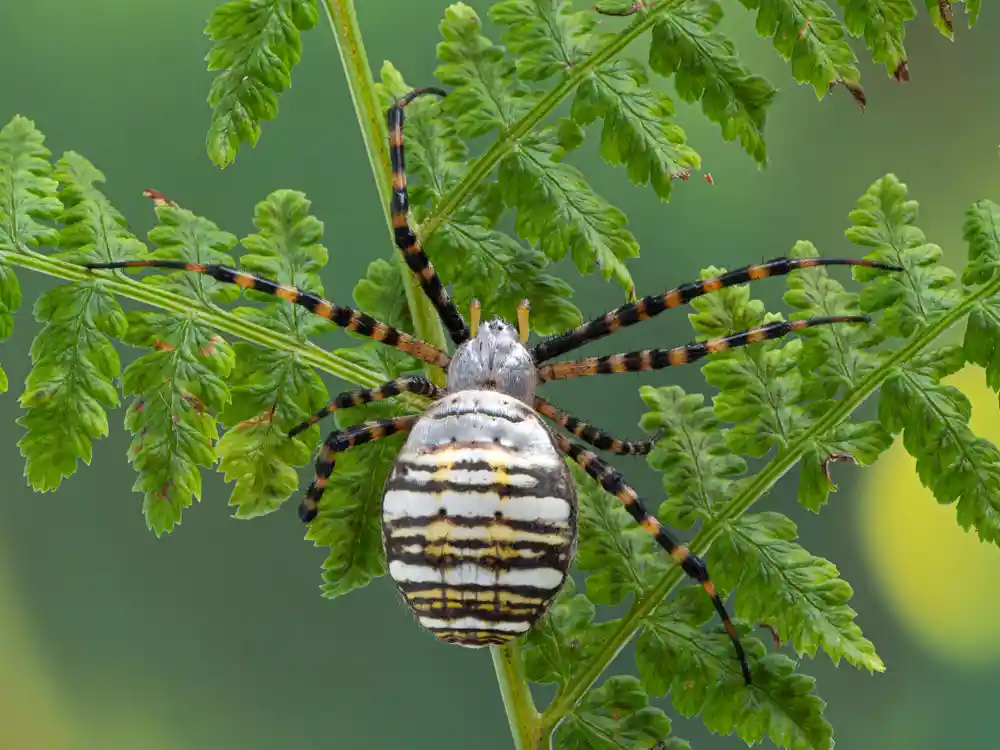
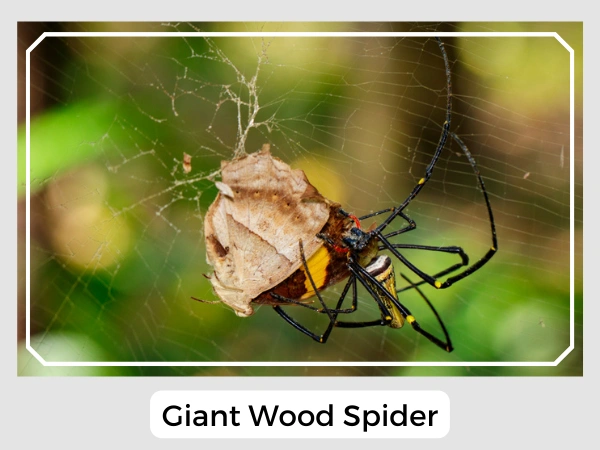
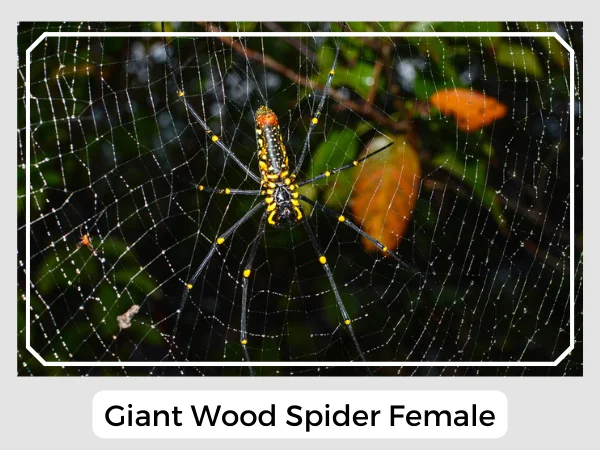
Almost nothing else in a Southeast Asian forest looks like an adult female Nephila pilipes. She hangs head-down in a wide yellow orb, her body longer than a thumbnail and her banded black-and-yellow legs stretched far beyond it. She is the type species of the genus Nephila and the largest golden orb-weaver, a group that sits inside the orb-weaver family as the subfamily Nephilinae.
Adults
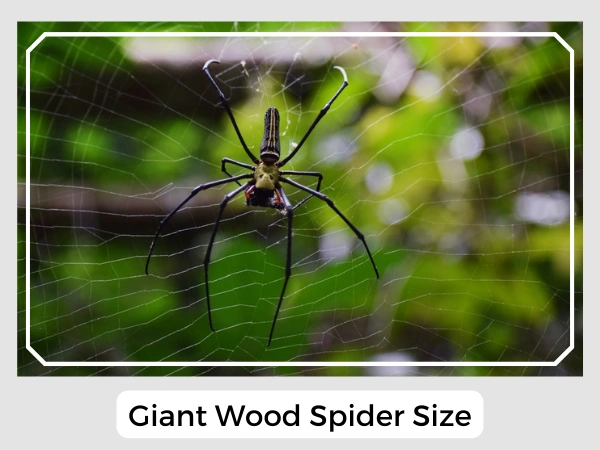
- Size: the sexes differ enormously. Female body length runs from roughly 30 mm to 50 mm, with a leg span that regularly reaches 12–20 cm. Males mature at only 5–6 mm and weigh a tiny fraction of what an adult female weighs.
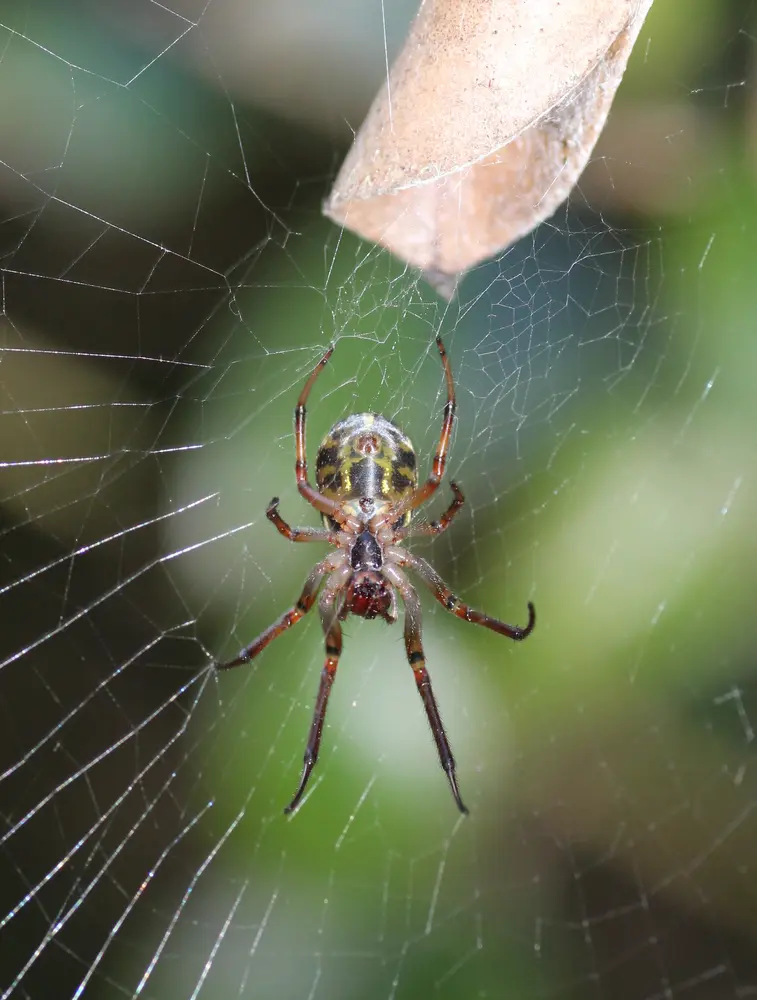
- Colour: the female's carapace is dark and covered in fine silvery-white hairs. Her long abdomen is mostly black or deep olive with paired yellow to cream blotches along the sides, and the underside carries a bold black pattern with red or yellow markings. The legs are black with vivid yellow or orange bands at the joints. Males are plain reddish brown with no banding.
- Eyes: eight small eyes in two rows of four, the side pairs set close together on low tubercles. None are enlarged; this spider works almost entirely by touch and vibration.
- Distinctive features: the abdomen is elongated and cylindrical rather than round, which separates Nephila from almost every other large orb-weaver. Mature females lose the juvenile leg hair, leaving a smooth, glossy, obviously banded leg.
Eggs and egg sac
The egg sac is not hung in the web. The female comes down to the ground near her supporting tree, digs a shallow pit, deposits a silk-wrapped mass of several hundred to a couple of thousand eggs, then covers it with soil, leaf litter and camouflaging silk. Burying the sac hides it from ants and parasitoid wasps. Females usually lay once at the end of their lives and die soon afterwards.
Spiderlings
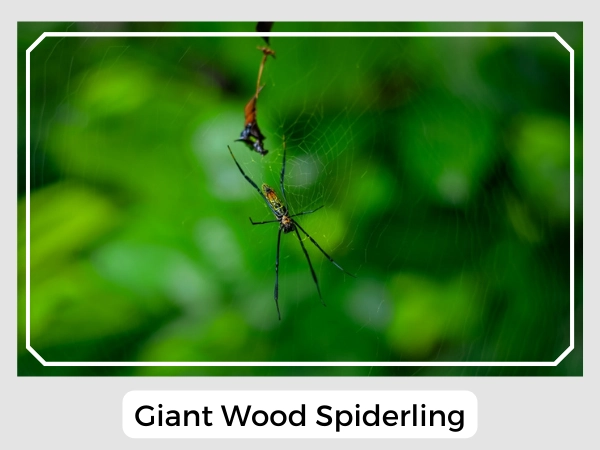
Hatchlings are pale and stay bunched together briefly before dispersing on silk lines. Juveniles of both sexes carry conspicuous brushes of dark hair on the first, second and fourth pairs of legs; the third pair lacks them. Those brushes are lost as a female matures, so a hairy-legged juvenile and a smooth-legged adult can look like two different spiders. Females pass through many more molts than males before maturing, which is the real reason for the size gap — contrary to a widespread claim, neither sex keeps molting once adult.
The web
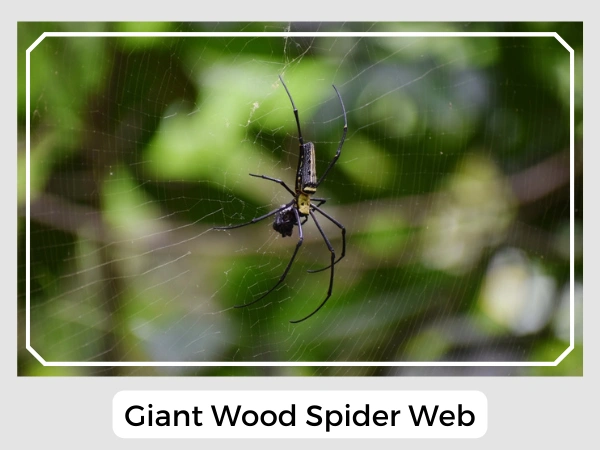
The orb is a fine-meshed golden wheel commonly 50 cm to 1 m across, hung from bridge lines that may run several metres between trees and often tilted slightly from vertical. In front of and behind it hang loose curtains of tangled barrier silk that stop birds flying through and knock insects into the trap. The silk is genuinely yellow, coloured by pigments the spider adds as she spins, and the frame lines are strong enough to be felt as a tug across the face. Unlike most orb webs, this one is semi-permanent: the female repairs sections rather than rebuilding nightly, so a single web may stay up for weeks or even months — not for years, as is sometimes claimed, since the spider lives only about a year.
Where the giant wood spider lives
Nephila pilipes is an Old World species with one of the widest ranges of any large orb-weaver. It occurs from India, Nepal, Sri Lanka and Myanmar eastwards through Thailand, Laos, Cambodia, Vietnam, southern China, Taiwan and southern Japan, south through Malaysia, Singapore, the Philippines and Indonesia to Papua New Guinea and the tropical north and east coasts of Australia.
Across that range the habitat requirement is consistent: a warm, humid, lightly wooded place with gaps wide enough to bridge. Primary and secondary rainforest, forest edges, clearings, river margins, mangroves, plantations, wasteland scrub and large gardens all suit it. Webs go up across footpaths, between trees, along fence lines and under the eaves of buildings at the forest edge, usually one to four metres above the ground. It is a lowland spider, scarce in cool uplands and absent from open desert.
Are giant wood spiders venomous?
Yes, in the sense that nearly every spider is venomous: Nephila pilipes uses venom to subdue the large flying insects that hit a web this size. The venom is not medically significant to humans or pets: it is tuned to insect nervous systems, delivered in small amounts, and has never been associated with tissue damage, systemic illness or a death. There is no antivenom because none is needed.
Size is not danger. A spider this large looks alarming, but the genuinely dangerous spiders of the region are quite different animals — the Australian funnel-webs are stocky ground spiders that build no orb, and the widow spiders are small and glossy with a tangled web. A giant orb strung between trees is the signature of a harmless spider.
Can giant wood spiders bite?
They can, but bites are genuinely rare. A female's first response to disturbance is to shake the web violently, then drop out of it on a dragline; she bites only when pinched or pressed against skin, which usually means somebody has walked into the web and grabbed at it. Her fangs are large enough to break skin easily, so the puncture itself is felt.
A bite produces sharp but short-lived pain often compared to a bee sting, with local redness and mild swelling that fade within a day. Blistering, numbness and nausea are not expected. Wash the site with soap and water, apply a cold pack and take a simple painkiller if needed. Seek medical advice if pain worsens after the first day, if redness spreads, or if there is breathing difficulty or faintness — that would be an allergic reaction of the person rather than an effect of the venom. Do not cut, suck or burn the bite, and keep a photograph of the spider if you can.
Ecological importance and behavior of the giant wood spider
A giant wood spider's web is a standing trap that works day and night. The female stays at the hub, reading tension in the radial lines to locate anything that lands. Large or dangerous prey is wrapped in silk before it is bitten; small items are bitten first. The diet is overwhelmingly flying insects — flies, bees, wasps, moths, beetles, grasshoppers and large cicadas — and one web removes hundreds of them in a season.
The exceptional catches: because the frame silk is so tough, small birds and bats are occasionally found entangled. Such cases are documented but unusual, and the spider often cannot subdue a struggling vertebrate at all.
Males and freeloaders: mature males stop building webs and live as tenants at the edge of a female's orb, approaching her while she is feeding or molting to reduce the risk of being eaten. Kleptoparasitic dewdrop spiders (Argyrodes) live in the barrier silk and steal wrapped prey; a large female may support a dozen uninvited guests.
Natural predators: birds, lizards, monkeys and spider-hunting wasps take adults, ants and parasitoids raid buried egg sacs, and in parts of Asia predatory damselflies pluck small spiders out of orb webs. Juveniles are far more vulnerable than adult females, whose size and bold colouring deter many attackers.
Relationship with humans: almost entirely positive. The species removes huge numbers of flying insects and never colonises the inside of a house. In Bình Thuận Province in Vietnam the Raglai people roast and eat the spiders. If a web blocks a doorway, lift the female onto a stick and move her to a nearby shrub instead of killing her.
Similar spiders and how to tell them apart
| Spider | How it differs from the giant wood spider |
|---|---|
| Golden silk orb-weavers (Nephila generally) | Same genus and same golden web, but no other species reaches this size, and most lack the bold yellow blotches on a black abdomen. |
| Golden silk spider of the Americas (Trichonephila clavipes) | A New World relative, orange-brown rather than black and yellow, with very obvious dark hair tufts retained on the adult female's legs. |
| Joro spider (Trichonephila clavata) | East Asian and much smaller, with a yellow and blue-grey banded abdomen and a red patch underneath. Its web is a fraction of the size. |
| Darwin's bark spider | A small body on colossal bridge lines spun across rivers. The silk is exceptionally tough but not golden, and the spider is nowhere near this size. |
| Argiope garden spiders | Also head-down in a large orb, but the abdomen is broad and oval, the silk is white, and the web usually carries a zigzag or cross-shaped decoration. |
Quick facts
| Other names | Northern golden orb weaver, giant golden orb-weaver, batik golden web spider; formerly published as Nephila maculata |
|---|---|
| Distribution | South and Southeast Asia from India to southern Japan, through Indonesia and New Guinea to northern and eastern Australia |
| Habitat | Primary and secondary forest, forest edges and clearings, mangroves, plantations, wasteland and gardens |
| Diet | Flying insects — flies, bees, wasps, moths, beetles, grasshoppers and large cicadas; very rarely small vertebrates |
| Predators | Birds, lizards, monkeys, spider-hunting wasps, damselflies and ants at the egg sac |
| Web | Semi-permanent golden orb 50 cm to 1 m across with barrier curtains; repaired rather than rebuilt |
| Lifespan | About twelve months; males die within weeks of their final molt |
| IUCN status | Not evaluated; widespread and locally common |
Did you know?
- Nephila pilipes is the type species of the genus — the reference point against which every other Nephila is compared.
- Several subspecies have been named, among them N. p. hasselti from Java and N. p. lauterbachi from New Guinea, though their status is debated.
- Juveniles build a line of insect husks and plant debris across the hub. Experiments show these decorations lower the chance of a wasp attack by breaking up the spider's outline.
- The bright yellow-and-black colouring is not an accident: field experiments indicate it works as a visual lure for insects while also deterring larger animals.
- Golden orb silk absorbs more energy before breaking than steel of the same weight, which is why it has been studied for sutures and nerve-repair scaffolds — and why Pacific islanders once stretched these webs over bent frames to make fishing nets.
In summary, the giant wood spider is spectacular but completely harmless. Learn the cylindrical black-and-yellow abdomen, the banded black legs and the semi-permanent golden orb, and you will recognise it for what it is: a superb insect trap with no interest in you.
Frequently asked questions about the giant wood spider
How big does a female giant wood spider get?
Female giant wood spiders reach a body length of about 30 to 50 millimetres, with a leg span that commonly spans 12 to 20 centimetres, so a large one covers an adult hand. Males mature at only 5 to 6 millimetres, which makes this one of the most extreme size gaps between the sexes in any animal.
What does a giant wood spider look like?
Look for a long, cylindrical abdomen, black or deep olive with paired yellow blotches, a dark carapace covered in silvery hairs, and long black legs with bright yellow or orange bands at the joints. Males are plain reddish brown, tiny, and usually sit at the edge of the female's web.
Is the giant wood spider venomous to humans?
It is venomous in the sense that it uses venom on insect prey, but the venom is not medically significant to people or pets. No tissue damage, systemic illness or death has been linked to this species, and no antivenom exists because none is needed.
What happens if a giant wood spider bites you?
Expect sharp but brief pain similar to a bee sting, with local redness and mild swelling that settle within a day. Wash with soap and water and apply a cold pack. Seek medical advice only if pain worsens after the first day, redness spreads, or you feel faint or short of breath.
Where do giant wood spiders lay their eggs?
Not in the web. The female descends to the ground near her supporting tree, digs a shallow pit, places a silk-wrapped egg mass of several hundred to a couple of thousand eggs in it, then covers the pit with soil, leaf litter and silk. Burying the sac hides it from ants and parasitoid wasps.
Why are male giant wood spiders so much smaller than females?
Because females pass through many more molts before maturing than males do. A male stops growing after a handful of instars and matures early to start searching for mates, while a female keeps molting for months. Neither sex continues to molt once adult, despite a commonly repeated claim that females do.
How long does a giant wood spider's web last?
Much longer than a typical orb web. Instead of rebuilding every night, the female repairs sections, so one web can stay in place for weeks or several months. Claims that a single web lasts a couple of years are wrong: the spider itself lives only about twelve months.
Why is the silk yellow?
The female adds yellow pigments to the silk as she spins it. In sunlit gaps the gold appears to attract bees and other insects that are drawn to yellow flowers, while in shade paler silk stays inconspicuous. Studies on golden orb-weavers show they adjust the pigment to suit the light available.
Do giant wood spiders really catch birds?
Occasionally, but it is not their diet. The frame silk is tough enough that a small bird or bat sometimes becomes entangled, and such cases are documented. The spider frequently cannot subdue a struggling vertebrate, and almost all of its food is flying insects such as flies, bees, moths and cicadas.
Should I remove a giant wood spider web from my garden?
There is no need. The spider removes large numbers of flying insects, will not come indoors and is not aggressive. If a web blocks a path or doorway, lift the female onto a stick and move her to a nearby shrub; she will usually have a new web up within a day or two.
References
- World Spider Catalog (2026). Nephila pilipes (Fabricius, 1793). Natural History Museum Bern. wsc.nmbe.ch/spec-data/29076/taxon