
Spiders in Netherlands
The Netherlands has several hundred spider species and not one of them is medically significant: there are no widows, no established recluses and no funnel-webs. The spiders people actually report are the giant house spider that sprints across the floor in September, the false widows that get mistaken for something worse, and the big cross orb weavers that hang their webs across every garden path in autumn.

On this page
- What spiders live in the Netherlands?
- Is any Dutch spider dangerous?
- The spiders in Dutch houses
- Gardens, dunes and polder wetlands
- Why Dutch houses fill with spiders in autumn
- Names people get wrong
- Common Spiders in Netherlands
- Biggest Spiders in Netherlands
- Most Venomous Spiders in the Netherlands
- Less Venomous Spiders in the Netherlands
- Living with spiders in the Netherlands
- Frequently asked questions
What spiders live in the Netherlands?
The Netherlands is small, flat and almost entirely managed, and its spider fauna reflects that. Several hundred species have been recorded, nearly all of them from families that run right across northern Europe: sheet-web weavers in every lawn, orb-weavers in gardens and reed beds, funnel weavers in sheds and cellars, crab spiders waiting in flowers and jumping spiders hunting on sunlit brickwork. What the country lacks is more interesting than what it has: no widow spiders, no established recluses, no funnel-webs and nothing whose venom threatens a healthy adult.
Four habitats do most of the work. The coastal dunes from Zeeland to the Wadden islands hold warmth-loving hunters scarce inland. Peat bogs, fens and polder ditches carry raft spiders of the genus Dolomedes, heavy-bodied animals that hunt at the water surface. Woodland and hedgerow hold the orb webs and the bark-dwelling species. And the buildings themselves hold the big, fast, long-legged residents of sheds, cellars and garages that most people mean when they say Dutch spiders.
Is any Dutch spider dangerous?
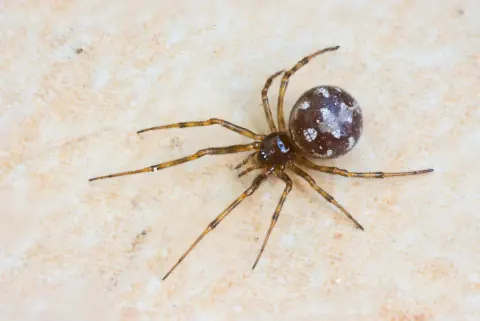
No. There is no spider in the Netherlands whose bite is life-threatening, and Dutch hospitals hold no spider antivenom because none is needed. The species most often labelled the venomous one are the false widows, and the label misleads. Steatoda nobilis, the noble false widow, has spread north through Europe and turns up in Dutch towns; Steatoda grossa, the cupboard false widow, has been here far longer; and the small triangulate cobweb spider is a harmless house resident with zigzag markings. All three belong to the cobweb spider family and are relatives of the true widow spiders, but relatives is where it ends: a Steatoda bite gives local pain like a wasp sting, some swelling and occasionally a few hours of feeling unwell, not the muscle cramping and hospital admissions of real latrodectism.
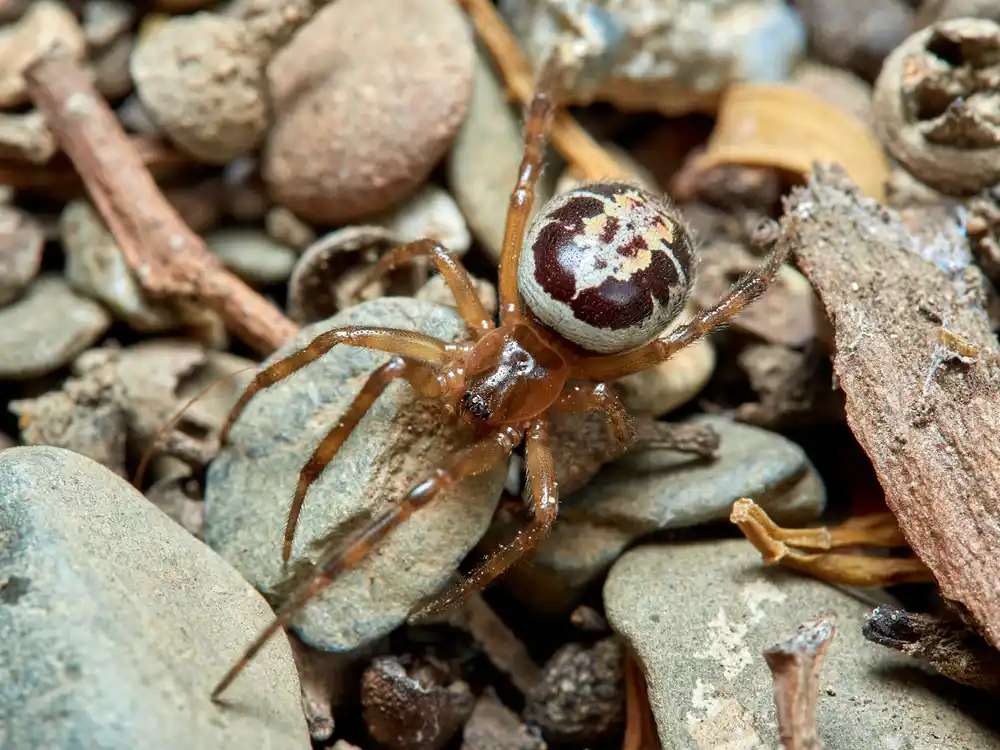
Two other names cause unnecessary alarm. The Mediterranean spiny false wolf spider, Zoropsis spinimana, is a southern European incomer now recorded in Dutch buildings; despite its English name it is not a wolf spider but a member of the family Zoropsidae, and its bite is no worse than a nettle sting. And the giant house spider is big and fast but reluctant to bite anything larger than a woodlouse.
Bitten? Wash with soap and water, apply a cold pack and take a painkiller if you need one. Do not cut, suck or disinfect with spirits. A Dutch spider bite needs a huisarts only if the wound turns hot, red and spreading after a day or two, which means bacterial infection rather than venom, or if you develop widespread hives or breathing difficulty.
The spiders in Dutch houses
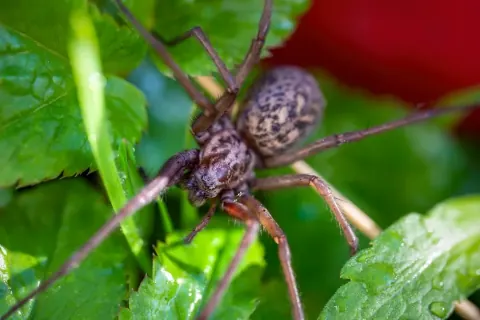
The giant house spider, Eratigena atrica, is the animal behind most autumn phone calls. It is a dark brown funnel weaver with a body of roughly 12 to 18 mm and a leg span reaching about 6 to 7.5 cm in a large male, impressive but well short of the ten centimetres often quoted. It builds a flat sheet with a tubular retreat behind a cupboard or under a shed, and the individuals that sprint across the living-room floor in September are wandering males looking for females.

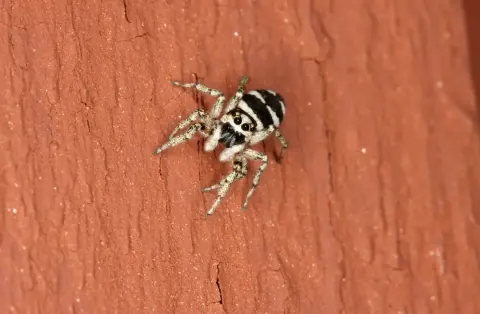
Sharing the building are the long-bodied cellar spider, the pale spindly animal that hangs upside down in bathroom corners and vibrates its web when disturbed, and the missing sector orb weaver, Zygiella x-notata, whose window-frame web has one obvious empty wedge with a signal thread running to a hidden retreat. The zebra jumping spider, black and white and barely six millimetres long, patrols sunny walls and window sills and is the easiest Dutch spider to watch at close range. Our house spiders guide covers the same cast.
Gardens, dunes and polder wetlands
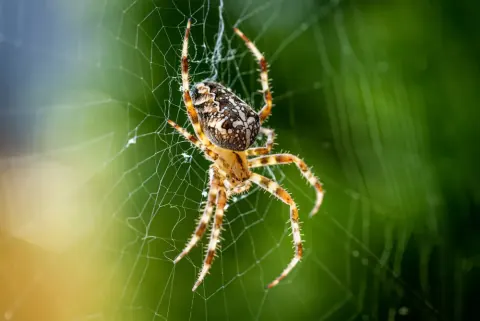
The cross orb weaver, Araneus diadematus, is the classic Dutch garden spider: a plump animal with a pale cross of dots on the abdomen, sitting head-down in a fresh orb web every morning from August onwards. Related orb-weavers nearby include the four-spot orb weaver Araneus quadratus in rough grassland and the walnut orb weaver Nuctenea umbratica, a flat glossy species that spends the day jammed under loose bark or fence rails.

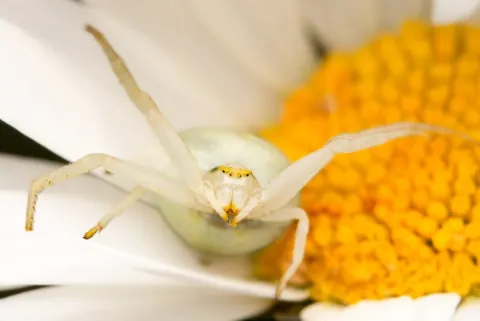
In flowering borders and dune grassland the goldenrod crab spider, Misumena vatia, sits motionless in a flower head and slowly changes between white and yellow to match it, ambushing bees far larger than itself. The wasp spider, Argiope bruennichi, has colonised the country in recent decades and is now familiar in tall grass, with a banded yellow and black abdomen and a thick zigzag ribbon in its web.
Why Dutch houses fill with spiders in autumn
Dutch spiders are not moving indoors to escape the cold, which is the usual explanation and the wrong one. House spiders live indoors all year and simply become visible in late summer, when newly mature males abandon their webs and walk around looking for females. That season runs from late August to October and is why every September brings another wave of giant house spider sightings.
Outdoors the same months are peak orb-web season: females that hatched in spring reach full size, their webs stretch across garden paths and canal railings, and egg sacs are hidden in bark crevices before the adults die in the first hard frosts. Our guide to where spiders go in the winter explains what happens next.
Names people get wrong
Three mix-ups are worth correcting. The animal Dutch people call a hooiwagen, and English speakers a daddy long legs, is usually a harvestman: an arachnid with a single fused body section, two eyes and no venom glands or silk at all. It is not a spider and not a cellar spider, even though the names are constantly swapped in spider lists. The true cellar spider, Pholcus phalangioides, does spin a web.
Second, Zoropsis spinimana is not a wolf spider despite being sold under that name in English; true wolf spiders are Lycosidae and carry the egg sac attached to the spinnerets. Third, no widow spider is established in the Netherlands. Anything black with a red marking found here is a false widow or a misidentification, and nothing on our most venomous spiders list lives in a Dutch garden.
Common Spiders in Netherlands
- Cricket-bat Orb weaver (Mangora acalypha)
- Triangle Crab Spider (Ebrechtella tricuspidate)
- Red-sided Sector Spider (Zygiella atrica)
- Ant Comb-Footed Spider (Asagena phalerata)
- Banded Comb-Footed Spider (Anelosimus vittatus)
- Forest Cobweb Weaver (Phylloneta impressa)
- Painted Cobweb Weaver (Theridion pictum)
Biggest Spiders in Netherlands
- Giant House Spider (Eratigena atrica)
- Mediterranean Spiny False Wolf Spider (Zoropsis spinimana)
- Silver-sided Sector Spider (Zygiella x-notata)
Most Venomous Spiders in the Netherlands
Cobweb Spiders/Tangle Web Spiders (Theridiidae)
 Cobweb SpidersFalse Black Widow (Steatoda grossa)Identify the false black widow (Steatoda grossa): size, colour, its gumfoot cobweb, how it differs from a true widow, and how bad the bite r
 Cobweb SpidersFalse Widow (Steatoda nobilis)Identify the noble false widow (Steatoda nobilis): cream markings, reddish legs, its tangle web, where it lives and how painful its bite rea
Less Venomous Spiders in the Netherlands
Orb Weavers (Araneids)
Crab Spiders
Jumping Spiders
Cobweb Spiders
Funnel Weaver Spiders
Living with spiders in the Netherlands
Given that nothing here can hurt you, the sensible approach is tolerance plus a little tidiness.
- Catch and release with a glass and a sheet of card; a giant house spider is fast but cannot climb smooth glass.
- Release indoor house spiders into a shed or garage, not the garden - they are building-adapted and will not survive outside.
- Vacuum webs and egg sacs instead of spraying insecticide.
- Fit brush strips under external doors and seal gaps around cellar vents if you want fewer wandering males in September.
- Leave garden orb webs alone; each one removes hundreds of flies and mosquitoes over a season.
For neighbouring faunas see our guides to the UK, where the false widow debate is loudest, and Denmark.
Frequently asked questions
Are there dangerous spiders in the Netherlands?
No. No Dutch spider has venom that threatens a healthy person, and Dutch hospitals hold no spider antivenom because none is required. The worst realistic outcome from a bite is local pain and swelling comparable to a wasp sting, plus a small risk of ordinary bacterial infection in the wound afterwards.
What is the biggest spider in the Netherlands?
The giant house spider, Eratigena atrica, measured by leg span, which reaches roughly six to seven and a half centimetres in a large male. By body weight the raft spiders of wet fens and dune slacks rival it, since they are far heavier-bodied even though their legs are shorter.
Is the false widow dangerous in the Netherlands?
No. The noble false widow and the cupboard false widow are relatives of true widow spiders but their venom is far weaker. A bite gives local pain, redness and swelling, occasionally with a few hours of feeling unwell. The severe muscle cramping seen in genuine widow bites does not occur.
Which spiders live in Dutch houses?
Mainly the giant house spider and the smaller barn funnel weaver in sheds and cellars, the long-bodied cellar spider hanging in ceiling corners, the missing sector orb weaver on window frames, small false widows and triangulate cobweb spiders behind furniture, and zebra jumping spiders on sunlit outside walls.
Why do I see so many spiders in September?
Because male house spiders mature in late summer, leave their webs and walk around the building searching for females. They are not coming in from the cold; they were living in the walls and cellar all year. The season runs from late August to October and then stops abruptly.
Is a daddy long legs a spider in the Netherlands?
Usually not. The animal Dutch people call a hooiwagen is a harvestman, an arachnid with one fused body section, no silk glands and no venom glands whatsoever. The true cellar spider, Pholcus phalangioides, is a real spider that hangs upside down in a loose web in bathrooms and cellars.
How do you identify a cross orb weaver?
Look for a plump spider, usually brown to orange, with a row of pale dots forming a distinct cross on the upper abdomen, sitting head-down in the middle of a fresh circular web. Adults are most obvious across Dutch gardens, hedges and canal railings from August into October.
Is the cucumber green spider venomous?
It is venomous in the way every spider is, but it is harmless to people. Araniella cucurbitina is a small bright green orb-weaver of shrubs and hedges with fangs too short to matter and venom aimed at tiny flies. Bites on humans are effectively unknown in the Netherlands.
Are there wolf spiders in the Netherlands?
Yes, plenty. True wolf spiders, family Lycosidae, hunt on the ground in dunes, heath, gardens and farmland, and females carry the egg sac attached to their spinnerets before the spiderlings ride on her back. They are harmless. Zoropsis spinimana, often sold as a false wolf spider, belongs to a different family.
What should you do if a spider bites you in the Netherlands?
Wash the area with soap and water, apply a cold pack and take a simple painkiller. Nothing else is needed. Contact a huisarts only if the wound becomes hot, red and spreading after a day or two, which indicates infection rather than venom, or if you develop widespread hives or breathing difficulty.
Published December 3, 2023 · Last updated September 14, 2026