
Spiders in Thailand
Thailand has a large tropical spider fauna and a very short list of spiders that matter medically: the widows, and nothing else. The tarantulas and huntsman spiders that dominate Thai spider stories give painful bites but have never been shown to kill anyone, and there are no Australian funnel-webs anywhere in Asia. Most of what you will actually see is orb web strung across a garden gap.

On this page
- What spiders live in Thailand?
- Which Thai spiders are actually dangerous?
- Tarantulas and huntsman spiders: big, not deadly
- Where you actually meet them
- The toilet seat spider and other Thai spider myths
- Spider season in Thailand
- Common Spiders in Thailand
- Biggest Spiders in Thailand
- Most Venomous Spiders in Thailand
- Less Venomous Spiders in Thailand
- Living with spiders in Thailand
- Frequently asked questions
What spiders live in Thailand?
Thailand covers monsoon forest in the northern hills, the dry Khorat plateau of Isan, limestone karst in Krabi, and wet evergreen rainforest down the peninsula, and each holds its own spider community. Several hundred species are recorded and the real total is certainly higher.

The obvious ones are web builders. The giant wood spider, Nephila pilipes, strings a golden orb several metres across between trees and is the spider most visitors photograph. Spiny orb weavers of the genus Gasteracantha, armoured and brightly enamelled, hang in hedges, and small jumping spiders such as the common housefly catcher hunt on sunlit walls. In Bangkok, Chiang Mai and Phuket the resident spiders are almost all small and unremarkable; the big animals live in the countryside.
Which Thai spiders are actually dangerous?
Only the widows. The brown widow, Latrodectus geometricus, has been carried around the tropics by trade and is well established in Thailand around buildings, in wall cavities and under garden furniture. It is tan to nearly black with an orange hourglass, and its egg sac — a pale ball covered in silk spikes — is the surest identification. The redback, Latrodectus hasselti, is an Australian species that shipping has introduced to ports across Asia. Both are true widows and their bites cause cramping pain spreading from the site, sweating and nausea, which Thai hospitals treat routinely.

What Thailand does not have matters just as much. There are no Atracidae — the Sydney funnel-web and its relatives are restricted to eastern Australia. There is no established Loxosceles recluse and no Phoneutria, a South American genus. Outside the widows, Thailand has no member of the global list of most venomous spiders.
Bitten? Wash with soap and water, apply a cold pack and keep the limb still. Go to a hospital if cramping pain spreads from the bite or if sweating, vomiting or chest tightness follow. Photograph the spider if you safely can. Never cut, burn or apply a tourniquet.
Tarantulas and huntsman spiders: big, not deadly
Thai tarantulas have an outsized reputation. The Thai black tarantula (Cyriopagopus minax, long called Haplopelma minax), the cobalt blue tarantula and the zebra leg tarantula are all burrowing, defensive and willing to bite. The bite hurts badly and brings swelling, cramping and hours of misery, but no death has ever been reliably attributed to any Asian tarantula, and no antivenom exists because none has been needed. The zebra leg tarantula is the species deep-fried and eaten in the region, which says enough about how lethal it is not.

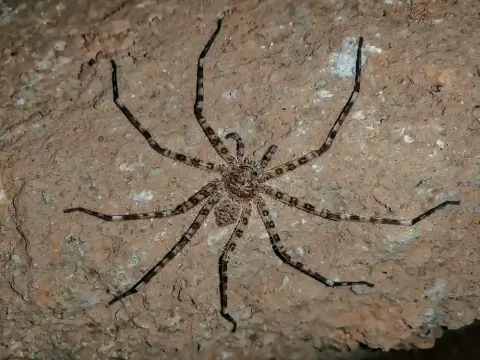
The same applies to huntsman spiders. Thai houses and resorts often host a large, flat, fast Heteropoda on a wall, where it hunts cockroaches all night. It is shy, bolts sideways when a light finds it, and its bite is a brief sting. Note that the giant huntsman, Heteropoda maxima, is a cave species known from Laos rather than a Thai animal, and that Olios giganteus, on older Thai lists, is a spider of the American southwest. Thailand has its own Heteropoda and Olios, none dangerous.
Where you actually meet them
Around the house and resort
The indoor cast is small: huntsman spiders on walls, daddy-long-legs spiders in ceiling corners, jumping spiders on sunlit ledges and small cobweb spiders behind furniture. Widows are the exception worth knowing, and they sit outside — in meter boxes, under stacked flowerpots, beneath outdoor chairs and in wall cavities. Our house spiders guide covers the indoor group.
Garden, paddy and plantation
Orb weavers own this layer. Giant wood spider webs span gaps between palms, Argiope species hang head-down over paddy margins, and spiny orb weavers stud hedges. Wolf spiders run over bare wet ground at night, their eyes returning torchlight as green points.
Forest and karst
Tarantulas hold silk-lined burrows in banks and between tree roots, and are most often exposed when soil is dug or timber moved. Limestone caves hold long-legged jumping spiders, whip spiders — which are not spiders and have no venom at all — and sheet-web weavers in the twilight zone.
The toilet seat spider and other Thai spider myths
The most durable Thai spider story is a hoax. A chain email circulating since the late 1990s describes a deadly spider under toilet seats, first as an invented blush spider and later as the two-striped telamonia, Telamonia dimidiata. That spider is real and common in Southeast Asia, but it is a harmless jumping spider a centimetre long that lives on foliage. There is no toilet spider, no cluster of deaths and no medical literature behind any version of the story.
A second myth is that Thailand has funnel-web spiders. It does not: Atracidae live only in eastern Australia. The confusion arises because Thailand does have harmless funnel-weaving spiders of other families, and because tourists arrive carrying Australian warnings.
A third is the joro spider, often added to Thai lists. It is a golden orb weaver of East Asia — Japan, Korea, China and Taiwan — and is not part of the normal Thai fauna. The big golden webs here belong to Nephila pilipes and its relatives instead.
Spider season in Thailand
Thailand has no cold season to suppress spiders, so the calendar follows rain. The southwest monsoon soaks most of the country from roughly May to October and insect numbers climb with it, which is when orb weavers reach full size and the largest golden webs appear along forest edges and canal banks. The cool dry months of November to February are quietest for webs.
Heavy rain pushes ground-living spiders, widows included, out of flooded cavities and into sheds and stores, so most bite reports cluster in the wet season. Tarantulas are usually found when people dig or move timber rather than when the spiders move.
Common Spiders in Thailand
- Wolf Spider
- Harvestmen Spider
- Abandoned-web orb-weaver (Parawixia dehaani)
- Cyrtarachne spider (Cyrtarachne inaequalis)
- Common Housefly Catcher (Plexippus petersi)
- Banded Phintellas
- Two-striped Telamonia (Telamonia dimidiate)
- Black and White Spiny Spider (Gasteracantha kuhli)
- Long-horned Orb Weavers
Biggest Spiders in Thailand
- Black Tarantula
- Huntsman Spiders
- Giant Golden Orb Weaver (Nephila pilipes)
- Heavy-bodied Jumping Spiders (Hyllus semicupreus)
- Thai Black Tarantula
- Cobalt Blue Tarantula (Cyriopagopus lividus)
- Giant Crab Spiders (Olios giganteus)
Most Venomous Spiders in Thailand
Cobweb Spiders (Theridiidae)
 Cobweb SpidersWidow (Latrodectus)A guide to the widow spiders (Latrodectus): how to identify the genus, the species you may meet, the gumfoot web, and how serious a widow bi
 Cobweb SpidersBrown Widow (Latrodectus geometricus)Identify the brown widow (Latrodectus geometricus) by its orange hourglass and spiky egg sac, and learn how its bite compares with a black w
Less Venomous Spiders in Thailand
Orb Weavers
 Orb WeaversGiant Wood Spider (Nephila pilipes)Identify the giant wood spider (Nephila pilipes): huge black-and-yellow females, tiny males, golden orb webs, range, diet and whether its bi
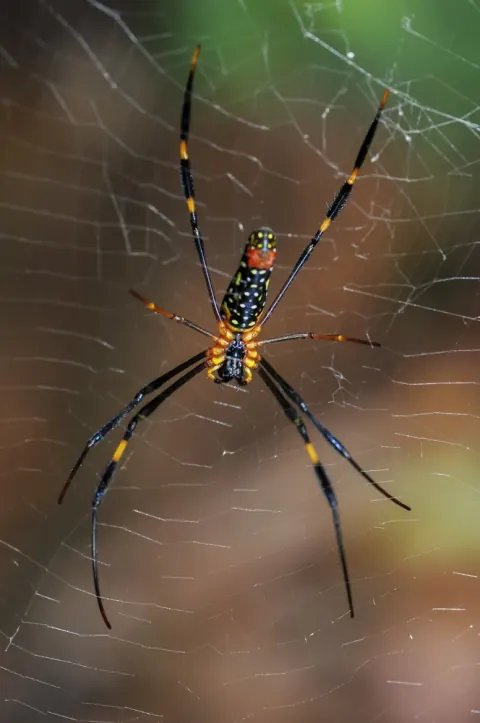 Orb WeaversJorō (Trichonephila clavata)Identify the Jorō spider (Trichonephila clavata): size, gold-and-blue colors, its three-layer golden web, its spread across the US South, an
Huntsman Spiders
Tarantulas
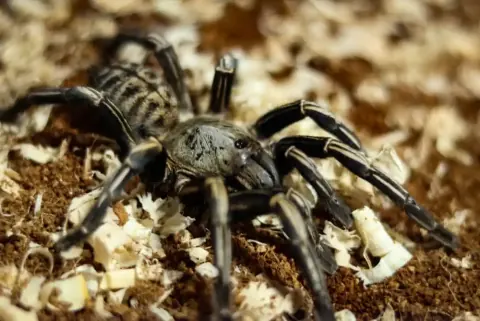 TarantulasThailand Zebra Leg Tarantula (Cyriopagopus albostriatus)Identify the Thailand zebra leg tarantula (Cyriopagopus albostriatus): striped legs, burrow life in Thailand and Cambodia, and its painful O
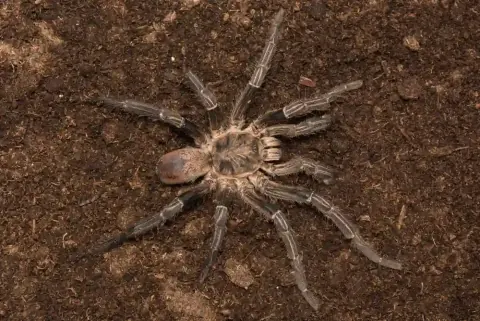 TarantulasCobalt Blue Tarantula (Cyriopagopus lividus)Identify the cobalt blue tarantula (Cyriopagopus lividus): iridescent blue legs, deep burrows in Myanmar and Thailand, and a bite that cause
Living with spiders in Thailand
Thai spiders are effective mosquito and cockroach controls, and the huntsman patrolling a bungalow wall does more for the room than any spray. A few habits remove almost all risk.
- Wear gloves and closed shoes when you move firewood, bricks, stacked pots or old timber — that is where widows and tarantulas shelter.
- Check meter boxes, outdoor furniture and stacked flowerpots for spiky white egg sacs before reaching in.
- Shake out shoes, clothing and bedding left on a veranda or in a room that has been shut up.
- Do not handle a tarantula; several Thai species are declining through collection for the pet trade.
- Move an indoor spider with a glass and card rather than killing it.
- Leave the big garden webs alone; they are seasonal and they work.
The Thai fauna continues into Cambodia and Malaysia with little change, and to understand what those golden webs are doing, read our guide to spider webs.
Frequently asked questions
Are there deadly spiders in Thailand?
No spider in Thailand is reliably known to have killed anyone. The only medically significant group is the widows, chiefly the introduced brown widow, whose bite causes cramping pain, sweating and nausea and is treated routinely in hospital. Tarantulas and huntsman spiders hurt but are not dangerous, and Thailand has no funnel-webs.
Is the Thai black tarantula dangerous?
It is defensive and its bite is very painful, with swelling and sometimes cramping that can last hours, but it is not life-threatening. No death has been reliably attributed to any Asian tarantula and no antivenom exists. Treat a bite with washing, a cold pack and pain relief, and see a doctor if symptoms escalate.
Are there funnel-web spiders in Thailand?
No. The dangerous Australian funnel-webs of the family Atracidae are restricted to eastern Australia and occur nowhere in Asia. Thailand does have harmless spiders from other families that build funnel-shaped webs, which is where the confusion comes from, but none of them poses any medical risk to people.
What is the toilet seat spider in Thailand?
It does not exist. The story comes from a chain email that has circulated since the late 1990s, later attached to the two-striped telamonia, Telamonia dimidiata. That spider is real and widespread in Southeast Asia but it is a harmless jumping spider about a centimetre long that lives on leaves, not in bathrooms.
Are huntsman spiders in Thai houses dangerous?
No. Thai huntsman spiders are large, flat and extremely fast, which makes them alarming, but they are shy, they flee from light and movement, and their bite is a brief sting with local pain. They hunt cockroaches indoors all night and are one of the more useful animals to have on a wall.
What is the biggest spider in Thailand?
The giant wood spider, Nephila pilipes, whose largest females have a body around five centimetres long and a leg span approaching twenty. It spins a golden-sheened orb web that can span several metres between trees. The giant huntsman sometimes listed for Thailand is actually a cave species described from Laos.
Are there black widow spiders in Thailand?
Yes, in the broad sense. The brown widow, Latrodectus geometricus, is established around Thai buildings and gardens, and the Australian redback has been introduced to ports across Asia. Both are true Latrodectus widows and both can cause cramping pain and sweating, though bites are uncommon and rarely severe.
Are there brown recluse spiders in Thailand?
No. No recluse spider of the genus Loxosceles has an established population in Thailand, so slow-healing sores blamed on spiders here are almost always something else, usually a bacterial skin infection. In a hot, humid climate an ordinary scratch can ulcerate without any spider being involved at all.
Do joro spiders live in Thailand?
Not normally. The joro spider is a golden orb weaver of East Asia, native to Japan, Korea, China and Taiwan, and it is not part of the regular Thai fauna despite appearing on some Thai spider lists. The large golden webs seen in Thailand belong to Nephila pilipes and its close relatives.
Where are spiders most common in Thailand?
In rural and forested areas rather than in cities. Bangkok, Chiang Mai and Phuket hold mostly small house spiders and jumping spiders, while the large orb weavers, tarantulas and huntsman spiders are concentrated in gardens, plantations, paddy edges and forest. Encounters rise sharply during and just after the rainy season.
Published December 17, 2023 · Last updated September 14, 2026