
Spiders in Manchester
Four species account for almost every spider report in Greater Manchester, and none of them is dangerous. Britain has no deadly spider, and the false widow at the top of this page delivers a bite closer to a wasp sting than to anything the headlines describe. The rest are harmless residents of damp Victorian brickwork, heated flats and wet lowland gardens.

On this page
- What spiders live in Manchester?
- Is the false widow in Manchester dangerous?
- Where you meet them
- Why Manchester sees spiders in autumn
- Two Manchester claims worth correcting
- Common Spiders in Manchester
- Biggest Spiders in Manchester
- Most Venomous Spiders in Manchester
- Less Venomous Spiders in Manchester
- Living with Manchester's spiders
- Frequently asked questions
What spiders live in Manchester?
Greater Manchester is wet, mild and heavily built, and its spiders reflect all three. Damp Victorian brick, mill conversions, cellars and shaded back yards give web builders exactly the humid, sheltered corners they want, while the Mersey and Irwell valleys, the lowland mosses to the west and the Pennine fringe to the east add wetland and moorland species that never come indoors.

The four species on this page are the ones actually reported. The giant house spider is the large brown sprinter of hallways and bathtubs. The long-bodied cellar spider hangs in a loose tangle under warm ceilings, a frost-sensitive species that depends on central heating to survive this far north. The zebra jumping spider hunts on sunlit brickwork and window ledges. And the noble false widow is the newcomer, part of a slow northward spread that has taken it from a few south-coast towns to buildings across much of England.
Is the false widow in Manchester dangerous?
No. This is the only Manchester species that regularly makes the local news, and the gap between the coverage and the evidence is wide. Steatoda nobilis is a shiny brown spider with a cream pattern on a bulbous abdomen, about the size of a small grape, and it sits in a tangle of web in window frames, porches, wall cavities and garden furniture.

It is one of roughly a dozen British species with fangs long enough to break skin. Documented bites cause immediate sharp pain, local redness and swelling, and occasionally a few hours of feeling generally unwell. Cases settle within one to three days without treatment. The recurring stories about rotting flesh, amputations and life-threatening illness involve secondary bacterial infection of the wound, not the venom, and infections are treated with antibiotics rather than antivenom. Britain has no true black widow, no recluse and nothing medically comparable.
Two long-established relatives are found in the same places and are often mistaken for it: the false black widow, Steatoda grossa, a plum-coloured spider of sheds and cellars, and the smaller rabbit hutch spider, Steatoda bipunctata, common on northern outbuildings. Both are harmless.
Bitten? Wash the spot with soap and water, apply a cold pack and leave it alone. See a pharmacist or GP if the skin turns hot, spreads or weeps after 48 hours, which indicates infection rather than venom. Seek urgent care only for breathing difficulty or swelling of the face and throat.
Where you meet them
Inside the house
Terraced and semi-detached housing stock with cellars, cavity walls and draughty sash windows suits house spiders very well. The giant house spider builds an untidy sheet with a funnel retreat behind wardrobes, in garages and under stairs, and the males are the ones that sprint across a carpet in September. The cellar spider takes the warm ceiling corners upstairs, vibrating its web into a blur when it is threatened, and it earns its keep by hunting other spiders, including house spiders much larger than itself. More on the indoor cast is in our guide to house spiders.

Yards, gardens and the mosslands
Outside, the zebra jumper patrols south-facing walls and fence posts in sunshine, stalking flies in short runs. The garden cross spider strings wheel webs across gates and shrubs from July onwards, the woodlouse spider lives under paving slabs and compost heaps, and the black lace weaver occupies damp cellar walls and log piles, where it is routinely misreported as a false widow. Wolf spiders run over open ground rather than building webs, and the surviving peat mosses west of the city hold wetland specialists such as raft spiders that never turn up in a house.
Why Manchester sees spiders in autumn
September and October are peak weeks, and nothing moves in from outside. House spiders spend the year inside the building as juveniles, hidden behind skirting boards and under floors. In late summer the males mature, leave their retreats and roam the rooms searching for females, which is why they suddenly appear in the open and end up stranded in baths and sinks they cannot climb out of. A towel over the rim gives them a way back out.
In the garden the trigger is size rather than courtship: orb-weavers hatched in spring are at their largest in early autumn, so their webs are at their most obvious just as dew and low sun start to show them. Wet Manchester autumns keep humidity high, which suits web builders and extends the season. By late November most adults are dead and the next generation is waiting in egg sacs, the cycle described in our guide to where spiders go in the winter.
Two Manchester claims worth correcting
The tube web spider, Segestria florentina, with its metallic green fangs, is often listed for Manchester. It is a southern animal, established in port cities and warm walls along the south coast and the Thames, and it is not part of the Greater Manchester fauna. If you find a large dark spider in a hole in a wall here, it is far more likely to be a lace weaver.
The cardinal spider, Tegenaria parietina, is also named as one of the biggest spiders in the city. It is Britain's largest spider, but it is concentrated in old buildings in London and south-east England, and northern records are scarce. The big brown spider in a Manchester bath is almost always a giant house spider. Harvestmen, meanwhile, are not spiders at all: one oval body segment, no waist, no silk and no venom.
Common Spiders in Manchester
- Long bodied cellar spider
- Giant house spider
Biggest Spiders in Manchester
- Giant house spider
- Cardinal spider
Most Venomous Spiders in Manchester
Cobweb Spiders

Less Venomous Spiders in Manchester
Funnel Weaver Spiders
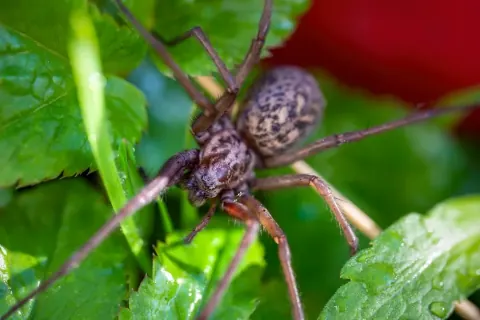
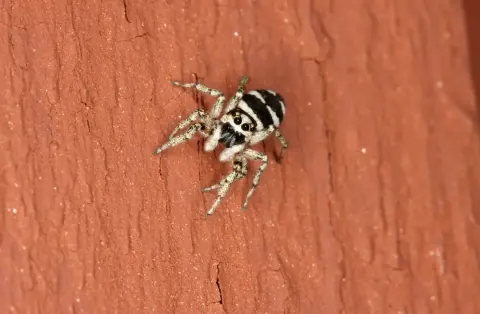
Jumping Spiders
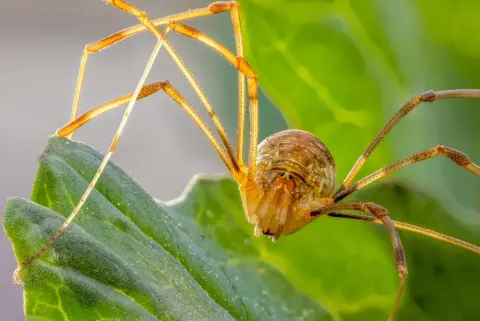
Cellar Spiders
Living with Manchester's spiders
Every species on this page earns its place by eating the insects that come with damp northern housing: houseflies, midges, mosquitoes, clothes moths and silverfish. Clearing them out achieves little, because a corner with a good insect supply is recolonised within weeks.
- Use a glass and a piece of card rather than a shoe; catch and release takes seconds.
- Vacuum webs and egg sacs from window frames, cellar heads and ceiling corners instead of spraying.
- Wear gloves when moving log piles, compost and shed clutter, which is where false widows and woodlouse spiders actually sit.
- Fit or repair brush strips on external doors if you would rather meet fewer wandering males in autumn.
For the wider picture see spiders in the United Kingdom, and for the southern comparison, London has a longer list and a slightly earlier season.
Frequently asked questions
Which spiders are most common in Manchester homes?
The giant house spider and the long-bodied cellar spider account for most indoor sightings, with the zebra jumping spider on sunny window frames and the false widow in porches and wall cavities. All four are harmless. The cellar spider is worth keeping because it preys on the larger house spiders people dislike.
Why do spiders appear indoors in Manchester in autumn?
They were already inside. House spiders live in the building all year as juveniles. In September and October the males reach maturity, leave their webs and walk the rooms looking for females, which is when people notice them. Smooth-sided baths and sinks trap the wanderers, so that is where they are found.
Are spider bites in Manchester dangerous?
No. Britain has no deadly spider and Greater Manchester has no medically significant species. About a dozen British spiders can pierce skin, and the result is short-lived pain, redness and swelling. A wound that worsens over several days is a bacterial infection and should be seen by a GP or pharmacist.
What is the biggest spider in Manchester?
The giant house spider, with a legspan that can approach seven centimetres in a large male. The cardinal spider is bigger, but it is a southern English species of old buildings with very few northern records, so a large brown spider crossing a Manchester floor is almost certainly a giant house spider.
Can a false widow spider bite you in Manchester?
It can, though it rarely does. The noble false widow bites only when it is pressed against skin, for example inside clothing or bedding. The bite produces sharp local pain and swelling for a day or two. No antivenom is needed, and no British false widow bite has caused lasting tissue damage.
Is the false widow spreading north into Greater Manchester?
Yes. The noble false widow arrived in southern England more than a century ago and has spread steadily north, helped by mild winters and heated buildings. Records around Manchester are relatively recent and cluster on houses, walls and outbuildings rather than in open countryside or moorland.
Are tube web spiders found in Manchester?
Not really. Segestria florentina, the green-fanged tube web spider, is established in southern England, especially in port cities and warm south-facing walls. It is not part of the Manchester fauna. Large dark spiders living in holes in walls here are usually lace weavers of the genus Amaurobius.
How do I tell a false widow from a black widow?
There is no black widow in Britain, so any candidate is a false widow. Steatoda nobilis is shiny brown rather than jet black, has a cream or pale band and skull-shaped markings on the abdomen, and lacks the red hourglass underneath. Its bite is minor and never causes the widow syndrome.
Do spiders in Manchester survive the winter?
Most do, in reduced activity rather than true hibernation. Adults shelter in sheds, cellars, cavity walls and leaf litter, while many species overwinter as eggs or half-grown juveniles. Cellar spiders survive this far north mainly because heated buildings keep them above the temperatures they would not otherwise tolerate.
Published April 26, 2022 · Last updated September 14, 2026