
Spiders in Vietnam
Vietnam has a rich spider fauna and almost none of it is dangerous. There are no Australian funnel-webs here and no established recluse spiders, so the only group worth real caution is the widows, chiefly the introduced brown widow. The giant golden orb-weavers, huntsman spiders and tarantulas that dominate the photographs are large and startling rather than harmful.

On this page
- What spiders live in Vietnam?
- Are any spiders in Vietnam dangerous?
- The biggest spiders in Vietnam, and why they are harmless
- Where you actually meet them
- When spiders are most active in Vietnam
- Myths, look-alikes and the toilet spider hoax
- Common Spiders in Vietnam
- Biggest Spiders in Vietnam
- Most Venomous Spiders in Vietnam
- Less Venomous Spiders in Vietnam
- Living with spiders in Vietnam
- Frequently asked questions
What spiders live in Vietnam?
Vietnam stretches more than 1,600 kilometres from the limestone karst and cool winters of the northern highlands to the permanently hot Mekong Delta, and it holds monsoon forest, mangrove, rice paddy and dense cities along the way. The spider fauna follows that spread, and it is only partly catalogued: new species are still being described from the northern karst caves and the Central Highlands every few years.

Three groups make up most sightings. Orb-weavers are everywhere outdoors, from the giant golden webs strung between trees down to the tiny armoured spiny spiders of the genus Gasteracantha and the long-horned orbweaver Macracantha arcuata, whose abdomen carries two curved spines longer than its body. Jumping spiders hunt by sight on walls, fences and leaves, including the two-striped Telamonia dimidiata, the pantropical jumping spider and the gray wall jumper. The third group is the household set: cellar spiders on ceilings, the Jorō and its relatives on garden frames, and tangle-web spiders in every corner that is left alone for a fortnight.
Are any spiders in Vietnam dangerous?
Older guides to Vietnam, including the page this one replaces, describe the country as full of lethal spiders. That is wrong, and it is worth correcting plainly. Vietnam has no Atracidae, the Australian funnel-web family responsible for the only spider deaths recorded in modern Australia, and no established population of recluse spiders, so the necrotic wounds often blamed on spiders here almost always have another cause. Vietnam records no reliable spider fatalities.

Widow spiders
The one genus that genuinely matters is Latrodectus. The pantropical brown widow has spread through Southeast Asian towns and is the widow most people will actually meet, hanging a scruffy tangle web with spiky, sputnik-shaped egg sacs under garden furniture, meter boxes, drain covers and window ledges. The Australian redback has been carried around the region in shipping and is established at scattered sites in Asia, so it is worth recognising. A serious widow bite gives cramping pain that spreads from the limb to the abdomen and back, with sweating and restlessness; it is treatable and very rarely life-threatening, but it needs a hospital rather than patience.
Sac spiders
Sac spiders of the genus Cheiracanthium are pale, fast night hunters that build a silk sleeping tube in rolled leaves and in ceiling corners, and they account for a fair share of Vietnamese bites simply because they end up in bedding. The bite stings sharply and leaves redness, mild swelling and itching for a day or two. The long-standing claim that they cause flesh-destroying ulcers has not stood up to review, and no antivenom or special treatment is needed.
Bitten? Wash the site with soap and water, apply a cold pack and keep the limb still; photograph the spider if you safely can. Go to a hospital the same day for cramping pain that spreads, sweating, vomiting or a racing heart, and for any bite on a young child. Do not cut, suck, burn or tourniquet a bite.
The biggest spiders in Vietnam, and why they are harmless
The largest spider in the country is the giant wood spider, Nephila pilipes, a golden orb-weaver whose females reach a body length of about five centimetres and a leg span near twenty. Old lists count it twice, once as the giant wood spider and once as the giant golden orb weaver, but they are the same animal. Its silk is strong enough to hold small birds by accident and its web can span a footpath, yet it drops and runs rather than bites, and its venom is trivial to humans.

Huntsman spiders come second. The flat, long-legged sparassids that sprint across bathroom walls are what Vietnamese lists call giant crab spiders, a name that elsewhere belongs to a different American species. They are fast, up to about fifteen centimetres across the legs, and completely harmless; they are also the most effective cockroach control a house can have.
Vietnam's tarantulas are the third giant. The blue-black burrowers sold in the pet trade as Vietnamese tarantulas are Chilobrachys dyscolus and species of Cyriopagopus, the genus that absorbed the old name Haplopelma. They are defensive, quick to rear up and capable of a painful bite that can leave the area aching and cramped for a day, but no Asian tarantula has venom of medical significance.
Where you actually meet them
In and around the house
Vietnamese homes hold cellar spiders under ceilings, tangle-web spiders in corners, sac spiders behind curtain rails and jumping spiders on sunlit window frames. All of them work for you against mosquitoes and cockroaches, which is the practical argument for leaving them alone; our guide to house spiders covers the group in detail.
Gardens, paddy and plantation
Rice paddy is genuinely important spider habitat here. Wolf spiders and long-jawed orb-weavers work the crop as free pest control against planthoppers, and researchers across Asia treat paddy spiders as a measurable part of the yield. Garden hedges carry Argiope orb-weavers and the red weaver ant-mimicking spider, a jumping spider so convincing as an ant that most people never look twice.
Forest and karst
Monsoon forest and the northern limestone country hold the real diversity, including the trapdoor spiders of the genus Cyclocosmia, which seal their burrows with a hardened, disc-shaped rear end that fits the tunnel like a manhole cover. Much of this fauna is still undescribed.
When spiders are most active in Vietnam
There is no dormant winter in the south, so spiders are visible all year and rainfall sets the rhythm instead of temperature. Insect numbers climb through the monsoon, roughly May to October in most of the country, and the orb webs that were fingernail-sized in spring span whole doorways by the end of it.
The north does have a cool, drier season from December to February, and there spiders retreat into crevices, leaf litter and buildings much as they do in a temperate country. Late in the wet season, when females are full of eggs and at their largest, is when people notice spiders most and when the classic huge golden webs appear across forest tracks.
Myths, look-alikes and the toilet spider hoax
The two-striped jumping spider Telamonia dimidiata is a harmless, brightly marked salticid that gained a global reputation from a chain email claiming that a South American spider hiding under aeroplane and restaurant toilet seats had killed several people. The story was fabricated, the name was borrowed at random, and the spider itself cannot hurt anyone. It remains one of the most-searched spiders in Southeast Asia for entirely fictional reasons.
Two other common reports are not spiders. Tailless whip scorpions, the flat, long-limbed amblypygids that sit inside karst caves and outbuildings, have no venom glands at all, and harvestmen, with a single fused body and no silk, are equally harmless. Vietnam's spitting spiders, which glue prey down with a zigzag of sticky venom-laced silk, are often mistaken for something sinister and are in fact tiny and slow.
Common Spiders in Vietnam
- Two-striped Telamonia
- Banded Phintella
- Common Housefly Catcher
- Red Weaver Ant-mimicking Spider
- Joro Spiders
- Black and White Spiny Spiders
- Multi-colored Phintellas
- Long-horned Orbweaver
- Hasselt’s Spiny Spider
- Pear-shaped Opadometas
- Decorative Vleispider
- Adanson’s House Jumper
- Pantropical Jumping Spider
- Gray Wall Jumping Spider
Biggest Spiders in Vietnam
- Giant Golden Orb Weaver
- Giant Wood Spider
- Giant Crab Spider
- Grass Cross Spider
- Vietnamese tarantula
- Abandoned-web Orb-weavers
- Pantropical Huntsman Spider
- Chilobrachys dyscolus Vietnam blue
Most Venomous Spiders in Vietnam
Sac Spiders
 Cobweb SpidersRed House (Nesticodes rufipes)Identify the red house spider (Nesticodes rufipes): rusty red body, tangled indoor web, why it is mistaken for a widow, and what its bite ac
 Sac SpidersCheiracanthiumA guide to Cheiracanthium, the yellow sac spiders: how to identify the genus, the silk sac it sleeps in, where its species live, and how bad
Cobweb Spiders (Theridiidae)
 Cobweb SpidersWidow (Latrodectus)A guide to the widow spiders (Latrodectus): how to identify the genus, the species you may meet, the gumfoot web, and how serious a widow biCobweb SpidersRed House (Nesticodes rufipes)Identify the red house spider (Nesticodes rufipes): rusty red body, tangled indoor web, why it is mistaken for a widow, and what its bite ac
 Cobweb SpidersBrown Widow (Latrodectus geometricus)Identify the brown widow (Latrodectus geometricus) by its orange hourglass and spiky egg sac, and learn how its bite compares with a black w
Less Venomous Spiders in Vietnam
Orb Weavers
Cobweb SpidersRed House (Nesticodes rufipes)Identify the red house spider (Nesticodes rufipes): rusty red body, tangled indoor web, why it is mistaken for a widow, and what its bite ac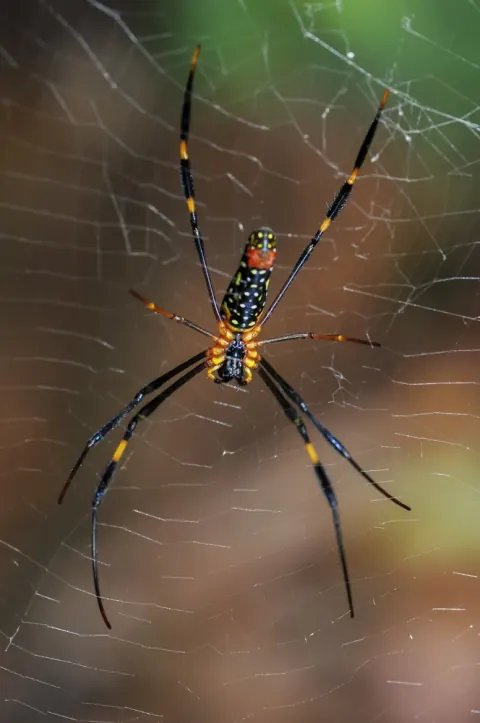 Orb WeaversJorō (Trichonephila clavata)Identify the Jorō spider (Trichonephila clavata): size, gold-and-blue colors, its three-layer golden web, its spread across the US South, an
Living with spiders in Vietnam
Because almost nothing here is dangerous, the aim is to keep spiders out of beds and clothing rather than out of the house entirely. Spraying costs you the mosquito and cockroach control that house spiders provide free.
- Shake out shoes, clothing and bedding, particularly in rural areas and during the monsoon.
- Wear gloves when moving firewood, stacked crates, pot plants and stored produce.
- Keep beds away from walls and store nothing in boxes underneath them.
- Fit and repair screens, and seal gaps under doors where sac spiders wander in at night.
- Clear tangle webs from garden furniture, meter boxes and drain covers, which is where brown widows settle.
- Leave the big garden orb webs alone. A single giant wood spider web removes a remarkable number of mosquitoes.
Neighbouring Cambodia and Thailand share nearly the same fauna, and our most venomous spiders round-up shows where Southeast Asia sits against the regions that really do have dangerous species.
Frequently asked questions
Are there dangerous venomous spiders in Vietnam?
Very few. Vietnam has no Australian funnel-webs and no established recluse spiders, and it records no reliable spider deaths. The only genus that genuinely matters medically is Latrodectus, the widows, mainly the introduced brown widow. Sac spider and tarantula bites hurt but are not medically significant and need no antivenom.
What is the most venomous spider in Vietnam?
A widow spider, in practice the brown widow, Latrodectus geometricus, which is common around houses and gardens. Its bite can cause cramping pain spreading from the limb to the abdomen and back, along with sweating and restlessness. It is treatable and very rarely dangerous, but it deserves a hospital visit.
What is the biggest spider in Vietnam?
The giant wood spider, Nephila pilipes, a golden orb-weaver whose females reach about five centimetres in body length and a leg span near twenty. Older lists count it twice, as the giant wood spider and the giant golden orb weaver, but both names refer to the same harmless species.
Is the Vietnamese tarantula dangerous?
No. The blue-black burrowing tarantulas sold as Vietnamese tarantulas are Chilobrachys dyscolus and species of Cyriopagopus, the genus that absorbed the old name Haplopelma. They are defensive and their bite is genuinely painful, sometimes leaving the area cramped for a day, but the venom has no medical significance for people.
Are there recluse spiders in Vietnam?
No established population is known. Recluse spiders of the genus Loxosceles are not part of the Vietnamese fauna, so slow-healing ulcers blamed on spider bites in Vietnam almost always have another cause, most often a bacterial skin infection. A wound that is spreading or not healing needs a doctor, not spider identification.
Can you find Joro spiders in Vietnam?
Trichonephila clavata is an East Asian golden orb-weaver whose range reaches the northern part of the region, so it can be encountered in the highlands. Most of the huge golden webs photographed in Vietnam, however, belong to the far larger giant wood spider, Nephila pilipes, which is common countrywide.
What are the most common spiders in Vietnamese homes?
Long-bodied cellar spiders under ceilings, tangle-web spiders in corners, pale sac spiders behind curtain rails and picture frames, and jumping spiders on sunlit windows. Huntsman spiders arrive in the wet season. All of them are harmless and all of them reduce mosquito and cockroach numbers indoors.
Is the two-striped Telamonia spider deadly?
No. Telamonia dimidiata is a small, harmless jumping spider. Its reputation comes from a fabricated chain email about a deadly spider lurking under toilet seats, which borrowed the name at random. The species has no medically significant venom and, like other jumping spiders, prefers to leap away from people.
Are huntsman spiders in Vietnam dangerous?
No. Huntsman spiders, which Vietnamese lists often call giant crab spiders, are flat, fast and up to about fifteen centimetres across the legs, but they have no medically important venom. They hunt cockroaches and other large insects indoors and would rather sprint behind a cupboard than confront anyone.
When is spider season in Vietnam?
Spiders are active all year in the south, with activity following rainfall rather than temperature. Numbers and web sizes peak through the monsoon, roughly May to October. Northern Vietnam has a cool, drier season from December to February when spiders shelter in crevices, leaf litter and buildings.
Published August 1, 2023 · Last updated September 14, 2026