
Spiders in Georgia
Georgia, the country on the southern flank of the Caucasus, has one spider that genuinely matters medically: the Mediterranean black widow of the dry eastern steppe, known locally as the shavi kvrivi. A second, the Mediterranean recluse, turns up rarely in cellars and old stonework. Everything else here — the false widows, the big orb-weavers, the cave spiders, the ground hunters — is harmless, and the species most often mistaken for a widow is not one.

On this page
- What spiders live in Georgia?
- Which spiders in Georgia are actually dangerous?
- The false widows, and why they cause most of the panic
- Where you meet them in Georgia
- Spider season in Georgia
- Common Spiders in Georgia
- Biggest Spiders in Georgia
- Most Venomous Spiders in Georgia
- Less Venomous Spiders in Georgia
- Georgia the country, not Georgia the US state
- Frequently asked questions
What spiders live in Georgia?
Georgia packs an improbable range of habitats into a small country, and its spiders follow the geography closely. The Black Sea lowlands of Adjara and Samegrelo are humid subtropics with relict Colchic forest, wet enough for web-builders all year. The Greater Caucasus rises to permanent snow, with alpine faunas of small, dark, cold-adapted hunters. And the east — Kartli, Kakheti, the badlands of Vashlovani — is dry steppe and semi-desert, the only part of the country where a widow is a realistic concern.
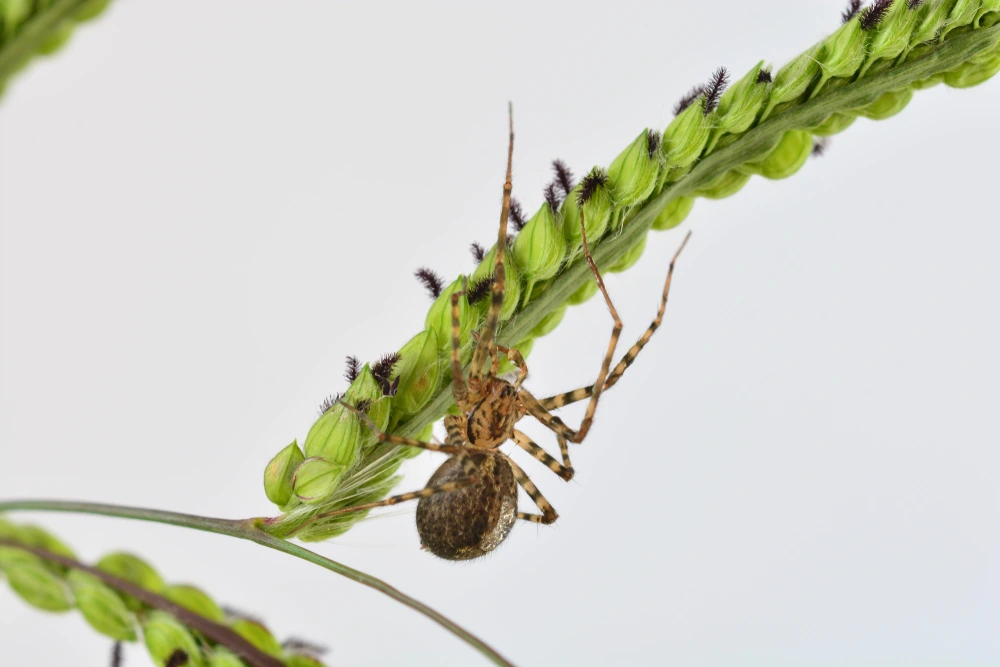
Most Georgian spiders people notice are web-builders. Untidy tangles in cellars, sheds and drystone walls belong to cobweb spiders: the common house spider, the small dark Theridion melanurum and the ant-hunting Asagena phalerata. Wheel webs belong to orb-weavers, including tiny Cyclosa species that decorate the hub with a line of prey husks, and in the dry east the chalky lobed argiope. Ground level belongs to flat, fast hunters — Gnaphosa under stones, wolf spiders on bare soil.
The karst of Imereti adds caves, which Georgia does unusually well: the long-legged orb-weaver Meta bourneti spins near cave and cellar mouths, and the deep Arabika systems hold invertebrates found nowhere else.
Which spiders in Georgia are actually dangerous?
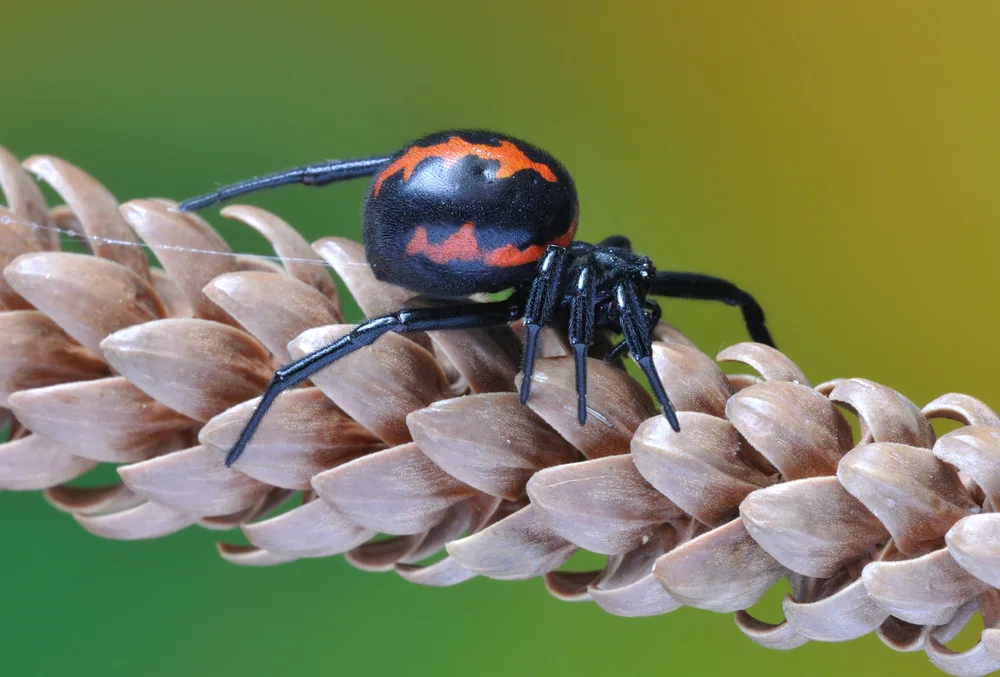
One, and it is a country animal, not a household one. The Mediterranean black widow, Latrodectus tredecimguttatus, is a glossy black widow marked with up to thirteen red or orange spots on top. It builds a low tangle under stones, in grass tussocks, in rodent burrows and at the base of field walls, and it is concentrated in the hot, dry east. Bites happen overwhelmingly to people working by hand in summer — clearing stones, cutting hay, harvesting — not to anyone indoors.
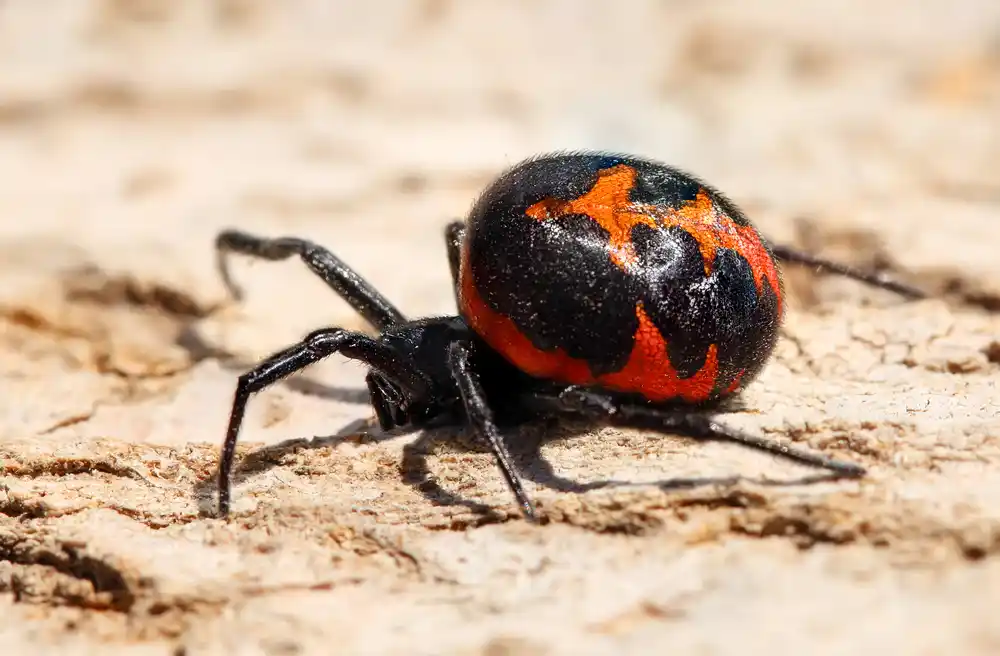
A genuine bite gives little more than a pinprick at first, then cramping muscle pain within an hour that spreads to the abdomen, back and thighs, with sweating, restlessness and nausea. That syndrome, latrodectism, is thoroughly unpleasant for a day or two but is treated routinely with pain relief, supportive care and, in severe cases, antivenom. Deaths are not a feature of modern treatment.
The only other name worth knowing is the Mediterranean recluse, Loxosceles rufescens — small, tan, with a darker violin mark behind six eyes in three pairs. It hides in cellars and ruins in the warmer lowlands and bites so rarely that confirmed Georgian cases are scarce. Slow-healing sores blamed on recluses here are usually bacterial infections.
Nothing else here is medically significant, whatever the older lists imply. Our round-up of the world's most venomous spiders shows where the Caucasus really sits: near the quiet end.
Bitten? Wash the site with soap and water, apply a cold pack and keep the limb still. Photograph the spider if you can do it safely. Get to a hospital or call 112 if cramping pain spreads from the bite, or if sweating, vomiting or chest tightness follow, and for any bite on a young child. Do not cut, suck or burn the wound.
The false widows, and why they cause most of the panic
The most useful thing to learn in Georgia is the difference between a widow and a Steatoda. The spider behind most alarmed phone photographs here is Steatoda paykulliana: glossy black, globular, with a bold red, orange or yellow crescent across the front edge of the abdomen. A widow's markings are spots on the top of the abdomen and an hourglass underneath. S. paykulliana shares the widow's stony habitat, which makes the confusion worse, but its bite produces local pain and swelling and nothing more.
Three smaller false widows live alongside people: the false black widow, purplish-brown with pale crescents, in cellars and skirting boards; the triangulate cobweb spider, pale with a zigzag of dark triangles, in sheds and window frames; and the rabbit hutch spider in outbuildings and animal sheds, exactly where its name suggests. None is dangerous.
Two other corrections are worth making. Older lists name the silver-sided sector spider, Zygiella x-notata, among Georgia's biggest spiders; it is a neat orb-weaver of five to seven millimetres, recognisable by the open wedge in its web. The real heavyweights are the steppe wolf spiders, the lobed argiope and the cave orb-weaver Meta bourneti. And harvestmen, in every damp Georgian cellar, are not spiders at all: one oval body, no silk, no venom.
Where you meet them in Georgia
Houses, cellars and marani
Old Georgian houses, wine cellars and stone outbuildings are ideal spider habitat: cool, dark, humid, full of flies. Expect cellar spiders hanging upside down, Steatoda around qvevri lids, jumping spiders on sunlit window frames. Our house spiders guide covers this group; none of it justifies an aerosol.
Eastern steppe, vineyards and field walls
This is widow country. Sun-baked ground with tussocky grass, loose stone and rodent burrows in Kakheti and Kvemo Kartli is exactly what Latrodectus tredecimguttatus needs, which is why gloves matter for anyone lifting rocks there in summer. The same terrain holds the lobed argiope.
Colchic forest and the mountains
The wet western forests are the richest part of the country for spiders and the least dangerous — orb-weavers between branches, sheet-web builders in leaf litter, ground spiders under bark. Higher up, alpine species shelter under stones.
Spider season in Georgia
The year starts quietly: ground hunters and jumping spiders become obvious on warm stone in April, and female wolf spiders carry egg sacs through May and June.
The peak runs from August into October. Orb-weaver females reach full size, adult males of the ground hunters roam for mates and end up indoors, and the widow population in the east is at its most numerous — which is why bite reports cluster with the hay and grape harvest. Winter shuts the highlands down, but the mild Black Sea coast keeps a trickle of activity going under bark and in wall cavities.
Common Spiders in Georgia
- Common Eastern Ray Spider (Theridiosoma gemmosum)
- Ant Comb-Footed Spider (Asagena phalerata)
- Scarce Candy-striped Spider (Enoplognatha latimana)
- Common House Spider (Parasteatoda tepidariorum)
- Common House Combfoot (Theridion melanurum)
- Banded Comb-Footed Spider (Anelosimus vittatus)
- Gnaphosa bicolor
- Cyclosa sierrae
- Gnaphosa saurica
Biggest Spiders in Georgia
- Silver-sided Sector Spider (Zygiella x-notata)
- Cave Spider (Meta bourneti)
Most Venomous Spiders in Georgia
Cobweb Spiders/Tangle Web Spiders (Theridiidae)
 Cobweb SpidersMediterranean Black Widow (Latrodectus tredecimguttatus)Identify the Mediterranean black widow (Latrodectus tredecimguttatus): the thirteen spots, its steppe habitat, its web, and how serious the
 Cobweb SpidersSteatoda paykullianaIdentify Steatoda paykulliana: size, the red crescent and dorsal stripe, its gumfoot web under stones, its Mediterranean range and how painf
 Cobweb SpidersFalse Black Widow (Steatoda grossa)Identify the false black widow (Steatoda grossa): size, colour, its gumfoot cobweb, how it differs from a true widow, and how bad the bite r
Less Venomous Spiders in Georgia
Orb Weavers
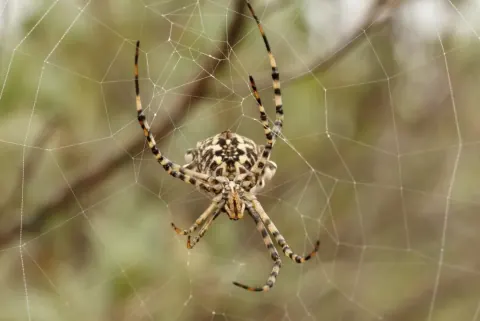
Cobweb Spiders/Tangle Web Spiders (Theridiidae)
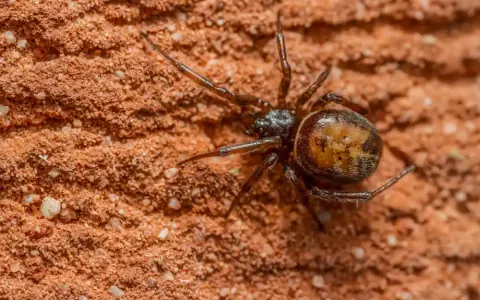 Cobweb SpidersRabbit Hutch Spider (Steatoda bipunctata)Identify the rabbit hutch spider (Steatoda bipunctata): glossy brown body, pale stripe, tangle web in sheds and hutches, and why its bite is
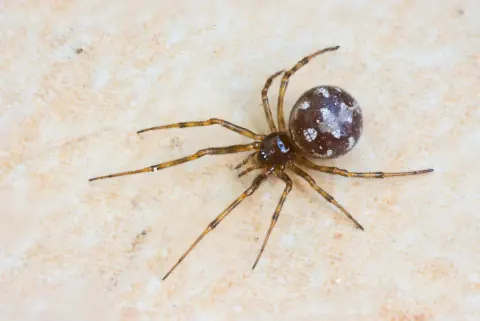 Cobweb SpidersTriangulate Cobweb (Steatoda triangulosa)Identify the triangulate cobweb spider (Steatoda triangulosa): the purple zigzag pattern, yellow legs, its tangle web, and whether the bite
Georgia the country, not Georgia the US state
Much of the spider information attached to the word "Georgia" online describes the American state, and the two faunas share almost nothing. The US state has the brown recluse, the southern black widow and the introduced joro spider; the Caucasus country has none of the three. For the southeastern United States, see our guide to spiders in Georgia, USA.
Living alongside Georgian spiders takes little effort, and they work usefully on mosquitoes and vine pests.
- Wear gloves for stone piles, field walls and firewood in the east — that is where widows sit.
- Shake out boots, gloves and work clothes left outside overnight.
- Fit door brushes and window screens rather than spraying.
- Move an indoor spider out with a glass and a card.
The fauna of neighbouring Turkey overlaps heavily with Georgia's and is a useful cross-reference for anything you cannot place.
Frequently asked questions
Are there venomous spiders in the country of Georgia?
Yes, but only one that matters. The Mediterranean black widow, Latrodectus tredecimguttatus, lives in the dry eastern steppe and its bite causes cramping pain, sweating and nausea that hospitals treat routinely. The Mediterranean recluse occurs rarely in cellars and ruins. Every other Georgian spider causes nothing worse than a brief sore mark.
Are there deadly spiders in Georgia?
No. No Georgian spider has caused a death under modern medical care. The Mediterranean black widow is the only species whose bite is medically significant, and latrodectism is managed with pain relief, supportive treatment and antivenom in severe cases. The false widows that cause most of the alarm are not dangerous at all.
What are the biggest spiders in Georgia?
The large wolf spiders of the eastern steppe, the lobed argiope in dry grassland, and the cave orb-weaver Meta bourneti near cave and cellar mouths. The silver-sided sector spider named on older lists is only five to seven millimetres long and does not belong among the country's largest species.
What spiders get into Georgian houses?
Cellar spiders hanging upside down in bathrooms and wine cellars, the common house spider and Theridion melanurum in ceiling corners, Steatoda false widows in sheds and around qvevri lids, and small jumping spiders on sunny window frames. All of them are harmless, and all of them eat the flies and mosquitoes you want gone.
How do I tell a black widow from a false widow in Georgia?
Look at where the colour sits. A Mediterranean black widow has red, orange or cream spots on top of the abdomen and an hourglass underneath. Steatoda paykulliana, the usual source of false alarms, has a single bold crescent across the front edge of the abdomen and no hourglass. If there is no hourglass, it is not a widow.
Where in Georgia do black widows live?
Almost entirely in the hot, dry east — Kakheti, Kvemo Kartli and the Vashlovani badlands — under stones, in grass tussocks, in rodent burrows and at the base of field walls. They are rare to absent in the humid Black Sea lowlands and in the high mountains, and they do not colonise houses.
Is the ant comb-footed spider dangerous?
No. Asagena phalerata is a small, squat cobweb spider that specialises in catching ants under stones. Its venom is tuned to insect prey and has no medical significance for people, bites are almost unheard of, and the worst realistic outcome is a little local irritation that fades within a day.
Where are cave spiders found in Georgia?
In the karst country of Imereti and along the Greater Caucasus, wherever there are caves, mines, cellars and wells. Meta bourneti builds a large orb web in the twilight zone near the entrance, where humidity is high and temperatures stay stable. It is entirely harmless and retreats from light.
Are the spiders in Georgia the same as in the US state of Georgia?
No, and the two are constantly confused online. The Caucasus country has no brown recluse, no southern black widow and no joro spider. Its one medically significant species, the Mediterranean black widow, does not occur in North America. Treat any advice that names American species as describing the wrong Georgia.
Published December 3, 2023 · Last updated September 14, 2026