
Spiders in Israel
Israel packs Mediterranean hills, coastal plain and true desert into a country the size of a small county, and its spiders follow that split. Only two groups matter medically: the widows of the genus Latrodectus, including a species found nowhere but the Negev, and the Mediterranean recluse. The huntsman spiders, tarantulas and orb-weavers that frighten people are harmless, and the camel spider is not a spider at all.

On this page
- What spiders live in Israel?
- Which spiders in Israel are actually dangerous?
- Where you meet them in Israel
- Spider season in Israel
- Camel spiders and other things that are not spiders
- Common Spiders in Israel
- Biggest Spiders in Israel
- Most Venomous Spiders in Israel
- Less Venomous Spiders in Israel
- Living with Israel's spiders
- Frequently asked questions
What spiders live in Israel?
Israel sits where three biogeographic regions collide — Mediterranean in the north and along the coast, Irano-Turanian steppe inland, Saharo-Arabian desert through the Negev and Arava — with a thin Sudanian strip along the Dead Sea rift. That is why a country this small carries several hundred spider species, and why desert species are still being described from it. What the country does not have is a tropical zone, despite the claim on older versions of this page.
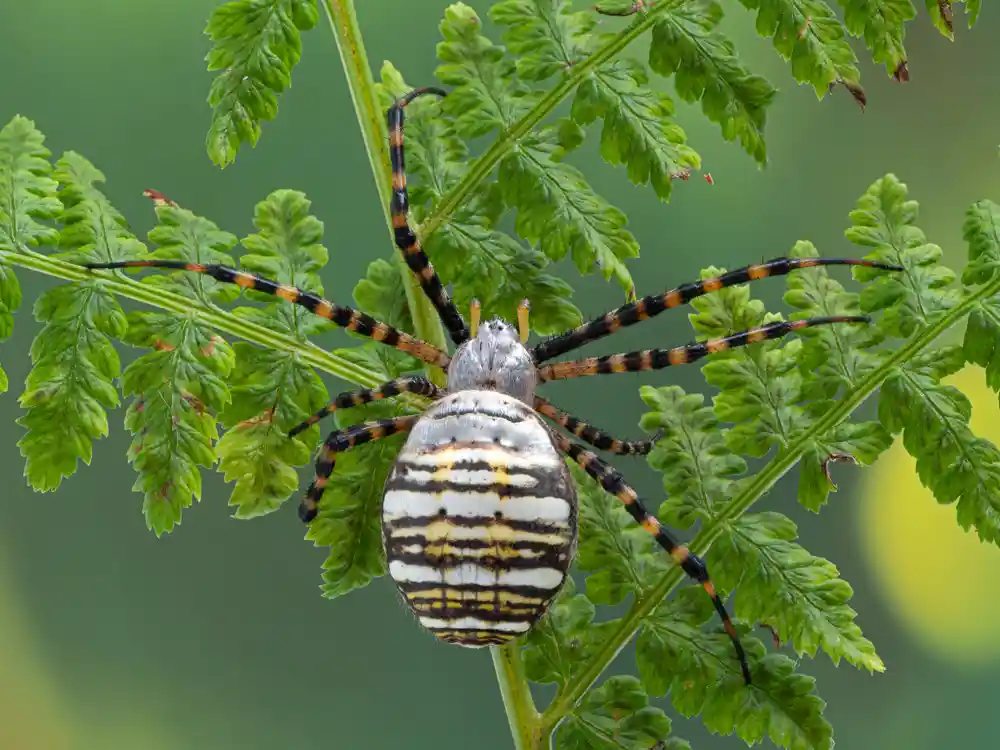
Most encounters are with web-builders. Wheel webs on garden shrubs and irrigation lines belong to orb-weavers: the striped banded garden spider and the chalk-white, scalloped lobed argiope in warm open country, with the cross orb-weaver reaching its southern limit in the cool, humid north around the Galilee and the Golan. Untidy tangles under stones and in walls are cobweb spiders, the family that holds the true widows.
The hunters are more conspicuous in the dry south. Wolf spiders work bare ground after dark, flat huntsman spiders sit on rock faces and building walls, and jumping spiders patrol sunlit stonework all summer.
Which spiders in Israel are actually dangerous?
The widows, and only the widows, deserve real respect. Three species share the country. The Mediterranean black widow, Latrodectus tredecimguttatus, is glossy black with red or cream spots and lives in Mediterranean scrub and field margins. The white widow, Latrodectus pallidus, is cream to straw-coloured and almost unmarked — the least widow-like widow there is. And Latrodectus revivensis, the Negev widow, is endemic to Israel's deserts, slinging its tangle web on desert shrubs and around burrow mouths. A widow bite produces a faint pinprick, then cramping muscle pain spreading from the bite into the abdomen, back and thighs within an hour or two, with sweating, nausea and agitation. It is treated in Israeli hospitals as a matter of routine, with pain relief, supportive care and antivenom where required.
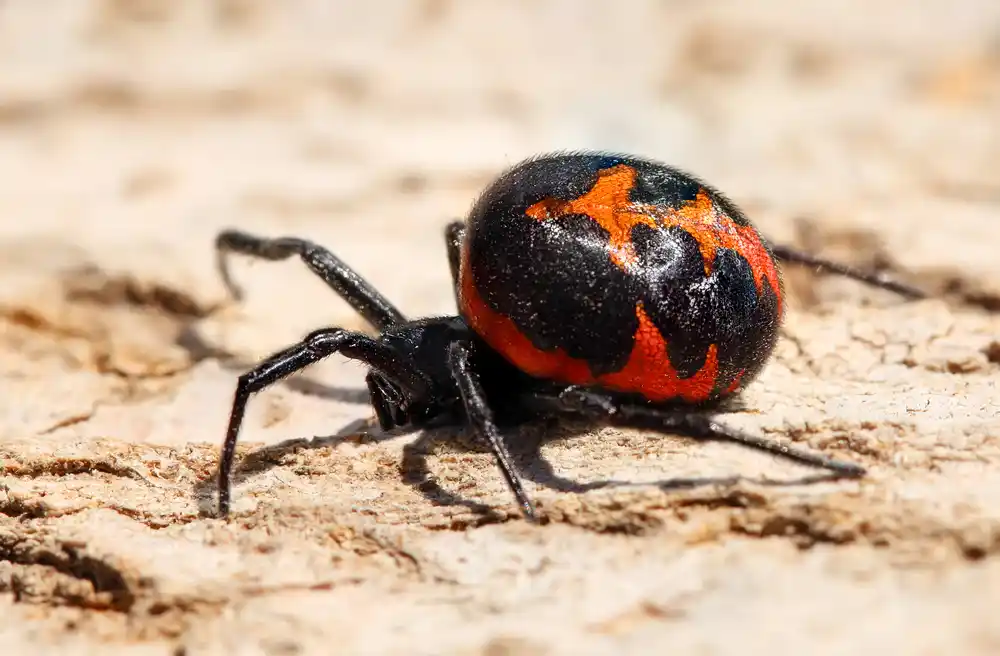
The brown widow, Latrodectus geometricus, is also established here, often around buildings and garden furniture. It is a true widow with an orange hourglass and a spiky egg sac, but it injects very little venom and its bites are usually confined to local pain.
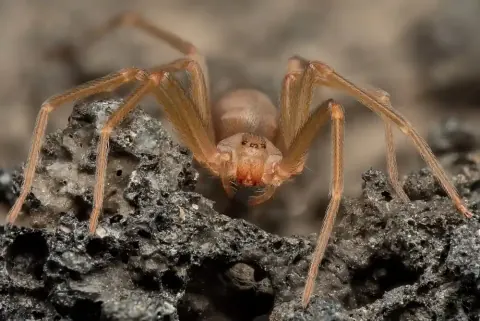
The second name worth knowing is the Mediterranean recluse, Loxosceles rufescens — small, tan, six-eyed in three pairs, with a faint violin mark. It lives in cellars, storerooms, ruins and rock crevices and bites very rarely; most bites heal as a sore mark, a minority ulcerate slowly.
Nothing else here is medically significant, whatever the older list said. Steatoda paykulliana is a false widow, black with a red or cream band across the front of the abdomen, and its bite means local pain and swelling — it is not a dangerous species.
Bitten? Wash with soap and water, apply a cold pack and keep the limb still. Photograph the spider if that is safe. Call 101 or go to an emergency room if cramping pain spreads from the bite, if sweating, vomiting or chest tightness follow, or if a wound is still worsening after two days. Do not cut, suck or burn a bite.
Where you meet them in Israel
Homes, gardens and the coastal plain
Israeli buildings hold cellar spiders in stairwells and bathrooms, Steatoda in electrical boxes and behind shutters, jumping spiders on hot window frames, and brown widows under garden chairs, window ledges and the rims of plant pots — the one indoor-adjacent spider worth checking for before you put your hand somewhere unseen. Our guide to house spiders covers this group.
Negev, Arava and the deserts
The desert is where Israeli arachnology gets interesting. Latrodectus revivensis builds on desert shrubs, wolf spiders and huntsman spiders hunt the sand at night, and the Arava dunes hold Cerbalus aravaensis, a pale huntsman described in 2007 with a legspan approaching fourteen centimetres, which shelters by day under a hinged trapdoor of sand-covered silk. It is one of the largest spiders in the Middle East and entirely harmless.
Galilee, Golan and the hills
Cooler, wetter northern habitats carry the Mediterranean fauna proper: the cross orb-weaver on hedges and woodland edges, crab spiders in flowers, and the Middle East black tarantula, Chaetopelma olivaceum, in burrows under rocks. Like all tarantulas of the region, it is not dangerous.
Spider season in Israel
Israel has a spring peak and an autumn peak, with a quiet, nocturnal summer in between. Spring, from March through May, is the richest time: rain-fed vegetation supports insects, hunters are active by day, and female wolf spiders carry egg sacs and then a crust of spiderlings on the back.
Summer pushes almost everything into the night, especially in the Negev and Arava, where daytime surface temperatures rule out activity entirely. The second peak runs from September into November, when orb-weaver females reach full size and their webs become impossible to miss, and adult males of the ground hunters wander for mates — which is when large spiders appear indoors after the first cool evenings.
Camel spiders and other things that are not spiders
No animal in Israel generates more panic than the camel spider, and it is not a spider. Solifuges — order Solifugae — look like they have ten legs (the front pair are sensory pedipalps), carry enormous jaws, and run at your shadow because they are chasing shade. They have no venom glands at all. A large one can pinch hard enough to draw blood, and that is the limit of it.
Scorpions are the genuine arachnid danger here. The yellow scorpion Leiurus quinquestriatus is a serious medical problem, particularly for children, and has nothing to do with spiders or with spider first aid. Harvestmen, with a single oval body and neither silk nor venom, are not spiders either.
Among true spiders, two get misjudged constantly. Huntsman spiders such as Walckenaer's huntsman, Eusparassus walckenaeri, are fast and flat and look terrifying on a bedroom wall; their bite is trivial. Tarantulas are bulky and hairy and equally harmless. If you cannot see red or orange markings on a glossy, globular abdomen, you are almost certainly not looking at a widow.
Common Spiders in Israel
- Bordered Orb Weaver Spider (Neoscona adianta)
Biggest Spiders in Israel
- Middle East Black Tarantula (Chaetopelma olivaceum) also called Black Furry, Black Tarantula, and Middle East Gold
- Walckenaer’s Huntsman (Eusparassus walckenaeri)
- Sand-dwelling Huntsman Spider / Israeli Huntsman Spider (Cerbalus aravaensis)
Most Venomous Spiders in Israel
Cobweb Spiders (Theridiidae)
 Cobweb SpidersSteatoda paykullianaIdentify Steatoda paykulliana: size, the red crescent and dorsal stripe, its gumfoot web under stones, its Mediterranean range and how painf
 Cobweb SpidersBrown Widow (Latrodectus geometricus)Identify the brown widow (Latrodectus geometricus) by its orange hourglass and spiky egg sac, and learn how its bite compares with a black w
Sicariidae
Less Venomous Spiders in Israel
Orb Weavers
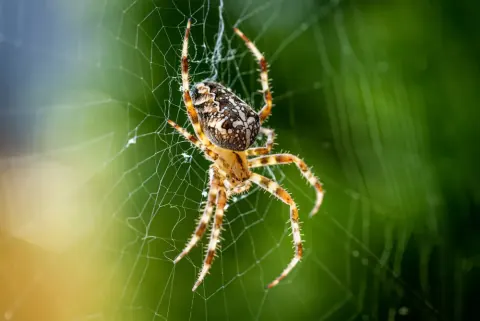 Orb WeaversCross Orb Weaver (Araneus diadematus)Identify the cross orb weaver (Araneus diadematus) by the white cross on its abdomen: size, colour, web, egg sac, range and whether the bite
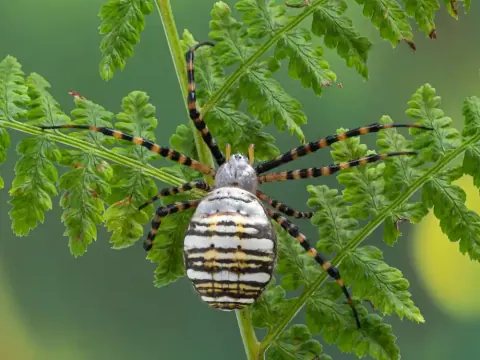 Orb WeaversBanded Garden (Argiope trifasciata)Identify the banded garden spider (Argiope trifasciata): silver banding, size, the zigzag in its web, egg sac, range, and whether its bite i
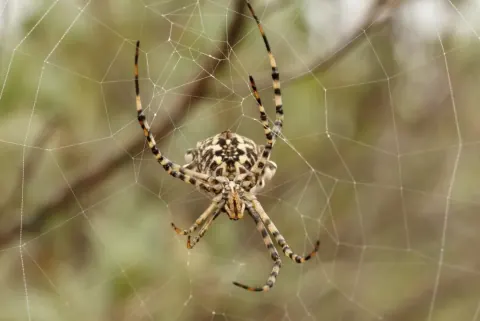 Orb WeaversLobed Argiope (Argiope lobata)Identify the lobed argiope (Argiope lobata): the scalloped silver abdomen, the big orb web, its range from Spain to South Africa, and how ha
Living with Israel's spiders
Spraying a house achieves nothing a screen and a little tidying would not. Israeli spiders eat mosquitoes, sandflies, cockroaches and moths, and a cleared corner refills within a fortnight. Sensible caution comes down to not putting a bare hand into places you cannot see.
- Wear gloves for rock piles, rubble, brushwood and firewood — that is widow habitat.
- Check under garden chairs, planter rims and window ledges for brown widows before grabbing them.
- Shake out shoes, work gloves and bedding left on the floor or outdoors overnight.
- Keep cardboard and sacking off cellar and storeroom floors, where Loxosceles hides.
- Move an indoor spider out with a glass and a piece of card.
Our round-up of the world's most venomous spiders puts the Israeli widows in proportion, and the fauna of Egypt across the border overlaps heavily with the Negev list.
Frequently asked questions
What are the most venomous spiders in Israel?
The widows: the Mediterranean black widow, the pale white widow, and Latrodectus revivensis, which is endemic to Israel's deserts. Their bites cause cramping pain, sweating and nausea, and hospitals treat them routinely. The Mediterranean recluse is a distant second, biting rarely and usually leaving nothing worse than a sore mark.
Is the false black widow in Israel dangerous?
No. Steatoda paykulliana is a false widow, black with a red or cream band across the front of the abdomen, and it is often killed on sight as a widow. Its bite produces local pain and a little swelling and nothing more. Older lists that rank it among Israel's most venomous spiders are wrong.
Are camel spiders in Israel venomous?
No. Camel spiders are solifuges, a separate order of arachnids, and they have no venom glands whatsoever. They are fast, nocturnal and armed with huge jaws, and they run toward people because they are chasing the shade of a shadow. A big one can pinch through skin but cannot envenomate you.
What is the biggest spider in Israel?
Cerbalus aravaensis, a pale huntsman spider described in 2007 from the sand dunes of the southern Arava, with a legspan approaching fourteen centimetres. It shelters by day under a hinged trapdoor of sand-covered silk, hunts at night, and is harmless. Its dune habitat is small and under pressure.
Are there tarantulas in Israel?
Yes. The Middle East black tarantula, Chaetopelma olivaceum, lives in burrows under rocks in the north and centre of the country. It is large, dark and slow, and it is not dangerous — a bite would cause localised pain and swelling comparable to a bee sting, with no systemic effects.
How do you identify a Mediterranean recluse?
Look for a small, uniformly yellowish-brown spider under a centimetre in body length, with long thin legs, six eyes arranged in three pairs rather than eight, and a faint darker violin shape behind the eyes. It hides in cellars, storerooms and rock crevices. Confident identification really needs magnification.
Are huntsman spiders in Israel dangerous?
No. Walckenaer's huntsman and the other Israeli sparassids are flat, long-legged and fast, which makes them alarming on a wall at night, but their venom has no medical significance for people. They hunt cockroaches and moths, do not build webs, and run from anything larger than prey.
Do jumping spiders in Israel bite?
Almost never. Israeli jumping spiders such as Adanson's house jumper and the pantropical jumper have venom suited to small insects and no medical significance. They are curious and will turn to watch you rather than flee, but biting a person is not part of their behaviour even when handled.
Where would I actually encounter a widow spider in Israel?
Outdoors, in undisturbed dry places: under stones, in rubble and rodent burrows, at the base of walls, and on desert shrubs in the Negev and Arava. Brown widows are the exception, favouring built-up areas under garden furniture, planter rims and window ledges. Gloves prevent nearly all bites.
What should I do if a spider bites me in Israel?
Wash the bite with soap and water, apply a cold pack and keep the limb still. Photograph the spider if it is safe. Call 101 or go to an emergency room if cramping pain spreads, if sweating or vomiting follow, or if the wound is still worsening after two days. Never cut or burn a bite.
Published December 5, 2023 · Last updated September 14, 2026