
Spiders in Malaysia
Malaysia has no deadly spider. Its rainforest fauna is the classic Southeast Asian set: giant golden orb-weavers spanning gaps between trees, spiny orb-weavers hanging like enamelled shells, huntsman spiders on house walls at night, earth tiger tarantulas in tree hollows and jumping spiders everywhere in the sun. The only species of real medical interest is the introduced brown widow, and there are no Australian-type funnel-webs anywhere in the country.

On this page
- What spiders live in Malaysia?
- Are there dangerous spiders in Malaysia?
- Three claims about Malaysian spiders that are wrong
- Where you meet them
- Spider season and the monsoon
- Common Spiders in Malaysia
- Biggest Spiders in Malaysia
- Most Venomous Spiders in Malaysia
- Less Venomous Spiders in Malaysia
- Living with spiders in Malaysia
- Frequently asked questions
What spiders live in Malaysia?
Malaysia sits astride the equator, with lowland dipterocarp rainforest, limestone hills, montane forest in the Cameron Highlands and Borneo's interior, mangrove along both coasts and oil palm in between. That produces one of the richest spider faunas in Asia, most of it undescribed, and no credible national species total exists. What you can learn is the set you will actually see.

The orb-weavers are the showpiece. The giant golden orb-weaver, Nephila pilipes, hangs golden silk strong enough to stop a small bird across forest gaps, while the long-horned orb-weaver Macracantha arcuata, with two curved spines longer than its body, and the black-and-white spiny spider Gasteracantha kuhli hang in low webs like painted ornaments. Jumping spiders are everywhere in the sun: the heavy-bodied Hyllus semicupreus, the banded Phintella species, the ant-mimicking Myrmaplata plataleoides that passes for a weaver ant until it moves. After dark the huntsman spiders take over walls and tree trunks, and earth tiger tarantulas wait at silk-lined tubes in trees and banks.
Are there dangerous spiders in Malaysia?
No Malaysian spider is known to have killed anyone, and the country produces no spider antivenom because it has no need of one. The only species worth knowing is the brown widow, Latrodectus geometricus, an introduced tropical member of the widow genus now common in Southeast Asian towns. It builds a tangle web under garden furniture, in meter boxes and along fence rails, and its bite gives local pain, sweating and a cramping ache that normally settles within a day or two.

The other frequent biter is the yellow sac spider, Cheiracanthium, which folds a leaf into a silk cell and defends it. The bite stings sharply and swells, and the necrotic reputation attached to the genus has never been supported by verified cases. Tarantulas and huntsman spiders worry people far more than they should: the Malaysian earth tiger, Omothymus schioedtei, is fast and defensive with long fangs, so a bite hurts mechanically and can throb for hours, but no Asian tarantula has caused a documented human death. Nothing from Malaysia appears on our most venomous spiders shortlist.
Bitten? Wash with soap and water, apply a cold pack and take a simple painkiller. Photograph the spider if you safely can. Seek medical care for a bite on a young child, for cramps that spread beyond the limb, for sweating or vomiting, or if the wound turns hot, swollen and weeping after two days, which points to infection rather than venom.
Three claims about Malaysian spiders that are wrong
The first is the oldest internet spider hoax. The two-striped Telamonia dimidiata, named on nearly every Malaysian list, owes its deadly reputation entirely to a chain email that circulated from 1999 claiming a lethal spider lurked under aircraft and restaurant toilet seats. The story was invented outright. Telamonia is a small, brightly marked, harmless jumping spider of vegetation and house walls.

The second is geographic. The six-spotted fishing spider, Dolomedes triton, listed here among Malaysia's venomous spiders, is a North American species of ponds and marshes. Malaysia has its own Dolomedes fishing spiders on forest streams; they sit at the water's edge, feel for ripples and take insects and small fish, and they are harmless.
The third is the deadliest-sounding. Malaysia has no Atracidae, the Australian funnel-web spiders, which live only in eastern Australia. Southeast Asian mygalomorphs that get called funnel-webs are unrelated animals with painful, non-lethal bites.
Where you meet them
In and around the house
The indoor cast matches our house spiders guide. Huntsman spiders are the flat, fast, long-legged animals on bedroom walls at night, and they are welcome residents that hunt cockroaches and geckos; they run rather than fight. Cellar spiders hold bathroom corners, the common housefly catcher Plexippus petersi and other jumpers work lit walls, and sac spiders build silk retreats where wall meets ceiling.
Gardens, kampung and plantation
Hedges, fruit trees and oil palm carry the heaviest web traffic: spiny orb-weavers in low webs, golden orb-weavers across wider gaps, and lynx spiders hunting on foliage. In paddy and plantation those spiders are a working part of pest control, which is why integrated pest management programmes ask growers to leave them alone.
Rainforest and limestone
Primary forest holds the richest fauna: huge orb webs across trails, hermit spiders with a retreat in a curled leaf, net-casting spiders that hold a silk rectangle between their front legs, and earth tiger tarantulas in tree hollows and bank tubes. Limestone caves add whip spiders and long-legged cave dwellers.
Spider season and the monsoon
Malaysia is hot and humid all year, so spiders breed continuously, nothing overwinters and there is no spider season in the temperate sense. The rhythm comes from the monsoons: the northeast monsoon brings heavy rain to the east coast and Borneo from November to March, and the southwest monsoon runs from May to September.
Insect numbers climb with the rain, and webs grow with them, so the weeks after heavy rain are when the big trail-spanning orb webs look most impressive. Storms also flood burrows and leaf litter, producing short pulses of indoor sightings as ground-living spiders and tarantulas are pushed out for a few days.
Common Spiders in Malaysia
- Two-striped Telamonia (Telamonia dimidiate)
- Heavy-bodied Jumping Spider (Hyllus semicupreus)
- Banded Phintella (Phintella vittate)
- Common Housefly Catcher (Plexippus petersi)
- Black and White Spiny Spider (Gasteracantha kuhli)
- Multi-colored Phintella (Phintelloides versicolor)
- Long-horned Orb Weaver (Macracantha arcuate)
- Hasselt’s Spiny Spiders
Biggest Spiders in Malaysia
- Giant Golden Orb Weaver (Nephila pilipes)
- Pantropical Huntsman Spider (Heteropoda venatoria)
- Malaysian Earth Tiger Tarantula (Omothymus schioedtei)
- Giant Tree Trunk Huntsman (Heteropoda boiei)
Most Venomous Spiders in Malaysia
Sac Spiders
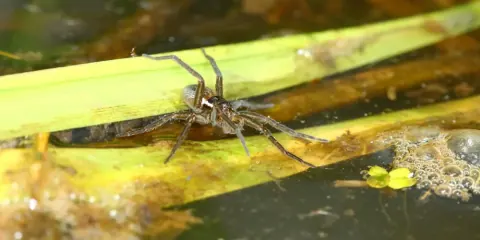 Nursery Web SpidersSix-spotted Fishing (Dolomedes triton)Identify the six-spotted fishing spider (Dolomedes triton): size, stripes, how it walks on water, its range, and whether its bite is dangero
 Sac SpidersCheiracanthiumA guide to Cheiracanthium, the yellow sac spiders: how to identify the genus, the silk sac it sleeps in, where its species live, and how bad
Cobweb Spiders (Theridiidae)
 Cobweb SpidersWidow (Latrodectus)A guide to the widow spiders (Latrodectus): how to identify the genus, the species you may meet, the gumfoot web, and how serious a widow bi
 Cobweb SpidersBrown Widow (Latrodectus geometricus)Identify the brown widow (Latrodectus geometricus) by its orange hourglass and spiky egg sac, and learn how its bite compares with a black w
Less Venomous Spiders in Malaysia
Orb Weavers
Cobweb SpidersWidow (Latrodectus)A guide to the widow spiders (Latrodectus): how to identify the genus, the species you may meet, the gumfoot web, and how serious a widow bi Orb WeaversGiant Wood Spider (Nephila pilipes)Identify the giant wood spider (Nephila pilipes): huge black-and-yellow females, tiny males, golden orb webs, range, diet and whether its bi
Living with spiders in Malaysia
The spiders in a Malaysian house are free mosquito and cockroach control, which counts for a lot in a dengue country. Clearing them out changes nothing while the insects remain.
- Wear gloves and closed shoes when moving timber, bricks, pots and stacked furniture, where brown widows shelter.
- Shake out shoes, bags and clothing left on the floor overnight, especially in kampung houses and jungle camps.
- Never reach blind into a tree hollow, a bank or a hole in the ground; use a stick if you need to look.
- Brush webs off window frames and furniture undersides rather than spraying insecticide indoors.
- Leave the huntsman on the bedroom wall alone. It is the most useful animal in the building.
For the wider region see our guides to Singapore, Thailand and Indonesia, and read how spider webs work to understand those golden trailside orbs.
Frequently asked questions
Are there deadly spiders in Malaysia?
No. Malaysia has no spider whose venom threatens a healthy person, and no local antivenom is produced because none is needed. The introduced brown widow can give a painful bite with cramping that settles within a day or two, and tarantula bites hurt mechanically, but neither is life-threatening.
Is the Malaysian earth tiger tarantula dangerous?
It is painful rather than dangerous. The earth tiger is fast, defensive and has long fangs, so a bite causes a mechanical wound, throbbing pain and swelling that can last hours. No Asian tarantula has caused a documented human death and no antivenom exists. Never handle one, and it will never bother you.
Is the two-striped Telamonia spider deadly?
No, and the story behind it is a hoax. A chain email circulating from 1999 claimed a deadly Telamonia spider hid under aircraft and restaurant toilet seats. It was fabricated. Telamonia dimidiata is a small, harmless, brightly marked jumping spider of vegetation and house walls, with fangs far too small to matter.
Does Malaysia have funnel-web spiders?
Not the dangerous kind. The Atracidae, the Sydney funnel-web and its relatives, occur only in eastern Australia. Malaysia has unrelated mygalomorph spiders that build silk tubes and are sometimes loosely called funnel-webs, but their bites are painful and local rather than life-threatening, and no antivenom is required.
What is the biggest spider in Malaysia?
The giant golden orb-weaver, Nephila pilipes, has the largest body and the biggest web, with females hanging several centimetres long in golden silk strung between trees. By leg span the giant tree trunk huntsman and the earth tiger tarantula are comparable. All of them are harmless or merely painful, never deadly.
What spiders live in Malaysian houses?
Huntsman spiders on walls and ceilings at night, cellar spiders in bathroom corners, jumping spiders such as the common housefly catcher on lit walls, and sac spiders in silk retreats where wall meets ceiling. All feed on insects already in the building, and none of them is dangerous to people.
How do you identify a long-horned orb-weaver?
By the two enormously long, curved spines that sweep up from the abdomen, longer than the spider's own body. The body is hard, shiny and brightly patterned, and the spider sits in a small orb web in forest understorey. Macracantha arcuata is one of the most distinctive spiders in Southeast Asia and is harmless.
Are huntsman spiders in Malaysia harmful?
No. Huntsman spiders build no webs, hunt cockroaches and geckos on walls at night, and run from people rather than confront them. A bite only happens if the spider is trapped against skin, and it amounts to a sting with brief swelling. They are among the most useful animals in a tropical house.
Do fishing spiders in Malaysia bite?
Rarely, and harmlessly. Malaysian Dolomedes species sit at the edge of forest streams with their front legs on the water, feeling for ripples and taking insects and small fish. They flee underwater when disturbed. The six-spotted fishing spider often listed for Malaysia is actually a North American pond species.
When are spiders most visible in Malaysia?
All year, with peaks after heavy rain. Malaysia's climate is hot and humid throughout, so spiders breed continuously and nothing overwinters. Insect numbers climb during and after the monsoon rains, and the biggest trail-spanning orb webs appear in the weeks that follow, along with short pulses of indoor sightings after flooding.
Published August 12, 2023 · Last updated September 14, 2026