
Spiders in Colombia
Colombia has three groups of spiders that matter medically: wandering spiders of the genus Phoneutria in the warm lowlands, widows in dry scrub and field margins, and recluses in and around houses. The giant tarantulas and huntsman spiders that frighten visitors are not among them. Most of the spiders people actually see are orb-weavers and jumping spiders that cannot harm anyone.

On this page
- What spiders live in Colombia?
- Which Colombian spiders are dangerous?
- The big spiders that are not a threat
- Where you meet them
- When Colombian spiders are most active
- Look-alikes and the banana spider confusion
- Common Spiders in Colombia
- Biggest Spiders in Colombia
- Most Venomous Spiders in Colombia
- Less Venomous Spiders in Colombia
- Living with spiders in Colombia
- Frequently asked questions
What spiders live in Colombia?
Colombia packs Amazon and Pacific rainforest, Caribbean dry scrub, three Andean ranges and high paramo into one country, and the spider fauna follows. Well over a thousand species are described from Colombian territory and the real total is certainly much higher, because whole families remain poorly surveyed in the Choco and the Amazon.

Orb-weavers are the most visible group: golden silk orb-weavers hang across forest gaps in webs with a yellow sheen, silver garden orbweavers sit head-down in a zigzag-marked web, and orchard orb-weavers of the genus Leucauge string small horizontal webs in shaded vegetation. Around buildings, the gray wall jumping spider patrols sunlit walls, the red house spider fills corners, and the southern house spider builds flat radiating silk over cracks in masonry.
Which Colombian spiders are dangerous?
Wandering spiders
The genus Phoneutria is Colombia's main spider of medical importance. Phoneutria boliviensis and P. depilata occur in warm lowlands on both sides of the Andes, including banana and plantain plantations. They are large, fast wandering spiders that hunt on the ground and on vegetation at night instead of building a web, and when threatened they raise the front legs high and expose red-tinged fangs.
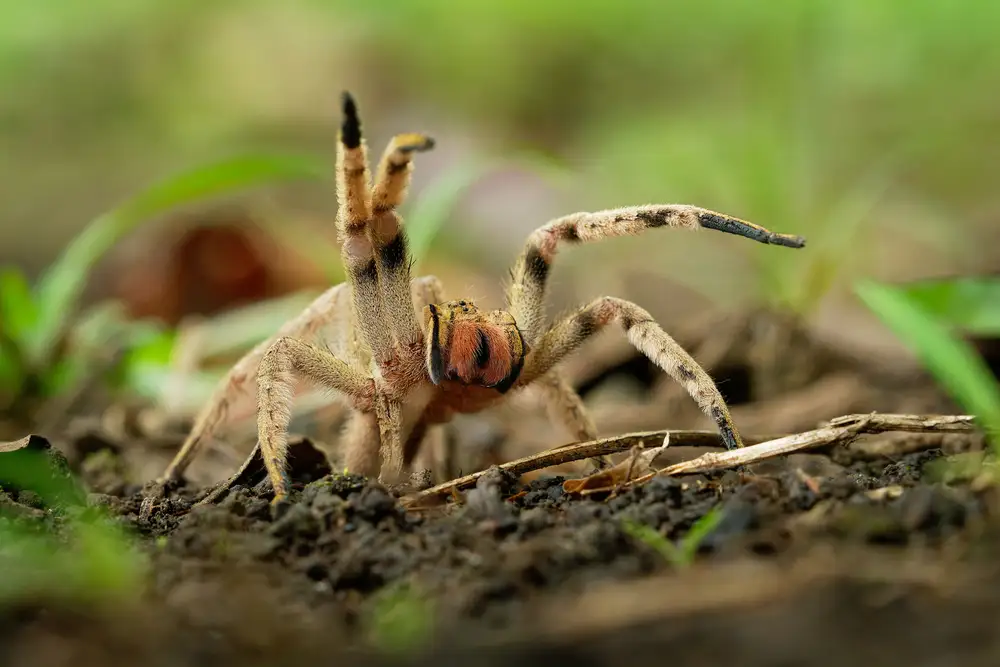
Their reputation outruns the clinical reality. Most recorded bites cause only severe local pain, sweating and swelling and need nothing more than pain control and observation; severe systemic envenomation, with high blood pressure, vomiting and heart-rhythm changes, is uncommon and falls mainly on small children. There is no Colombian antivenom for the genus, so treatment is supportive and guided by the national poison-information service, with Brazilian anti-arachnid serum the regional product for severe cases.
Widows and recluses
Widow spiders of the genus Latrodectus, including the South American black widow and the introduced brown widow, live in dry scrub, stone piles, fence lines and outbuildings of the Caribbean lowlands and dry inter-Andean valleys. A bite gives cramping pain spreading to the abdomen and back, with sweating and agitation, and responds to pain control and, in severe cases, the Latin American anti-latrodectus serum. Recluses of the genus Loxosceles are also present indoors and in stored material, and cause a painful, slowly ulcerating wound that needs medical review.
Bitten? Wash the site, use a cold pack, keep the limb still and go to a health centre; photograph the spider if it is safe. Spreading pain, sweating, vomiting, a racing heart or any bite on a child needs a hospital the same day. Never cut, suck, burn or tourniquet a bite.
The big spiders that are not a threat
The Colombian giant redleg tarantula, Megaphobema robustum, is the largest spider in the country, a dark rainforest animal with orange-red leg segments. It is defensive rather than dangerous: it flicks barbed urticating hairs that itch and irritate the eyes, and its bite, though mechanically painful, carries venom of no medical significance. The same is true of every other Colombian tarantula.
Huntsman spiders are the other false alarm: large, flat and startlingly fast on walls, with no medically important venom anywhere in their range. Golden silk orb-weavers, despite a leg span the width of a hand, drop from the web rather than bite. Colombia's biggest spiders and its dangerous ones are different animals.
Where you meet them
In and around houses
Warm-region houses hold a predictable set: cellar spiders on ceilings, cobweb spiders in corners, the southern house spider in wall cracks and Adanson's house jumper on door frames. All are harmless and all eat mosquitoes, flies and cockroaches; our guide to house spiders covers the group. Recluses are the one indoor spider to know, and they favour stored boxes, wardrobes and rarely worn clothing.

Gardens, farms and plantations
Hedges and garden plants carry Argiope and other orb-weavers, and the tropical tent-web spider builds colonial sheets over shrubs in dry coastal areas. Banana, plantain and coffee plots are where wandering spiders and people overlap, which is why harvest workers, not hikers, account for most Colombian bites.
Forest and paramo
Amazon and Choco rainforest hold the deepest diversity, while the paramo above the treeline supports a small, specialised set of ground and moss spiders. Colombia's funnel-web spider of the genus Linothele is a distinctive Andean forest species, unrelated to Australia's dangerous funnel-webs.
When Colombian spiders are most active
Most of Colombia has no cold season, so spiders are active all year and the calendar that matters is rainfall. Insect numbers, and with them spider numbers, climb during the two rainy periods that cover much of the country, roughly April to May and October to November, and webs are most conspicuous at the end of each wet spell.
Wandering spiders are nocturnal and become more obvious in homes during heavy rain, when flooding pushes them out of leaf litter and plantation debris. After a downpour in the lowlands, check inside boots, behind stacked crates and under bunched banana leaves before reaching in.
Look-alikes and the banana spider confusion
The phrase banana spider causes more trouble in Colombia than any other name. Locally it means Phoneutria, the wandering spiders of plantations; in North American usage it means the golden silk orb-weaver, a harmless web-builder. Ask what the spider was doing: one sitting in a big yellow-tinted web is an orb-weaver, while one running loose on the ground at night is the one to leave alone.
The other routine confusion is the false black widow, Steatoda grossa, a cosmopolitan cobweb spider found around Colombian buildings, especially at cooler elevations. Plum-brown and globular, it is killed on sight as a widow, yet it has no red hourglass, its bite is minor, and it preys on widows where the two meet. Tailless whip scorpions and harvestmen are also reported as giant venomous spiders; neither has venom glands.
Common Spiders in Colombia
- Silver Garden Orbweaver (Argiope argentata)
- Banana spiders
- Adanson’s House Jumper (Hasarius adansoni)
- Banded Garden Spider (Argiope trifasciata)
- Translucent Green Jumping Spiders
- Southern House Spider (Kukulcania hibernalis)
- Tropical Tent-web Spider (Cyrtophora citricola)
- Long-bodied Cellar Spider (Pholcus phalangioides)
- Common House Spider (Parasteatoda tepidariorum)
Biggest Spiders in Colombia
- Golden Silk Spider (Trichonephila clavipes)
- Colombian Giant Tarantula or Colombian Giant Red-legged Tarantula (Megaphobema robustum)
Most Venomous Spiders in Colombia
Cobweb Spiders/Tangle Web Spiders (Theridiidae)
 Cobweb SpidersWidow (Latrodectus)A guide to the widow spiders (Latrodectus): how to identify the genus, the species you may meet, the gumfoot web, and how serious a widow bi
 Cobweb SpidersFalse Black Widow (Steatoda grossa)Identify the false black widow (Steatoda grossa): size, colour, its gumfoot cobweb, how it differs from a true widow, and how bad the bite r
 Cobweb SpidersBrown Widow (Latrodectus geometricus)Identify the brown widow (Latrodectus geometricus) by its orange hourglass and spiky egg sac, and learn how its bite compares with a black w
Less Venomous Spiders in Colombia
Wandering Spiders

Jumping Spiders

Cobweb Spiders/Tangle Web Spiders (Theridiidae)
Long Jawed Spiders (Tetragnathidae)
 Cobweb SpidersRed House (Nesticodes rufipes)Identify the red house spider (Nesticodes rufipes): rusty red body, tangled indoor web, why it is mistaken for a widow, and what its bite ac
 Long-Jawed SpidersMabel's Orchard Orb Weaver Spider (Leucauge argyrobapta)Identify Mabel's orchard orb weaver (Leucauge argyrobapta): size, silver and green colouring, its horizontal web, range, and how it differs
Living with spiders in Colombia
Most Colombian spiders are harmless and the dangerous ones are avoidable with a few habits, so blanket spraying is wasteful. These measures target the real risk.
- Shake out shoes, boots, clothing and bedding, particularly in lowland areas and after rain.
- Wear gloves when handling banana and plantain bunches, firewood, crates and stored produce.
- Keep beds away from walls, avoid storing boxes under them, and vacuum behind wardrobes to deny recluses their hiding places.
- Use a torch outside at night in the lowlands; wandering spiders are nocturnal ground hunters.
- Seal gaps under doors, repair screens and cut back vegetation touching the walls.
- Leave garden orb webs alone. They cost nothing and remove mosquitoes.
Panama and Brazil share most of Colombia's medically important groups, and our most venomous spiders round-up shows how Phoneutria compares worldwide.
Frequently asked questions
Are there dangerous venomous spiders in Colombia?
Yes, three groups. Wandering spiders of the genus Phoneutria live in warm lowlands and plantations, widows occupy dry scrub and outbuildings, and recluses live indoors and in stored material. All three deserve medical attention after a bite. Tarantulas, huntsman spiders and orb-weavers, despite their size, are not medically significant.
What is the most dangerous spider in Colombia?
A Phoneutria wandering spider, most often Phoneutria boliviensis or P. depilata in lowland areas. Most bites cause severe local pain, sweating and swelling and settle with pain control and observation. Serious systemic cases are uncommon and mainly affect small children, but any suspected bite should be assessed at a health centre.
Is there antivenom for spider bites in Colombia?
There is no Colombian antivenom for Phoneutria; severe cases are managed supportively, and Brazilian anti-arachnid serum is the product used where one is required. Latin American anti-latrodectus serum exists for severe widow envenomation, and anti-loxosceles products are made regionally. Treatment decisions are guided by the national poison-information service.
What is the biggest spider found in Colombia?
The Colombian giant redleg tarantula, Megaphobema robustum, a dark rainforest tarantula with orange-red leg segments and a leg span of around twenty centimetres. It is defensive and will flick irritating urticating hairs, but its venom is not medically significant to humans. It lives in burrows in humid lowland forest.
Are Colombian tarantulas dangerous to humans?
No. No tarantula in Colombia has venom of medical significance. Their defences are retreat and the barbed urticating hairs they flick from the abdomen, which cause itching and can irritate eyes badly. A bite from a large species hurts mechanically, like a deep scratch, but produces no serious systemic effects.
What are banana spiders in Colombia?
In Colombia the name usually refers to Phoneutria wandering spiders, which shelter in banana and plantain bunches and are medically important. In North American usage the same name means the harmless golden silk orb-weaver. Judge by behaviour: a spider sitting in a large yellow-tinted web is the harmless one.
What are the most common spiders in Colombian homes?
Long-bodied cellar spiders on ceilings, cobweb spiders in corners, the southern house spider in masonry cracks, Adanson's house jumper on door frames and the gray wall jumping spider on sunlit walls. All are harmless and all reduce mosquito, fly and cockroach numbers indoors.
How can you identify a golden silk orb-weaver in Colombia?
Look for a large female with a long, spotted abdomen, a silvery front body and dark legs bearing tufts of hair, sitting head-down in a big, slightly yellow web that keeps the same site for weeks. Tiny males often share the web. The spider is harmless and very reluctant to bite.
Why does Colombia have so many spider species?
Because it packs Amazon and Pacific rainforest, Caribbean dry scrub, three Andean ranges and high paramo into one country, each with its own climate and insect supply. Well over a thousand species are described from Colombian territory, and poorly surveyed regions such as the Choco certainly hold many more.
What should you do after a spider bite in Colombia?
Wash the site with soap and water, apply a cold pack, keep the limb still and go to a health centre, bringing a photograph of the spider if possible. Seek hospital care the same day for spreading pain, sweating, vomiting or a racing heart, and for any bite on a young child.
Published August 30, 2023 · Last updated September 14, 2026