
Spiders in El Salvador
El Salvador packs a full tropical spider fauna into a small, steep country, and almost all of it is harmless. Only three groups matter medically: widow spiders of the genus Latrodectus, recluses of the genus Loxosceles, and the wandering spiders of the genus Phoneutria that reach the Central American lowlands. Everything else on this page, tarantulas and big house-invading huntsman spiders included, causes nothing worse than a painful nip.

On this page
- What spiders live in El Salvador?
- Which Salvadoran spiders are genuinely dangerous?
- Where you actually meet them
- Spider season and the rains
- Big spiders that are not the dangerous ones
- Common Spiders in El Salvador
- Biggest Spiders in El Salvador
- Most Venomous Spiders in El Salvador
- Less Venomous Spiders in El Salvador
- Living with spiders in El Salvador
- Frequently asked questions
What spiders live in El Salvador?
El Salvador is the smallest country in Central America and one of the most vertically varied: within a two-hour drive you cross hot Pacific coastal plain, a volcanic belt of cane and shaded coffee, and cool cloud forest on the northern ridges. Together they hold several hundred species, most of them small web-builders nobody notices.
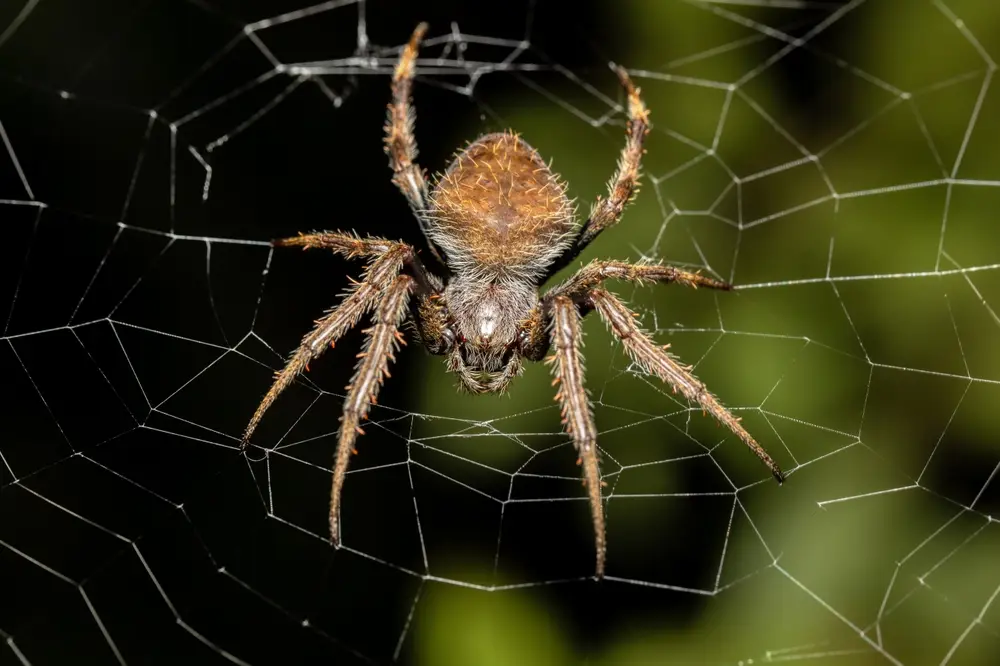
The animals people photograph are the orb-weavers. The tropical orb-weaver spins a large wheel across footpaths after dark and takes it down before dawn; the spinybacked orbweaver hangs in coffee shade like an enamel button with six black spines; arrow-shaped micrathena and Mabel's orchard orb weaver work at face height along forest edge. The biggest webs belong to the golden silk orb-weavers, whose yellow silk catches the light across riverside gaps.
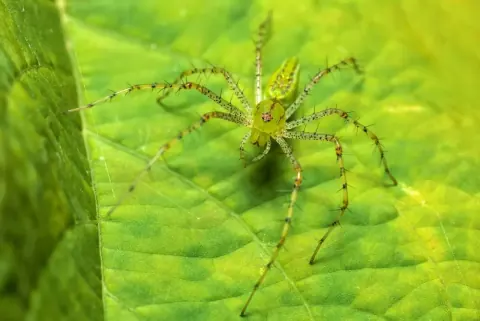
The hunters build no capture web. The green lynx waits on flower heads and takes bees in mid-air; jumping spiders stalk foliage and sunlit plaster, the emerald jumping spider on leaves and the gray wall jumping spider on walls and posts. On volcanic slopes, tarantulas such as the Costa Rican zebra tarantula wait at the mouth of silk-lined burrows at dusk.
Which Salvadoran spiders are genuinely dangerous?
Three genera, and no others. Widow spiders of the genus Latrodectus are the ones you are most likely to meet: black widows in rubble, woodpiles, meter boxes and under garden furniture, and the introduced brown widow, now common around lowland buildings and best identified by its spiky, cotton-boll egg sac rather than by colour. A widow bite produces latrodectism — sharp local pain, then cramping in the abdomen, back and thighs, sweating and a rising heart rate over several hours. It is worth a hospital visit, but deaths are very rare and antivenom for Latin American widows exists.

Recluses, genus Loxosceles, are the second group: small, uniformly tan, six-eyed and long-legged. They occupy the dry undisturbed spaces where people put their hands — behind stacked boards, inside cardboard, in clothing folded away for months — and bite only when pressed against skin. A minority of bites develop the slow-healing ulcer that gives the genus its reputation. This is the only spider in the country whose bite can leave a lasting wound, and it is the real source of the "necrotising" warning older lists apply to the whole Salvadoran fauna — a blanket claim that is simply false.
Third, wandering spiders. Phoneutria boliviensis is recorded across Central America and is the only member of its genus that plausibly reaches Salvadoran lowlands, usually in banana and plantain. Bites hurt at once and can bring sweating and agitation, but Central American cases are consistently milder than the genus's Brazilian reputation implies.
Bitten? Wash with soap and water, apply a cold pack and keep still. Photograph the spider only if it is safe. Never cut, burn, suck or apply chemicals. Go to a clinic at once for muscle cramps, sweating, chest or abdominal pain, vomiting, or a bite that darkens and spreads over 24 to 72 hours.
Where you actually meet them
In and around the house
Houses collect a predictable set: cellar spiders in bathroom corners, cobweb spiders behind furniture, jumping spiders on sunlit outside walls, and large flat huntsman spiders that appear at night and vanish behind a picture frame. Widows and recluses prefer the margins — pila surrounds, meter boxes, stored building materials, the gap behind a wardrobe that has not moved in a year.

Gardens, cane and coffee
The shade-coffee belt on the volcanic slopes is the richest spider habitat in the country. Orb-weavers rebuild between the bushes nightly, lynx spiders patrol flowering understorey, and the litter holds wolf spiders and ground hunters.
Forest and volcanic slope
Cloud forest on Montecristo and the upper volcano slopes supports species that never reach the coast. Dry forest and barranca walls in the south suit tarantulas, which take burrows under rocks and roots and are most visible when males wander in search of females.
Spider season and the rains
El Salvador has two seasons rather than four, and spiders follow the water. The dry season from November to April thins the visible fauna: webs are torn by wind and dust, and many species retreat to shaded gullies. The rains from May to October bring an explosion of flying insects, and spider numbers climb with them.
The peak for large webs is the end of the wet season, roughly September to November, when orb-weavers hatched in the early rains reach adult size and male tarantulas cross patios at dusk. Cellar spiders and huntsmen carry on indoors all year, because a Salvadoran house never gets cold enough to interrupt them.
Big spiders that are not the dangerous ones
Most alarm here is caused by size, not venom. The tiger bromeliad spider, Cupiennius salei, is the classic case: it is routinely labelled "large wandering spider", which makes people assume it is a Phoneutria. It is not. It sits in a different genus, lives in bromeliads, bananas and heliconias, and its bite causes brief local pain and nothing more.
The pantropical huntsman, Heteropoda venatoria, is the flat, fast, straw-brown spider on the bedroom wall: a leg span the width of a hand, no medical significance whatever, and one of the best cockroach controllers a tropical house can have. Tarantulas are the same story — impressive fangs, weak venom, and a real irritant that is not the bite but the cloud of urticating hairs a disturbed spider kicks off its abdomen.
Two frequent reports are not spiders. Tailless whip scorpions, the flat black arachnids with whip-like front legs on bathroom walls at night, have no venom glands at all. Harvestmen, with one oval body and no waist, make no silk and have no venom either. For perspective on the few spiders worldwide that warrant caution, see our round-up of the most venomous spiders.
Common Spiders in El Salvador
- Spined Micrathena (Micrathena gracilis)
- Silver Garden Orb Weaver Spiders (Argiope argentata)
- Arrowhead Orb Weaver Spiders (Verrucosa arenata)
- Pretty Orbweaver (Eriophora nephiloides)
Biggest Spiders in El Salvador
- Tiger Bromeliad Spider (Cupiennius salei) also known as Large Wandering Spider and American Wandering Spider
- Costa Rican Blue Front Tarantula (Aphonopelma crinirufum)
- Guatemalan Tiger Rumped Tarantula (Davus pentaloris)
- Golden Silk Spider (Trichonephila clavipes)
- Pantropical Huntsman Spider (Heteropoda venatoria)
Most Venomous Spiders in El Salvador
Cobweb Spiders/Tangle Web Spiders (Theridiidae)
 Cobweb SpidersBrown Widow (Latrodectus geometricus)Identify the brown widow (Latrodectus geometricus) by its orange hourglass and spiky egg sac, and learn how its bite compares with a black w
 Cobweb SpidersWidow (Latrodectus)A guide to the widow spiders (Latrodectus): how to identify the genus, the species you may meet, the gumfoot web, and how serious a widow bi
Less Venomous Spiders in El Salvador
Lynx Family
Jumping Spiders
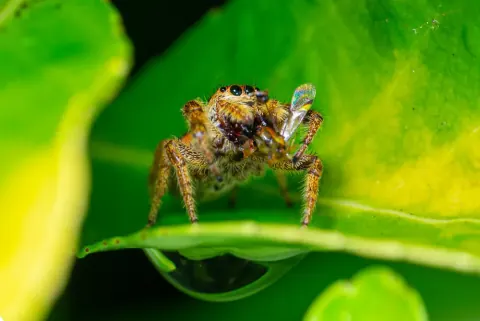 Jumping SpidersEmerald Jumping Spider (Paraphidippus aurantius)Identify the emerald jumping spider (Paraphidippus aurantius): its iridescent green scales, real size, range from the USA to Panama, and whe
 Jumping SpidersGray Wall Jumping (Menemerus bivittatus)Identify the gray wall jumping spider (Menemerus bivittatus): size, the flattened grey-haired body, its walls-and-tree-trunks habitat, and w
Orb Weavers
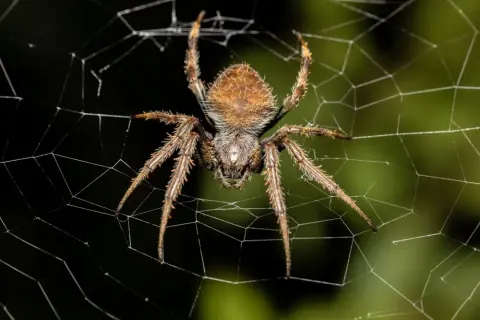 Orb WeaversTropical Orb-weaver (Eriophora ravilla)Identify the tropical orb-weaver (Eriophora ravilla): size, colour forms, the huge orb it builds and eats each night, its Gulf Coast range a
 Orb WeaversWestern Spotted Orbweaver Spider (Neoscona oaxacensis)Identify the western spotted orbweaver (Neoscona oaxacensis): size, mottled black-and-white abdomen, its nightly orb web, range and whether
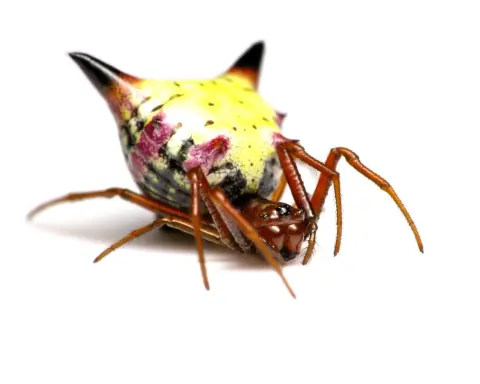 Orb WeaversArrow-shaped Micrathena (Micrathena sagittata)Identify the arrow-shaped micrathena (Micrathena sagittata): the yellow arrowhead abdomen, its two long rear spines, web, range, season and
 Orb WeaversGolden Silk Orb-Weaver (Nephila)Golden silk orb-weavers (Nephila): huge females, tiny males, giant golden webs, where they live, what they eat and whether their bite is dan
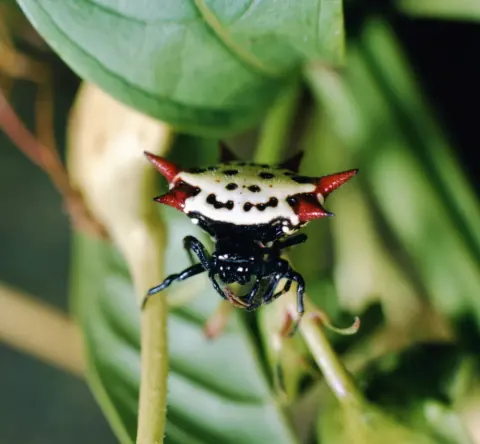 Orb WeaversSpinybacked Orbweaver (Gasteracantha cancriformis)Spinybacked orbweaver (Gasteracantha cancriformis) identification: six abdominal spines, colour forms, the silk-tufted web, range and whethe
 Long-Jawed SpidersMabel's Orchard Orb Weaver Spider (Leucauge argyrobapta)Identify Mabel's orchard orb weaver (Leucauge argyrobapta): size, silver and green colouring, its horizontal web, range, and how it differs
Tarantulas

Living with spiders in El Salvador
Spiders here remove an enormous volume of mosquitoes, flies, moths and cockroaches, and the genera that matter are managed by habit rather than by spraying — insecticide rarely reaches the cracks where widows and recluses sit.
- Wear gloves when you move stacked wood, bricks, roof sheets or stored boards, and lift them away from you.
- Shake out boots and work gloves, and do not leave shoes outside overnight.
- Store clothes and bedding in sealed boxes rather than open cardboard.
- Keep the strip around the house clear of rubble and cut vegetation, which is where widows build.
- Brush out corners, meter boxes and pila surrounds; removing webs and egg sacs beats spraying.
- Leave garden orb-weavers alone — one adult female clears thousands of insects before the dry season ends.
This fauna continues almost unchanged across the border into Guatemala. To understand what those big overnight webs are doing, read our guide to spider webs.
Frequently asked questions
What are the most common spiders in El Salvador?
Orb-weavers, by a wide margin. Tropical orb-weavers, spotted orbweavers, spinybacked orbweavers, micrathenas and orchard orb weavers build the circular webs seen in gardens, coffee shade and forest edge. Indoors, cellar spiders, cobweb spiders, jumping spiders and huntsman spiders are the usual residents. All of these are harmless to people.
Are the spiders in El Salvador dangerous?
Only three groups are. Widow spiders of the genus Latrodectus, recluses of the genus Loxosceles and, in lowland areas, wandering spiders of the genus Phoneutria have venom of medical importance. Every other spider in the country, including tarantulas and huntsman spiders, causes at worst brief local pain, swelling and itching.
Are there brown recluse spiders in El Salvador?
Not the North American brown recluse, Loxosceles reclusa, which is restricted to the central and southern United States. Central America has its own recluse species in the same genus, and they behave the same way: small, tan, six-eyed, living in dry stored material and biting only when pressed against skin.
Does El Salvador have tarantulas?
Yes. Several tarantula species live in burrows on volcanic slopes, in dry forest and under rocks and tree roots, including zebra-legged Aphonopelma species. They are large and long-lived but not medically significant. The practical hazard is the urticating hairs a disturbed tarantula flicks from its abdomen, which irritate skin and eyes.
What is the biggest spider in El Salvador?
Tarantulas have the heaviest bodies, with a leg span approaching twelve centimetres in a large female. The pantropical huntsman spider looks just as big because of its long, flat, sideways-held legs, and the tiger bromeliad spider is close behind. Golden silk orb-weavers are the largest web-builders, with long-legged females on very large webs.
Is the tiger bromeliad spider the same as a Brazilian wandering spider?
No, and this is the commonest mix-up in Central America. Cupiennius salei is often called a large or American wandering spider, but it belongs to a different genus from Phoneutria. It lives in bromeliads and banana plants and its bite causes brief local pain rather than serious envenomation.
What should I do if a spider bites me in El Salvador?
Wash the area with soap and water, apply a cold pack and stay still. Photograph the spider only if it is safe. Seek medical care immediately if you develop muscle cramps, sweating, abdominal or chest pain, vomiting, or if the wound darkens and spreads over the next two to three days.
Do huntsman spiders in Salvadoran houses need to be removed?
Not for safety reasons. The pantropical huntsman is a fast, flat, straw-coloured spider that hunts cockroaches, crickets and moths at night and is one of the most useful animals in a tropical house. It bites only if trapped against skin, and the effect is a brief sting with local redness.
Where are widow spiders found around Salvadoran homes?
In dark, sheltered pockets close to the ground: rubble piles, stacked blocks and roof sheets, water-meter and utility boxes, the underside of outdoor furniture, and gaps behind the pila. They rarely enter living space. Wearing gloves when moving stored material is the single most effective precaution.
When is spider season in El Salvador?
Numbers rise through the rains from May to October and peak at the end of the wet season, roughly September to November, when orb-weavers reach adult size and male tarantulas wander at dusk. The dry season from November to April is the quietest stretch outdoors, though indoor species remain active all year.
References
- National Institute for Occupational Safety and Health (NIOSH), Centers for Disease Control and Prevention — Venomous Spiders at Work www.cdc.gov/niosh/topics/spiders
- Isbister, G. K. & Fan, H. W. (2011). Spider bite. The Lancet 378(9808): 2039-2047. doi.org/10.1016/S0140-6736(10)62230-1
Published December 6, 2023 · Last updated September 14, 2026