
Spiders in Fiji
Fiji has no spider with venom of medical significance. The archipelago holds a typical Indo-Pacific island fauna — golden orb-weavers, dome-web spiders, jumping spiders and a handful of tramp species that arrived with shipping — and the only one worth naming at all is the introduced brown widow, whose bite is far milder than the name suggests. Nothing here justifies the warnings older travel lists attach to Fijian spiders.

On this page
- What spiders live in Fiji?
- Are any spiders in Fiji dangerous?
- Where you actually meet them
- Species on old Fiji lists that do not live here
- Season, rain and cyclones
- Common Spiders in Fiji
- Biggest Spiders in Fiji
- Most Venomous Spiders in Fiji
- Less Venomous Spiders in Fiji
- Living with spiders in Fiji
- Frequently asked questions
What spiders live in Fiji?
Fiji is an oceanic archipelago of more than 300 islands, and its spider fauna behaves accordingly. Remote islands receive their arachnids by air and sea rather than by land bridge, so the list is short, heavily weighted towards good dispersers, and topped up by tramp species that arrived in cargo. The result is web-builders in the vegetation, small hunters on the ground and a predictable set of tramps around buildings.

The spiders visitors notice are the big golden orb-weavers, whose yellow-tinted silk spans gaps between trees along tracks and river edges and is strong enough to stop a small bird. Beside them the dome web spider, Cyrtophora moluccensis, builds a tight horizontal dome slung in a scaffold of guy lines, often in colonies across a hedge. Smaller orb-weavers including Neoscona and the trashline Cyclosa, which decorates its web with a vertical line of prey husks, fill the layer below.
On foliage and sunlit trunks are jumping spiders, and Fiji has its own: Cosmophasis lami, a metallic green-and-bronze salticid named after Lami, sits alongside the more widespread Cosmophasis bitaeniata. Ground level belongs to wolf spiders hunting without webs across sand and leaf litter.
Are any spiders in Fiji dangerous?
No native Fijian spider is medically significant, and this is the main correction to make to older lists, which rank sac spiders as the country's "most venomous". Sac spiders of the genus Cheiracanthium do live in the Pacific, hunt at night without a capture web and occasionally bite when trapped against skin in bedding or clothing. The result is a sharp sting, redness and itching for a day or two. The necrosis once attributed to them has not held up in clinical review. Note also that the species usually pictured on these lists, the black-footed yellow sac spider, is an American animal; Fiji's sac spiders are other members of the same genus.

The one spider in Fiji with venom worth naming is not native at all. The brown widow, Latrodectus geometricus, has spread through warm ports worldwide and is established on many Pacific islands. It is a true widow with an orange hourglass and a spiky, cotton-boll egg sac, but its bites in practice stay local: sharp pain, redness and swelling, occasionally cramping, and almost never the systemic illness a black widow can cause.
Bitten? Wash the site with soap and water and apply a cold pack. There is no Fijian spider that requires antivenom. See a doctor if cramping or sweating develops, or if the wound becomes hot, swollen and weeping over the following days — that is an ordinary bacterial infection, which in a humid tropical climate is far more likely than any venom effect.
Where you actually meet them
Houses and resorts
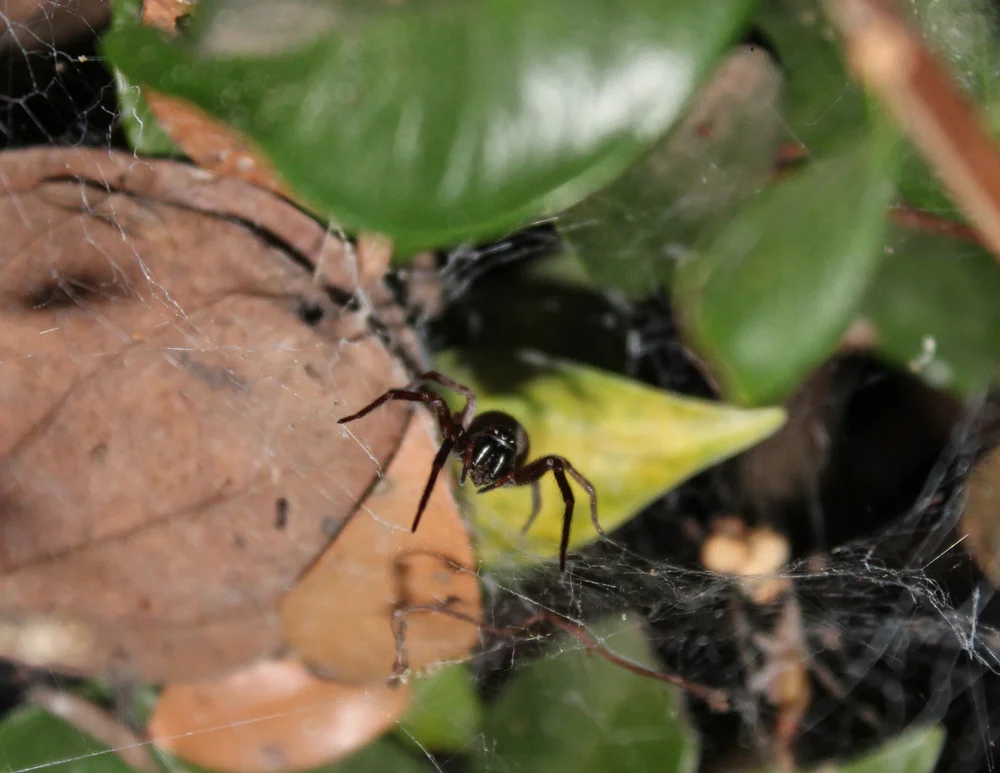
The grey house spider, Badumna longinqua, is the scruffy grey-brown spider whose lacy, hackled tangle fills window frames, eaves, meter boxes and outdoor light fittings. It is Australian in origin, now established around buildings across the Pacific, and harmless. Alongside it are long-legged cellar spiders such as Pholcus phalangioides in ceiling corners, small cobweb spiders behind furniture, and flat, fast huntsman spiders that hunt cockroaches on walls at night.
Gardens and plantations
Hibiscus hedges, cane, coconut and taro gardens hold the orb-weavers and dome-web colonies. This is where the big golden orb webs are strung, usually above head height across a gap with good insect traffic.
Forest, beach and rural tracks
Inland forest on Viti Levu and Vanua Levu is the least surveyed habitat and holds the most undescribed species. On the coast, wolf spiders work the strand line after dark. Closed footwear on rural paths at night is sensible — but for coral cuts, centipedes and broken glass rather than for spiders.
Species on old Fiji lists that do not live here
Several names attached to Fiji online belong to other countries entirely. The banded tunnel web spider, Hexathele hochstetteri, is a New Zealand mygalomorph and part of the New Zealand fauna, not the Fijian one; it is also harmless, despite the alarming name. The tarantula wolf spider, Lycosa tarantula, and the radiated wolf spider, Hogna radiata, are Mediterranean species that have never been part of a Pacific island fauna. "Tongan giant spider" is not a recognised species at all.
Two more entries are not spiders. Harvestmen have a single oval body with no waist, no silk glands and no venom, and are only ever called spiders by mistake. The "daddy long legs" label is applied to harvestmen, cellar spiders and crane flies indiscriminately, which keeps alive the untrue claim that one of them is the most venomous animal in the world with fangs too short to use.
Where genuinely large spiders are concerned, Fiji's belong to the golden orb-weaver group, and the same handful of big Indo-Pacific web-builders reaches down through Australia. For a realistic picture of which spiders anywhere warrant caution, see our round-up of the most venomous spiders.
Season, rain and cyclones
Fiji's spider year tracks the wet season rather than temperature. From November to April, warm rain and high humidity drive insect numbers up and spider populations follow, so this is when the golden orb webs are largest and most numerous and when garden webs reappear across paths every morning.
Cyclones reset the picture abruptly. A severe storm strips webs, vegetation and egg sacs from an entire coast, and the rebuilding that follows is fast: orb-weavers are strong ballooners and recolonise cleared ground within weeks. The drier season from May to October is quieter outdoors, but house species carry on unchanged, since a Fijian building never gets cold enough to slow them down.
Common Spiders in Fiji
- Common House Spiders
- Brown House Spider
- Harvestman Spider
- Dome web spider (Cyrtophora moluccensis)
- Yellow Garden Spider
- Zipper Spider
- Trashline orbweavers (Cyclosa litoralis)
- Spotted orb-weavers (Neoscona plebeja)
- Green Ant Hunter Spider (Cosmophasis bitaeniata)
- Lami Beach Northern Jumping Spider (Cosmophasis lami)
Biggest Spiders in Fiji
- Banded Tunnel Web Spider (Hexathele hochstetteri ausserer)
- Tongan Giant Spiders
- Radiated Wolf Spider (Hogna radiata)
- Tarantula wolf spider (Lycosa tarantula)
- Daddy Long Legs Spiders (Pholcus phalangiodes)
- Female Golden Orb Weaver/Northern Golden Orb Weaver/Giant Golden Orb Weaver (Nephila pilipes)
- Golden Silk Orb Weaver
Most Venomous Spiders in Fiji
Sac Spiders

Less Venomous Spiders in Fiji
Desidae
Living with spiders in Fiji
Because no Fijian spider can seriously hurt you, the practical questions are about comfort and about the insects the spiders are eating for you — mosquitoes above all, in a country where dengue matters far more than any arachnid.
- Move a spider outdoors with a glass and a card rather than killing it; the ones indoors are eating mosquitoes and cockroaches.
- Brush webs out of window frames, eaves and light fittings now and then instead of spraying; removing the web and its egg sacs is what actually works.
- Shake out shoes, towels and clothing left outside or in an open bure, mainly to dislodge ants, centipedes and geckos.
- Wear gloves when you move firewood, coconut husk, stacked timber or garden rubbish.
- Leave the big golden orb webs alone. They are strung above head height on purpose and their owner is not interested in you.
- Check bedding in rooms closed up for weeks, which is where wandering sac spiders end up.
Fiji's forest interior is still poorly documented, so clear photographs of jumping spiders and orb-weavers are genuinely useful records.
Frequently asked questions
Are there venomous spiders in Fiji?
Every spider has venom, but none in Fiji is medically significant. Sac spiders can give a sharp, itchy bite if trapped against skin, and the introduced brown widow can cause local pain and swelling. Neither requires antivenom. There are no recluses, no funnel-webs and no wandering spiders in the country.
What is the biggest spider in Fiji?
The golden orb-weavers. Adult females have small bodies relative to very long legs, giving a span that can approach twelve centimetres, and they build the biggest webs on the islands in yellow-tinted silk. They are shy, reluctant to bite, and the males sharing the web are a fraction of the female's size.
What spiders live inside Fijian houses?
The grey house spider in window frames and eaves, cellar spiders in ceiling corners, small cobweb spiders behind furniture, and huntsman spiders hunting cockroaches on walls after dark. Jumping spiders come in through open windows on sunny days. All of them are harmless, and all of them reduce the insect load indoors.
Is the banded tunnel web spider found in Fiji?
No. Hexathele hochstetteri is a New Zealand species and is not part of the Fijian fauna, despite appearing on several Fiji spider lists. It is also not dangerous. Fiji has no large burrowing mygalomorph that poses any risk to people, and no funnel-web of the Australian medically important group.
Does Fiji have black widow spiders?
No native widow occurs in Fiji, but the introduced brown widow, Latrodectus geometricus, is established around buildings on many Pacific islands. It is glossy with an orange hourglass and a spiky egg sac. Bites cause local pain and swelling rather than the systemic illness associated with black widows elsewhere.
How do you identify a golden orb-weaver web?
By the silk. It is distinctly yellow in sunlight, unusually strong, and the web is large, slightly asymmetrical and left standing for days rather than rebuilt nightly. There is often a mess of small threads to one side and several tiny males waiting at the edge of the female's hub.
Should I worry about spider bites in rural Fiji at night?
Not really. Closed footwear on rural paths after dark is sensible, but the reasons are coral cuts, broken glass, centipedes and ants rather than spiders. No Fijian spider hunts or attacks people, and bites happen almost exclusively when a spider is pressed against skin inside clothing or bedding.
Are wolf spiders common in Fiji?
Ground-hunting spiders including wolf spiders are present and are active at night on sand, litter and open ground, where a torch picks up their eyeshine. The specific Mediterranean species listed on some Fiji pages, such as Lycosa tarantula and Hogna radiata, do not occur anywhere in the Pacific islands.
What should I do if a spider bites me in Fiji?
Wash the area with soap and water, apply a cold pack and watch it. No antivenom is needed anywhere in Fiji. See a doctor if you develop cramping or sweating, or if the wound becomes hot, red and weeping over the next few days, which points to infection rather than venom.
Is the daddy long legs the most venomous spider in Fiji?
No, and the claim is false everywhere. Cellar spiders have weak venom in very small quantities and can bite, but nothing follows. The same myth is attached to harvestmen, which are not spiders at all: they have no silk glands, no venom glands and no fangs capable of piercing skin.
References
- Australian Museum — Spiders: identification, biology and classification australian.museum/learn/animals/spiders/
- Isbister, G. K. & Fan, H. W. (2011). Spider bite. The Lancet 378(9808): 2039-2047. doi.org/10.1016/S0140-6736(10)62230-1
Published August 26, 2023 · Last updated September 14, 2026