
Spiders in Honduras
Honduras has pine highlands, cloud forest, dry interior valleys and the rainforest of La Mosquitia, and every one of them holds spiders. Three lineages account for all the medically serious bites in the country: Latrodectus widows, Loxosceles recluses and, on the hot coastal lowlands, Phoneutria boliviensis. The tarantulas and hand-sized bromeliad spiders that frighten people most are not among them.

On this page
- What spiders live in Honduras?
- Which Honduran spiders are actually dangerous?
- Where you actually meet them
- Spider season and the Honduran rains
- The big frightening ones that are harmless
- Common Spiders in Honduras
- Biggest Spiders in Honduras
- Most Venomous Spiders in Honduras
- Less Venomous Spiders in Honduras
- Living with spiders in Honduras
- Frequently asked questions
What spiders live in Honduras?
Honduras is the most mountainous country in Central America and the only one with vast highland pine savanna, a mix no neighbour quite matches: wet Caribbean coast and banana plantation in the north, rainforest and swamp in La Mosquitia, cloud forest on Celaque and Cusuco, dry interior valleys around Comayagua and the Aguán, a hot Pacific strip on the Gulf of Fonseca. There are no deserts here, whatever older lists say — only rain shadows. The spider fauna runs into the hundreds of species, almost all of it small and harmless.
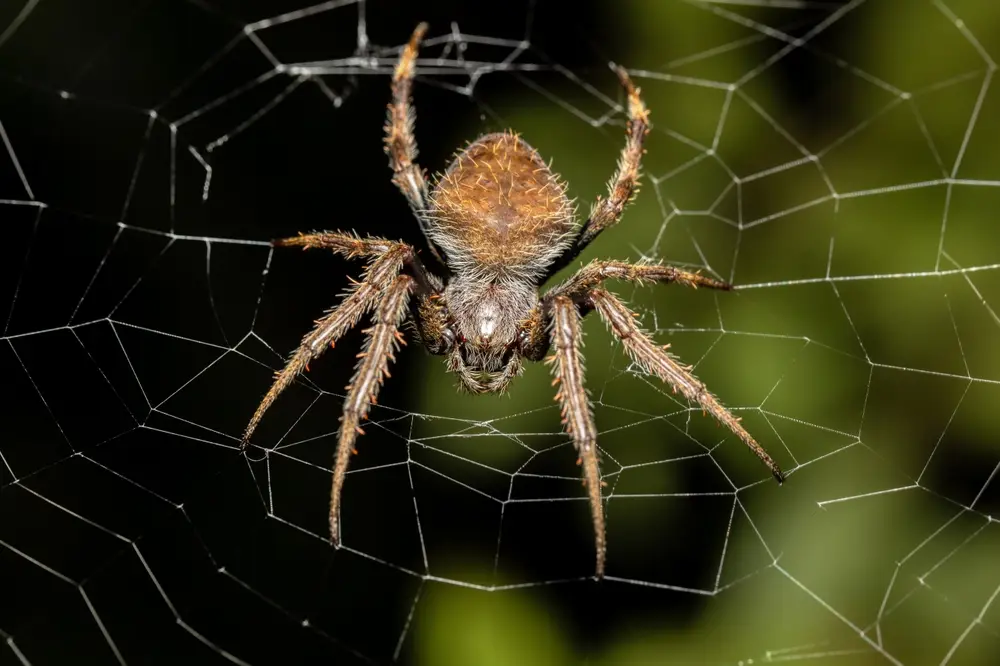
The conspicuous animals are orb-weavers: the tropical orb-weaver putting up a wheel after dark and taking it down at first light, the spinybacked orbweaver hanging in coffee and citrus like a hard enamel chip, micrathenas at eye level along trails, and the golden silk orb-weaver stringing yellow cable across river gaps.
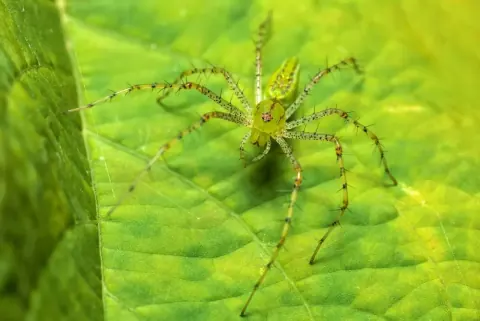
The hunters need no web. The green lynx is the bright green spider that grips a flower head and snatches bees out of the air. Jumping spiders work every sunlit surface, from the emerald jumping spider on leaves to the gray wall jumping spider on plaster, and wolf spiders patrol litter after dark. Tarantulas such as the zebra tarantula sit at the mouth of a silk-lined burrow at dusk.
Which Honduran spiders are actually dangerous?
Three genera. Widow spiders of the genus Latrodectus are the first and the likeliest — black widows in rubble, woodpiles and utility boxes, and the introduced brown widow around lowland buildings, recognised by an egg sac studded with short silk spikes rather than by colour. A bite sets off latrodectism over a few hours: muscle cramp radiating into the belly, lower back and thighs, clammy skin and a queasy stomach. It deserves a hospital assessment, and it is very rarely fatal.

This is where a common claim needs correcting. Cobweb spiders as a family are not "highly venomous": Theridiidae holds thousands of species, the harmless house spiders in your ceiling corners among them, and only the widows within it carry venom of medical importance.
Second, recluses of the genus Loxosceles — small, plain tan, long-legged, with six eyes in three pairs. They occupy the dry, undisturbed places people reach into blind: stacked boards, cardboard, stored clothing, the back of a cupboard. A small share of bites develop the slow ulcer the genus is known for, which makes this the one spider in Honduras capable of leaving a lasting wound.
Third, the wandering spider Phoneutria boliviensis, which reaches the hot lowlands and turns up in banana and plantain. Its bite hurts immediately and can bring agitation and heavy sweating, yet the cases recorded across Central America run milder than the genus's Brazilian notoriety would suggest.
Bitten? Rinse the bite under running water with soap, cool it with an ice pack wrapped in cloth, and keep the limb quiet. Bring a photograph of the spider if taking one is safe. No cutting, no heat, no suction device, nothing poured on the skin. Reach a clinic straight away if muscle cramp sets in, or heavy sweating, vomiting or pain in the chest or belly — and the same if the mark turns dark and keeps growing after the first day.
Where you actually meet them
In and around the house
Cellar spiders take bathroom corners, cobweb spiders the gaps behind furniture, jumping spiders the sunlit outside wall, and a flat huntsman arrives after dark. Widows and recluses keep to the margins — meter boxes, the pila surround, stacked block and timber, a suitcase left under a bed.

Plantation, coffee and garden
Banana and plantain on the north coast and shade coffee in the western hills carry more spiders per hectare than anything else in the country: fresh orb webs between the plants nightly, lynx spiders in the flowering understorey.
Cloud forest, pine and lowland rainforest
Cusuco and Celaque hold cool-forest species that never reach the coast, and the central pine savanna has its own ground fauna. In La Mosquitia the big web-builders and the lowland wandering spiders are at their most abundant.
Spider season and the Honduran rains
Most of the country runs on a dry season from roughly November to April and rains from May to October, though the Caribbean coast stays wet almost year-round. Insects surge with the rain and spiders surge behind them, so silk is at its most conspicuous as the wet season ends, roughly September to November — which is also the height of hurricane season, when one storm can strip a hillside bare.
Recovery is quick, because spiderlings balloon on air currents and recolonise gaps within weeks. Altitude matters as much as the calendar: highland nights in Intibucá slow spiders considerably, while on the north coast house spiders breed without interruption. For the underlying pattern, see how a spider's life cycle maps onto a tropical year.
The big frightening ones that are harmless
Honduras's most famous spider is a pet, not a hazard. The Honduran curly hair tarantula is a stocky, dark, bristly Central American theraphosid, now formally Tliltocatl albopilosus after being moved out of Brachypelma in 2020, and still sold worldwide as the curly hair tarantula. It is famously placid, its venom is no threat to a person, and the only real irritant is the urticating hairs it flicks when cornered.
The bromeliad spiders are the other source of alarm. Cupiennius salei and Cupiennius getazi are big, long-legged, fast and often labelled "tiger wandering spiders", which leads people to assume Phoneutria. They sit in a separate family, spend the night hunting among bromeliads, banana and heliconia, and a bite from one fades within the hour.
"Banana spider" is the same trap with a north-coast accent. On a Honduran plantation the name usually belongs to the pantropical huntsman, Heteropoda venatoria — flat, straw-coloured, medically insignificant and a first-class cockroach hunter — or to the golden silk orb-weaver, whose worst offence is a web across your face. Harvestmen and the flat, whip-legged amblypygids on bathroom walls get reported as spiders too, and neither owns a venom gland.
Common Spiders in Honduras
- Arrowhead Orb Weaver (Verrucosa arenata)
- Pretty Orb Weaver (Eriophora nephiloides)
- Silver Garden Orb Weaver (Argiope argentata)
Biggest Spiders in Honduras
- Tiger Bromeliad Spider / Tiger Wandering spider (Cupiennius salei)
- Spot-legged Bromeliad Spider (Cupiennius getazi)
- Costa Rican Blue Front Tarantula - also known as the Nicaraguan Blue Front Tarantula (Aphonopelma crinirufum)
- Honduran Curly-haired Tarantula (Tliltocatl albopilosus)
Most Venomous Spiders in Honduras
Cobweb Spiders/Tangle Web Spiders (Theridiidae)
 Cobweb SpidersBrown Widow (Latrodectus geometricus)Identify the brown widow (Latrodectus geometricus) by its orange hourglass and spiky egg sac, and learn how its bite compares with a black w
 Cobweb SpidersWidow (Latrodectus)A guide to the widow spiders (Latrodectus): how to identify the genus, the species you may meet, the gumfoot web, and how serious a widow bi
Less Venomous Spiders in Honduras
Lynx Spiders
Jumping Spiders
 Jumping SpidersGray Wall Jumping (Menemerus bivittatus)Identify the gray wall jumping spider (Menemerus bivittatus): size, the flattened grey-haired body, its walls-and-tree-trunks habitat, and w
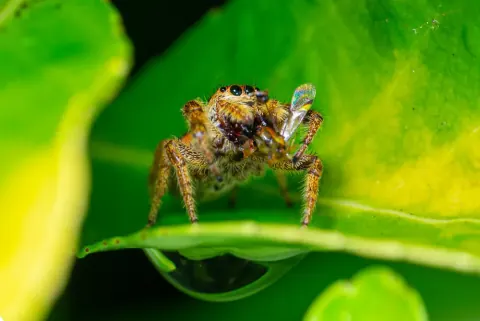 Jumping SpidersEmerald Jumping Spider (Paraphidippus aurantius)Identify the emerald jumping spider (Paraphidippus aurantius): its iridescent green scales, real size, range from the USA to Panama, and whe
Orb Weaver
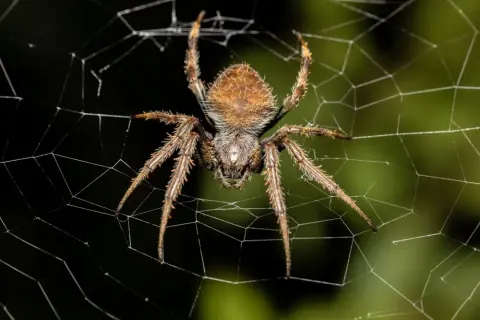 Orb WeaversTropical Orb-weaver (Eriophora ravilla)Identify the tropical orb-weaver (Eriophora ravilla): size, colour forms, the huge orb it builds and eats each night, its Gulf Coast range a
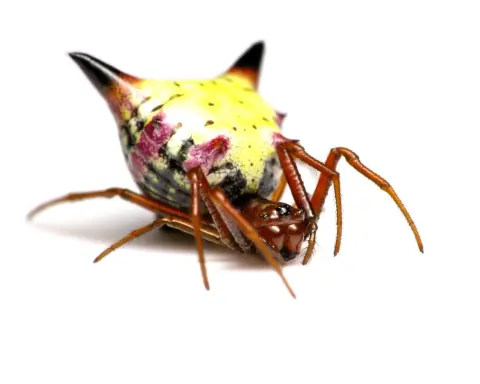 Orb WeaversArrow-shaped Micrathena (Micrathena sagittata)Identify the arrow-shaped micrathena (Micrathena sagittata): the yellow arrowhead abdomen, its two long rear spines, web, range, season and
 Orb WeaversGolden Silk Orb-Weaver (Nephila)Golden silk orb-weavers (Nephila): huge females, tiny males, giant golden webs, where they live, what they eat and whether their bite is dan
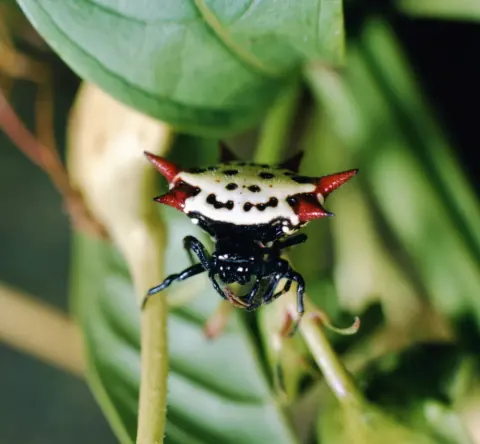 Orb WeaversSpinybacked Orbweaver (Gasteracantha cancriformis)Spinybacked orbweaver (Gasteracantha cancriformis) identification: six abdominal spines, colour forms, the silk-tufted web, range and whethe
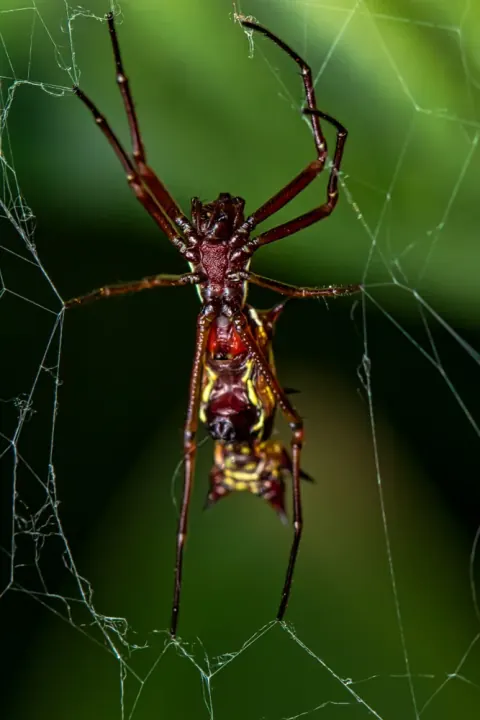 Orb WeaversSpined Micrathena (Micrathena gracilis)Identify the spined micrathena (Micrathena gracilis): its black-and-white spined abdomen, the dense daytime orb web it rebuilds each morning
 Orb WeaversWestern Spotted Orbweaver Spider (Neoscona oaxacensis)Identify the western spotted orbweaver (Neoscona oaxacensis): size, mottled black-and-white abdomen, its nightly orb web, range and whether
Tarantulas

Living with spiders in Honduras
Honduran spiders remove a vast number of mosquitoes, flies and cockroaches every night, and the genera worth managing respond to housekeeping rather than to spray.
- Wear gloves to move firewood, block, roofing sheets and stored timber, and lift them away from your body.
- Shake out boots and work clothes, and do not leave shoes outside overnight.
- Keep clothing and bedding in sealed boxes rather than open cardboard.
- Clear rubble from the strip around the house, which is where widows settle.
- Sweep meter boxes, pila surrounds and ceiling corners; removing webs and egg sacs beats chemicals.
- Leave the garden orb-weavers where they are — one adult female eats thousands of insects in a season.
Cross the southern border into Nicaragua and the species list barely changes. For the few species anywhere in the world that genuinely justify caution, see our round-up of the most venomous spiders.
Frequently asked questions
What are the most common spiders in Honduras?
Outdoors it is orb-weavers: the silver garden and arrowhead species, tropical orb-weavers, micrathenas and the spinybacked orbweaver, in gardens, coffee and along forest edges. Jumping spiders cover sunlit walls and wolf spiders work the litter. Indoors you get cellar spiders, cobweb spiders and a huntsman. None of them is dangerous.
Are there medically significant spiders in Honduras?
Three, and only three: Latrodectus widows, Loxosceles recluses, and Phoneutria boliviensis on the hot coastal lowlands. Everything else in the country — tarantulas, huntsmen, bromeliad spiders, lynx spiders, orb-weavers — tops out at a short sting with some redness and itching around the mark.
Are all cobweb spiders in Honduras highly venomous?
No. The family Theridiidae contains thousands of species, most of which are harmless house and garden spiders with venom that does nothing to a person. Only the widow spiders within it, the genus Latrodectus, carry venom of medical importance. Labelling the whole family dangerous is a long-standing error.
Is the Honduran curly hair tarantula dangerous?
No. It is one of the calmest tarantulas kept in captivity, and its venom poses no threat to a healthy person. If harassed it will flick urticating hairs from its abdomen, which itch on skin and sting badly in the eyes. Its current scientific name is Tliltocatl albopilosus, formerly Brachypelma albopilosum.
What is the biggest spider in Honduras?
A tarantula carries the most bulk, a big female reaching roughly twelve centimetres across the legs. Cupiennius salei and Cupiennius getazi look comparable thanks to their long legs, and so does the pantropical huntsman. The largest web-builder is the golden silk orb-weaver, whose long-bodied female sits on an enormous sheet of yellow silk.
Is the tiger wandering spider the same as a Brazilian wandering spider?
No. The nickname sticks to Cupiennius salei, but the animal sits in a separate family from Phoneutria. It spends its nights hunting insects among bromeliads, banana and heliconia, and the worst a bite delivers is a short burst of local pain, not serious envenomation.
Should I worry about banana spiders in Honduras?
Usually not. On Honduran plantations the name is normally applied to the pantropical huntsman or the golden silk orb-weaver, both of which are harmless. The one genuine concern in banana and plantain is Phoneutria boliviensis, which is far less common and bites only when trapped against skin.
Are there recluse spiders in Honduras?
Yes. Native Loxosceles species live in dry, undisturbed places inside and around buildings: stacked boards, cardboard boxes, stored clothing and the backs of cupboards. A bite happens only when one is squeezed against skin, and a small share of those produce a slowly ulcerating wound that needs medical care rather than home treatment.
What tarantulas live in Honduras besides the curly hair?
Several terrestrial burrowers of the genus Aphonopelma occur in the region, including the blue-front tarantulas and the zebra-legged species of the Pacific slope. Each digs a silk-lined burrow beneath a rock or tree root, and they are easiest to see when adult males set off at dusk looking for a mate. None is medically significant.
When is spider season in Honduras?
Numbers climb through the May to October rains and reach their high point as the wet season ends, roughly September to November, with females full-grown and webs at maximum size. November to April is quieter outdoors, though the humid Caribbean coast never really shuts spider activity down.
References
- National Institute for Occupational Safety and Health (NIOSH), Centers for Disease Control and Prevention — Venomous Spiders at Work www.cdc.gov/niosh/topics/spiders
- Isbister, G. K. & Fan, H. W. (2011). Spider bite. The Lancet 378(9808): 2039-2047. doi.org/10.1016/S0140-6736(10)62230-1
Published December 4, 2023 · Last updated September 14, 2026