
Spiders in Hong Kong
Hong Kong has no deadly spider. Its fauna is the standard subtropical South China set: huge golden orb webs strung across country-park paths, flat huntsman spiders on walls after dark, jumping spiders on sunlit concrete and cobweb spiders in every stairwell. The only species of real medical interest is the introduced brown widow, and there is no established recluse anywhere in the territory.

On this page
- What spiders live in Hong Kong?
- Are there dangerous spiders in Hong Kong?
- Species that do not belong on a Hong Kong list
- Where you meet them
- Spider season in Hong Kong
- Common Spiders in Hong Kong
- Biggest Spiders in Hong Kong
- Most Venomous Spiders in Hong Kong
- Less Venomous Spiders in Hong Kong
- Living with spiders in Hong Kong
- Frequently asked questions
What spiders live in Hong Kong?
Hong Kong squeezes secondary woodland, upland grassland, stream valleys, mangrove and one of the densest cities on earth into a little over a thousand square kilometres. Roughly three quarters of the territory sits outside the built-up area, much of it inside country parks, and that green backbone is why a city this size still holds a well over a hundred recorded spider species, with new records still appearing as the hillsides are surveyed.

What you actually meet sorts into a handful of groups. Big orb-weavers dominate the trails, led by the giant golden orb-weaver, whose yellow-tinted web can span the gap between two trees over a footpath. Smaller Argiope and Gasteracantha orb-weavers work the shrub layer. Jumping spiders such as the grey wall jumper patrol sunlit concrete and balcony railings by day. Huntsman spiders take over the same walls at night. Flattened two-tailed spiders of the genus Hersilia press themselves against tree trunks until they are almost invisible, and wolf spiders hunt on damp ground beside streams and paddies.
Are there dangerous spiders in Hong Kong?
No Hong Kong spider has been shown to kill a healthy person, and the territory produces no spider antivenom because none is needed. The one species with genuine medical interest is the brown widow, Latrodectus geometricus, an introduced tropical cobweb spider that tangles its untidy web under garden furniture, in electricity meter boxes, along fence rails and inside stacked flowerpots. Its bite gives sharp local pain, redness and a cramping ache that usually eases within a day or two; systemic reactions are far milder than those of the bigger black widows. Its Australian relative the redback, Latrodectus hasseltii, turns up in the wider region as a stowaway in cargo, so a widow-shaped spider with a red stripe is worth photographing rather than handling.

Everything else on the classic Hong Kong list is painful at worst. Sac spiders of the genus Cheiracanthium can bite when trapped against skin in bedding, giving a stinging welt; the necrotic reputation attached to the group, including to the American black-footed yellow sac spider, is not supported by clinical evidence. Huntsman, orb-weavers and jumping spiders are all harmless. Nothing on our most venomous spiders shortlist lives here.
Bitten? Wash the site with soap and water, apply a cold pack and take a simple painkiller. Photograph the spider if you can do it safely. Get medical care for a bite on a young child, for spreading cramps, sweating or vomiting, or if the wound turns hot, swollen and weeping after a couple of days, which points to bacterial infection rather than venom.
Species that do not belong on a Hong Kong list
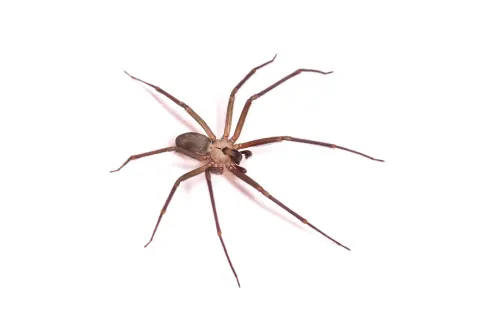
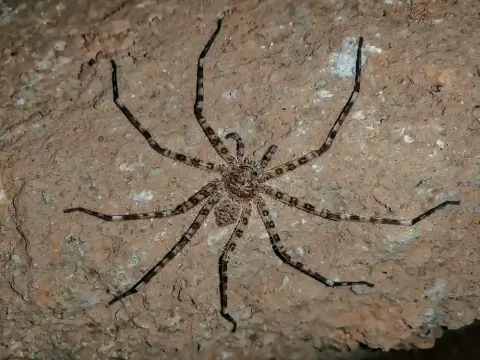
Older versions of this page, like most spider lists for Asia, borrow animals from other continents. The brown recluse is a North American species of the central and southern United States and has no established population anywhere in Hong Kong or southern China; slow-healing sores here are infections, burns or bites from other arthropods, never a recluse. The giant huntsman, Heteropoda maxima, is a cave species described from Khammouane in Laos; the large huntsman that crosses a Hong Kong ceiling is the pantropical cane spider, Heteropoda venatoria.

Two more names travel badly. The cross orb-weaver is a temperate European and North American garden spider, not a subtropical one, and the giant crab spider Olios giganteus named in some Hong Kong lists is a Sonoran Desert animal from Arizona and Mexico. The banded garden spider is the one genuinely wide-ranging Argiope on the list. It is also worth stating plainly that Australian funnel-webs — the family Atracidae, covered on our Australian funnel-web page — occur only in eastern Australia and have never lived in Hong Kong, whatever a holiday rumour says.
Where you meet them
Flats, stairwells and village houses
Cellar spiders hold bathroom and stairwell corners with loose tangles, small cobweb spiders take ceiling angles, jumping spiders work window frames and light wells, and huntsman spiders appear on bedroom walls at night. The huntsman is the most useful animal in the building — a fast, effective cockroach hunter that runs rather than fights. Our house spiders guide covers the same indoor cast worldwide.
Country parks and hiking trails
The trails on Lantau, in the Tai Mo Shan uplands and along the MacLehose Trail carry the heaviest web traffic anywhere in the territory. Golden orb webs are strung head-high across gaps, spiny Gasteracantha shells hang in low shrubs, and trunk-hugging Hersilia spiders sit flattened on bark with their long spinnerets held apart.
Gardens, podium planting and village edges
Brown widows shelter under pot rims, in drainage holes and beneath plastic furniture, which is exactly where fingers go. Lynx spiders hunt on foliage, and orb-weavers rebuild nightly across gaps between shrubs and railings.
Spider season in Hong Kong
Hong Kong is warm enough that spiders remain active all year, so nothing truly overwinters, but the population still has a strong rhythm. The wet season from roughly May to September floods the hills with insects, webs get larger, and orb-weavers reach full adult size in its second half. August to October is when the golden orb webs across country-park paths are at their most spectacular and when sightings peak.
Typhoon rain and the winter monsoon both push spiders indoors for short bursts: heavy rain floods ground-dwellers out of leaf litter and drains, while the cool, dry northerlies of December to February concentrate activity around heated interiors and lit walkways where insects still gather. Egg sacs guarded through the cooler months hatch as the humidity returns in spring.
Common Spiders in Hong Kong
- Common two-tailed spider
- Pirate Wolf Spider
Biggest Spiders in Hong Kong
- Giant Golden Orb weaver (Nephila pilipes)
- Giant Huntsman Spider (Heteropoda maxima)
- Giant Crab Spider (Olios giganteus)
Most Venomous Spiders in Hong Kong
Sac Spiders

Sicariidae
Cobweb Spiders/Tangle Web Spiders (Theridiidae)

Less Venomous Spiders in Hong Kong
Huntsman Spiders (Sparassidae Family)
Orb Weaver
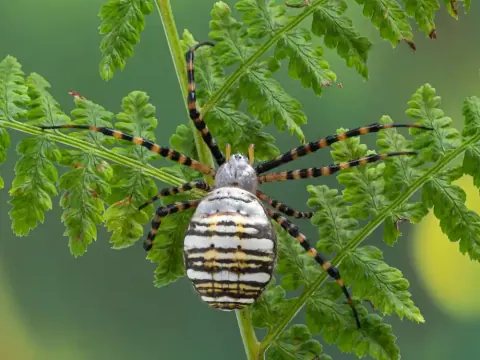 Orb WeaversBanded Garden (Argiope trifasciata)Identify the banded garden spider (Argiope trifasciata): silver banding, size, the zigzag in its web, egg sac, range, and whether its bite i
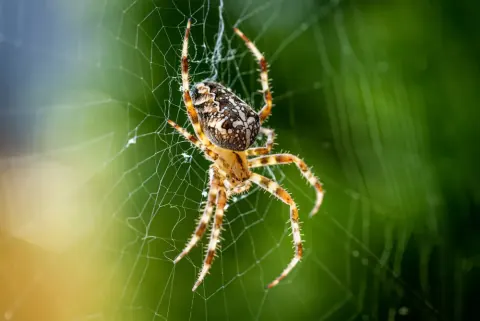 Orb WeaversCross Orb Weaver (Araneus diadematus)Identify the cross orb weaver (Araneus diadematus) by the white cross on its abdomen: size, colour, web, egg sac, range and whether the bite
 Orb WeaversGiant Wood Spider (Nephila pilipes)Identify the giant wood spider (Nephila pilipes): huge black-and-yellow females, tiny males, golden orb webs, range, diet and whether its bi
Jumping Spiders

Living with spiders in Hong Kong
In a subtropical city the spiders in your flat are free mosquito and cockroach control, and removing them changes nothing while the insects that feed them remain. A few habits remove almost all risk of a bite:
- Wear gloves when moving stacked flowerpots, bricks, timber and garden furniture, where brown widows shelter.
- Shake out shoes, gloves and laundry left on a floor or balcony overnight.
- Brush webs off window frames and furniture undersides rather than spraying insecticide indoors.
- Walk trails with a stick held ahead of you in late summer so you break orb webs before they reach your face.
- Leave the huntsman on the wall alone; it will be gone by morning and it is eating your cockroaches.
For neighbouring faunas see our guides to Vietnam and Thailand, and to understand how those huge trailside webs are engineered, read how spider webs work.
Frequently asked questions
How many spider species live in Hong Kong?
Well over a hundred species have been recorded in the territory, and the list still grows as the country parks are surveyed. That diversity comes from the green three quarters of Hong Kong that lies outside the built-up area: woodland, upland grassland, stream valleys and mangrove all support different spider communities.
Are there dangerous spiders in Hong Kong?
None that threaten a healthy adult. The introduced brown widow is the only species of real medical interest, and its bite causes local pain, redness and a cramping ache that usually settles within a day or two. Everything else you are likely to meet, including huntsman and orb-weavers, is harmless.
Is there a brown recluse in Hong Kong?
No. The brown recluse is a North American spider of the central and southern United States, and no recluse species is established in Hong Kong. Slow-healing skin sores blamed on spiders here are almost always bacterial infections, burns or reactions to other arthropod bites, and need a doctor rather than a spider hunt.
What is the biggest spider in Hong Kong?
The giant golden orb-weaver has the largest body, with females several centimetres long hanging in webs that can span a footpath. Huntsman spiders have the widest legspan you will see indoors. The giant huntsman often listed here is a Laotian cave species that does not occur in Hong Kong.
Is the huntsman spider in Hong Kong aggressive?
No. Huntsman spiders run rather than fight and bite only when pressed against skin. A bite gives local pain and swelling for a few hours and nothing more. They are excellent cockroach hunters, so the flat huntsman on a bedroom wall is worth leaving where it is.
What spiders live inside Hong Kong flats?
Cellar spiders in bathroom and stairwell corners, small cobweb spiders in ceiling angles, jumping spiders on sunlit window frames and huntsman spiders on walls at night. All are harmless, all live on insects already in the building, and none of them wants anything to do with people.
Where do golden orb-weavers build their webs in Hong Kong?
Across gaps in country parks, along hiking trails and at woodland edges, wherever there is open space for a large web and flying insects to cross it. Lantau, Tai Mo Shan and the MacLehose Trail are reliable places to see head-high golden webs, especially from August to October.
What should I do if a spider bites me in Hong Kong?
Wash the site with soap and water, apply a cold pack and take a simple painkiller. Photograph the spider if you safely can. Seek medical care if the person bitten is a small child, if cramps, sweating or vomiting develop, or if the wound becomes hot and weeping after two days.
Are Australian funnel-web spiders found in Hong Kong?
No. The family Atracidae, which includes the Sydney funnel-web, occurs only in eastern Australia and has never had a wild population anywhere in Asia. Any large, dark, glossy burrowing spider you find in Hong Kong belongs to a different and harmless group.
When is spider season in Hong Kong?
Late in the wet season. Orb-weavers reach full adult size from August to October, which is when the big golden webs across trails are most obvious and when most sightings are reported. Spiders stay active through the mild winter, but activity concentrates around lit, sheltered places.
Published December 5, 2023 · Last updated September 14, 2026