
Spiders in Argentina
Three groups of spiders in Argentina matter medically: the native widow spiders of the grasslands, above all Latrodectus mirabilis and L. corallinus; the Chilean recluse, which lives inside houses nationwide; and the wandering spiders of the subtropical north. All three are treatable, serious bites are uncommon, and the hundreds of other species you will meet here are harmless.

On this page
- What spiders live in Argentina?
- Which Argentine spiders are dangerous?
- What the older Argentina list gets wrong
- Where you meet them
- Spider season in Argentina
- Easy mix-ups in Argentina
- Common Spiders in Argentina
- Biggest Spiders in Argentina
- Most Venomous Spiders in Argentina
- Less Venomous Spiders in Argentina
- Living with Argentina's spiders
- Frequently asked questions
What spiders live in Argentina?
Argentina runs from the subtropics to the sub-Antarctic, and its spiders change completely along the way. The humid Atlantic forest of Misiones and the dry Chaco hold a warm-climate fauna shared with Paraguay and Brazil; the Pampas around Buenos Aires are temperate open grassland; the Monte desert along the Andes is arid, and Patagonia is windy steppe. Well over a thousand spider species have been described from the country; the twelve profiled here are the ones people meet in houses and gardens.

The eye-catching web builders are orb weavers. The golden silk orb weaver strings huge yellow-tinted webs between trees in the north, the banded garden spider works open grassland, and the tiny spinybacked orbweaver, a hard white shell with red spines, hangs in northern gardens. Around buildings the southern house spider fills wall cracks with lacy sheets, while the red house spider and triangulate cobweb spider take ceiling corners.
The hunters are just as common. Lyssomanes are translucent green jumping spiders of the northeastern forests, and the gray wall jumping spider patrols sunlit walls in the warm north. Grammostola tarantulas, including the bulky Guaraní giant, walk the grasslands at dusk in the mating season.
Which Argentine spiders are dangerous?
Widow spiders. Argentina's medically important widows are native grassland species, chiefly Latrodectus mirabilis and Latrodectus corallinus. The female is black with red or orange markings and builds an untidy snare at ground level in tussock grass, vacant lots, under boards and inside abandoned machinery. Envenoming produces latrodectism: local pain spreading into muscle cramping, sweating, raised blood pressure and a board-like abdomen. Specific widow antivenom is produced in Argentina and held by hospital networks; with treatment the outlook is excellent. The introduced brown widow (Latrodectus geometricus) is now common around cities, but it is shy and injects little venom, so bites are usually mild.

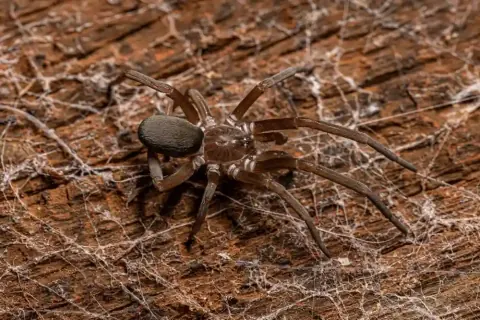
The Chilean recluse. Loxosceles laeta is the single most important spider for Argentine households. It is a plain tan spider with six eyes in three pairs that lives behind wardrobes and pictures, in skirting boards, stored clothes and rarely used bedding, and it bites only when pressed against skin. Cutaneous loxoscelism begins as a pale, painful patch that darkens over a day or two into a slowly ulcerating wound; the rarer viscerocutaneous form, which mostly affects children, causes fever and haemolysis and is a medical emergency. Specific antivenom works best given early, so speed matters more than anything you can do at home.
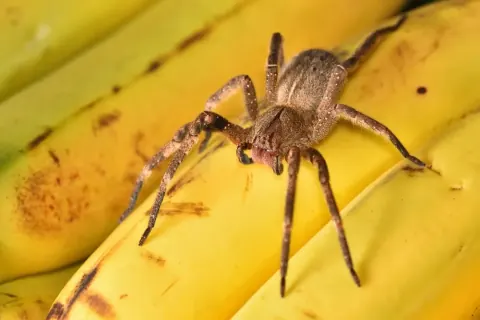
Wandering spiders. Phoneutria nigriventer reaches the humid north-east — Misiones, Corrientes, Chaco and Formosa. It builds no web, hunts at night and shelters by day in banana bunches, woodpiles, boots and rubble. Most bites are dry or mild, causing immediate severe local pain and sweating; severe envenoming is uncommon and mainly affects small children. Treatment is pain control, observation and, in serious cases, arachnid antivenom.
Bitten? Wash with soap and water, apply a cold pack, keep the limb still and go to a hospital — take a photograph of the spider if you can do it safely. Antivenom exists for widow and recluse bites and works best early, so do not wait to see how a wound develops. Never cut, suck, burn or apply a tourniquet.
What the older Argentina list gets wrong
The widow here is not Latrodectus curacaviensis. That species belongs to the Caribbean and northern South America. Argentina's widows of medical importance are L. mirabilis and L. corallinus, both spiders of open grassland rather than houses.
The golden silk orb weaver is Trichonephila clavipes. The genus was split from Nephila, so older pages carry the outdated name. The spider itself is unchanged: large, harmless and famous for its golden silk.
The pantropical huntsman is not dangerous. Heteropoda venatoria is fast, flat and alarming on a bedroom wall, but its bite is a brief local sting. Nor are Grammostola tarantulas dangerous; they flick irritating abdominal hairs long before they consider biting.
Where you meet them
In the house
The common house spider and small cobweb species take ceiling corners; the southern house spider fills cracks in exterior walls with pale lacy sheets. The one to know is the Chilean recluse, which prefers undisturbed storage: behind furniture, in boxes, inside clothes left folded for months. Our guide to house spiders covers indoor species in detail.
Gardens and the Pampas
Orb weavers work hedges, fences and tall grass. Widows live at ground level in rough grass, rubble, vacant lots and old farm equipment, which is where gloves are worth wearing.
The subtropical north
Misiones and the Chaco add golden silk orb weavers, green Lyssomanes jumpers and the wandering spiders. Shake out boots and check firewood and banana bunches here, not in Buenos Aires.
Spider season in Argentina
Seasons run opposite to the northern hemisphere. Spiders hatched in spring mature from late November, and activity peaks in the southern summer, December to March, when orb webs appear overnight in gardens and mature males wander in search of females. That wandering, not an invasion, is what puts hunting spiders indoors in midsummer. The nightly rebuilding behind those webs is covered in our guide to the spider web.
Recluse bites follow the same calendar for a different reason: summer clothing comes out of storage, so a spider that has sat undisturbed for months ends up against skin. In Patagonia the active season is much shorter, and most species overwinter as eggs or juveniles.
Easy mix-ups in Argentina
The southern house spider causes more false recluse reports than anything else. The female is dark and velvety and the male a leggy tan spider of roughly the right size, but both build a lacy crevice web, which a recluse never does, and both have eight eyes. A recluse has six eyes in three pairs and leaves only a scruffy retreat.

The false black widow, Steatoda grossa, is the usual stand-in for a true widow: purplish-brown with pale markings, common in sheds, and no threat. Harvestmen, with one fused body section and no venom glands, are not spiders, and the sun spiders of the Monte desert and Patagonia — fast, pale solifuges with oversized jaws — have no venom at all.
Common Spiders in Argentina
- Common House Spider (Parasteatoda tepidariorum)
- Adanson’s House Jumper (Hasarius adansoni)
- Pantropical Huntsman Spider (Heteropoda venatoria)
- Silver Garden Spider (Argiope argentata)
Biggest Spiders in Argentina
- Golden Silk Orb Weaver Spider (Trichonephila clavipes)
- Guarani giant tarantula (Grammostola grossa)
Most Venomous Spiders in Argentina
Cobweb Spiders/Tangle Web Spiders (Theridiidae)
 Cobweb SpidersBrown Widow (Latrodectus geometricus)Identify the brown widow (Latrodectus geometricus) by its orange hourglass and spiky egg sac, and learn how its bite compares with a black w
 Cobweb SpidersFalse Black Widow (Steatoda grossa)Identify the false black widow (Steatoda grossa): size, colour, its gumfoot cobweb, how it differs from a true widow, and how bad the bite r
Wandering Spiders
Sicariidae Spiders
Less Venomous Spiders in Argentina
Orb Weavers
 Orb WeaversGolden Silk Orb-Weaver (Nephila)Golden silk orb-weavers (Nephila): huge females, tiny males, giant golden webs, where they live, what they eat and whether their bite is dan
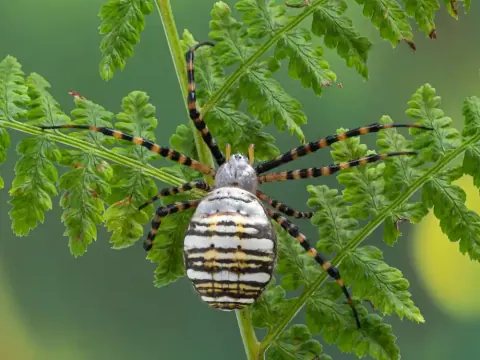 Orb WeaversBanded Garden (Argiope trifasciata)Identify the banded garden spider (Argiope trifasciata): silver banding, size, the zigzag in its web, egg sac, range, and whether its bite i
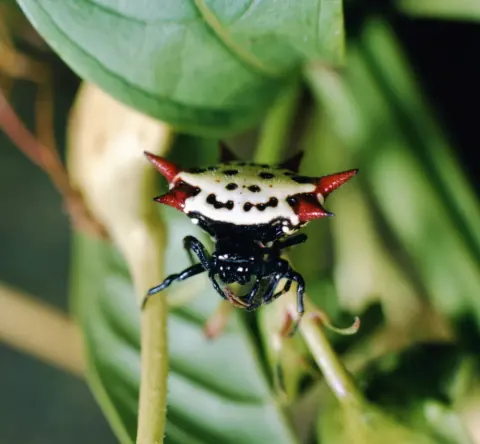 Orb WeaversSpinybacked Orbweaver (Gasteracantha cancriformis)Spinybacked orbweaver (Gasteracantha cancriformis) identification: six abdominal spines, colour forms, the silk-tufted web, range and whethe
Jumping Spiders
 Jumping SpidersLyssomanesA guide to Lyssomanes, the translucent green jumping spiders of the Americas: how to identify them, where they live, what they hunt and whet
 Jumping SpidersGray Wall Jumping (Menemerus bivittatus)Identify the gray wall jumping spider (Menemerus bivittatus): size, the flattened grey-haired body, its walls-and-tree-trunks habitat, and w
Cobweb Spiders/Tangle Web Spiders (Theridiidae)
 Cobweb SpidersRed House (Nesticodes rufipes)Identify the red house spider (Nesticodes rufipes): rusty red body, tangled indoor web, why it is mistaken for a widow, and what its bite ac
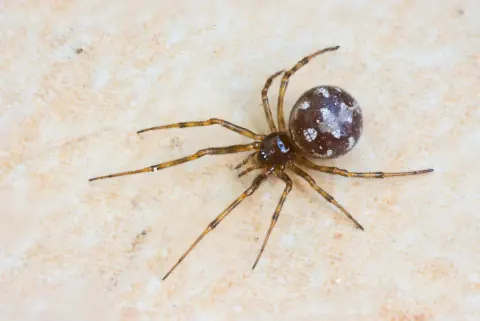 Cobweb SpidersTriangulate Cobweb (Steatoda triangulosa)Identify the triangulate cobweb spider (Steatoda triangulosa): the purple zigzag pattern, yellow legs, its tangle web, and whether the bite
Crevice Weaver Spiders (Filistatidae)
Living with Argentina's spiders
Almost all risk comes from a spider being trapped against skin, so the useful habits are about storage rather than spraying:
- Shake out clothes, shoes and towels that have been folded or stored, especially at the start of summer.
- Keep beds away from walls, and do not let bedding or boxes touch the floor in rooms that are rarely used.
- Wear gloves for woodpiles, rubble, sheet metal and old machinery on farms.
- Vacuum webs, retreats and egg sacs rather than spraying, and fit door sweeps and screens.
Frequently asked questions
What are the most dangerous spiders in Argentina?
Three groups. The native widow spiders Latrodectus mirabilis and L. corallinus cause cramping and sweating; the Chilean recluse, Loxosceles laeta, causes slow-ulcerating wounds and, rarely, a serious systemic illness in children; and Phoneutria nigriventer in the far north causes intense local pain. All three have effective treatment, and deaths are very rare.
Is the Chilean recluse common in Argentine houses?
Yes. Loxosceles laeta is established in buildings across much of the country and is the main cause of medically significant spider bites here. It hides behind furniture, in wardrobes, stored clothing and bedding, and bites only when pressed against skin. Any darkening, spreading wound after a bite needs prompt medical assessment.
Are there Brazilian wandering spiders in Argentina?
Yes, Phoneutria nigriventer occurs in the humid north-east, including Misiones, Corrientes, Chaco and Formosa. It builds no web, hunts at night and shelters in woodpiles, banana bunches and shoes. Most bites are mild or dry, with severe local pain and sweating; serious envenoming is uncommon and mainly affects young children.
What should you do if a spider bites you in Argentina?
Wash the site with soap and water, apply a cold pack, keep the limb still and go to a hospital, taking a photograph of the spider if that is safe. Antivenom for widow and recluse bites works best when given early. Do not wait to see how the wound develops, and never cut, suck or apply a tourniquet.
Which black widow lives in Argentina?
Not Latrodectus curacaviensis, which older lists name; that species belongs to the Caribbean and northern South America. Argentina's medically important widows are Latrodectus mirabilis and Latrodectus corallinus, native grassland spiders that build tangled snares at ground level. The introduced brown widow is also common around cities but causes only mild bites.
What is the biggest spider in Argentina?
The Guaraní giant tarantula, Grammostola grossa, one of several bulky Grammostola species in the grasslands, and the golden silk orb weaver of the northern forests, whose legs span a hand even though her body is far lighter. Neither is dangerous; tarantulas defend themselves with irritating abdominal hairs rather than venom.
What are the most common spiders in Argentine homes?
The common house spider, small cobweb spiders such as the triangulate cobweb and the red house spider, and the southern house spider in exterior wall cracks. In the warm north the pantropical huntsman and the gray wall jumping spider come indoors. All of them are harmless and all feed on household insects.
How many spider species live in Argentina?
Well over a thousand described species, and the number keeps rising as the Chaco, Misiones and Patagonia are sampled. The range from subtropical forest to sub-Antarctic steppe creates many separate faunas, which is why a spider list for Buenos Aires looks so different from one for Misiones or Tierra del Fuego.
Are tarantulas in Argentina dangerous?
No. Grammostola species, sold worldwide as beginner pets for exactly this reason, are slow and reluctant to bite. Their defence is a cloud of irritating abdominal hairs flicked with the hind legs, which can inflame skin and eyes. Their venom is not medically significant to people, and a bite is comparable to a wasp sting.
When is spider season in Argentina?
December to March, the southern summer. Spiders hatched in spring reach adult size, orb webs appear overnight in gardens, and mature males wander in search of females, which is when they come indoors. Recluse bites also peak then, because stored summer clothing and moved furniture disturb spiders that have sat undisturbed for months.
Published December 7, 2023 · Last updated September 14, 2026