Red Stripe Spider (Castianeira crocata)
A slim black ant-mimic with a single orange-red stripe running down its back, the red stripe spider is one of the easier members of Castianeira to name in the field. It builds no web, hunts on foot among leaf litter and stones across eastern North America, and is regularly mistaken for a young black widow by people who see only a dark spider with red on it.
 By Dr Richard J. Pearce (PhD)Published May 14, 2022Updated September 13, 2026✓ Reviewed by Dr. James Watuwa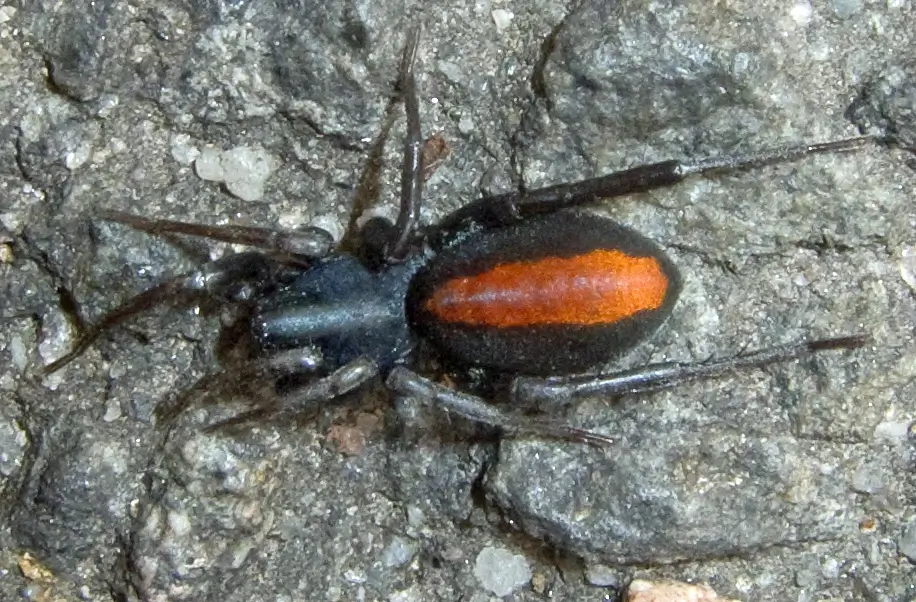
In this guide
Physical description and identification
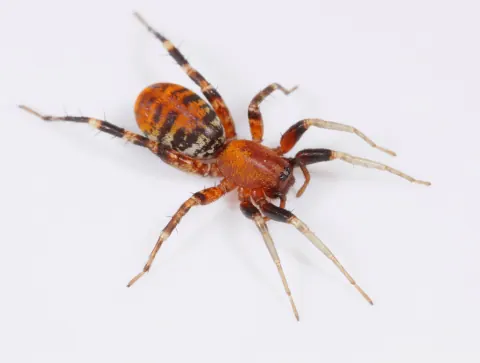
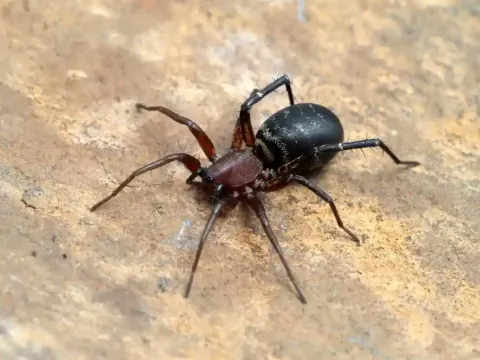
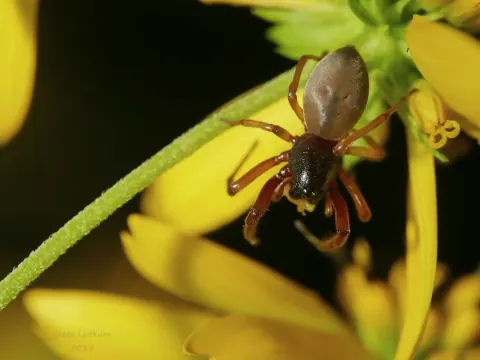
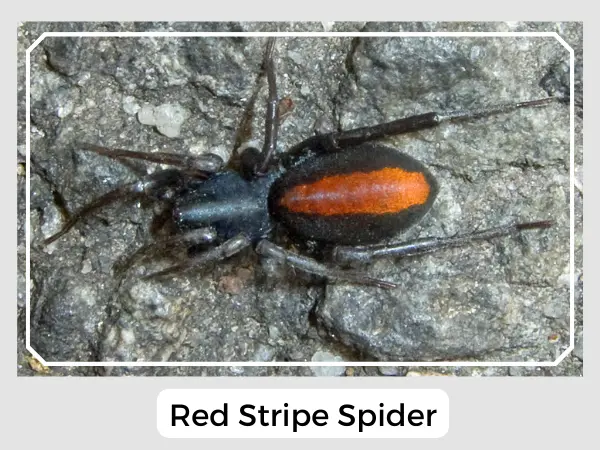
The red stripe spider is a small, glossy, ground-running hunter in the family Corinnidae and the ant-mimicking genus Castianeira. Seen from above it looks like a narrow black ant with a bright line painted down its back, and that line is the whole identification: among eastern North American members of the genus, a lengthwise orange-red stripe on a black abdomen is distinctive.
Adults
- Size: body length is roughly 5–10 mm (0.2–0.4 in). Mature females sit at the upper end of that range and are noticeably broader; males are smaller, narrower and longer-legged, with swollen pedipalp tips that look like tiny boxing gloves.
- Colour: the carapace and legs are blackish to very dark brown with a lacquered shine. The abdomen is black and carries a single orange to orange-red stripe running lengthwise along the upper surface, usually broadest toward the front and tapering back. The stripe is formed by coloured hairs and scales, so it looks brighter in direct sun and duller in shadow.
- Eyes: eight small eyes of similar size in two curved rows of four. No pair is enlarged; that alone rules out the jumping spiders, whose ant-mimicking species can otherwise look similar in a photograph.
- Other characteristic features: the body is elongated and sparsely haired, the abdomen is slightly narrowed where it meets the carapace, and the hind legs are the longest pair. In life, the front legs are usually raised and waving rather than walking, which is the quickest way to spot the genus.
A correction to a claim repeated in older material: the red stripe spider is not closely similar to a true black widow, even if the colours suggest it. The two are not related, do not share a body shape, and are not confusable once the outline is seen. The comparison below explains what to look for.
Eggs
The female encloses her eggs in a white, roughly circular silk sac and fastens it in a sheltered place — the underside of a rock or slab, a fold of loose bark, a board lying on soil. She may stay with it for a time but does not carry it, and the spiderlings receive no care after they emerge.
Spiderlings
Young are independent from the moment they leave the sac. They are paler and less clearly striped than adults, so half-grown individuals can be hard to name to species; the stripe strengthens with successive moults.
The web and how it hunts
This is another point that older accounts get wrong. The red stripe spider builds no web near its resting place or anywhere else. It is a cursorial hunter: it runs prey down on soil, litter, logs and low plants and overpowers it directly. Silk is used for two purposes only — a safety dragline paid out as it moves, and a flattened sac-shaped retreat tucked into a crevice, where the spider rests during the day, moults and shelters with an egg sac. For how this compares with true web builders, see our guide to spider webs.
Where the red stripe spider lives
Castianeira crocata is native to North America. It is recorded widely through the eastern and central United States, from New England and the Great Lakes states south to the Gulf and west into the prairies, and it reaches southern Canada. Older summaries that limit it to "the United States" are too narrow; the northern edge of the range crosses the border into Ontario and neighbouring provinces.
The preferred habitat is open, sunlit ground with plenty of surface cover: deciduous woodland edges and clearings, old fields, prairie remnants, hedgerows, parks and gardens. The spider spends its time under and between stones, logs, loose bark, boards and leaf litter, emerging to hunt across open soil. Like most of the genus, it is closely associated with ant activity, which is a large part of why it looks the way it does. It is not a house spider and does not establish indoors, although a wandering male may come in through a gap at floor level during the summer.
Is the red stripe spider venomous?
Yes, in the same limited sense as nearly all spiders: it injects venom to subdue the insects it catches. That venom is tuned to small arthropods and is not medically significant to people, pets or livestock. No antivenom exists because none is required, and no serious envenomation has been documented for the species. It is unrelated to the recluse spiders and the widow spiders, the two North American groups that matter medically.
Can a red stripe spider bite?
It can, but records are very few, because the spider's reflex on meeting anything large is to sprint for cover. Bites occur only where escape is impossible — a spider caught inside a glove, pressed under a hand on a log, or trapped in clothing left on the ground. The effect described is a short, sharp pinprick, followed by slight redness and perhaps a little local swelling that settles within a day. Wash the area with soap and water and hold a cold pack against it if it aches. Expanding redness, an ulcerating wound or fever warrant medical advice, as those indicate infection rather than venom.
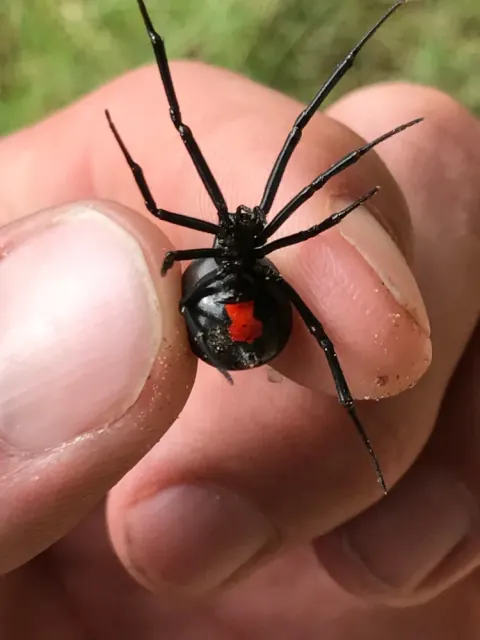
Red stripe spider or black widow? A black widow has a fat, round, hairless abdomen, hangs upside down in a tangled web in a dark cavity, and carries a red hourglass on its underside. A red stripe spider is slim and ant-shaped, builds no web at all, runs about in the open, and carries its red as a lengthwise stripe on top of the abdomen. Shape and posture separate them instantly.
Ecological importance and behavior of the red stripe spider
The red stripe spider is a wandering predator with an ant's manners. It walks on its rear six legs and holds the front pair up, waving them like antennae; it moves in short jerky bursts and pauses, and its glossy, constricted-looking body finishes the impression. This is myrmecomorphy, and for the spider it is primarily a defence: many visual hunters — birds, wasps, and especially other spiders — avoid anything that reads as an ant, because ants bite, sting and arrive with reinforcements.
Diet: small ground-living arthropods — ants, flies, small beetles, springtails, leafhoppers, crickets and other small spiders. A single spider works through a steady stream of such prey across a season, so a garden population is a real contribution to pest control.
Natural predators: older summaries name only birds and wasps, but the list is longer. Birds and parasitoid wasps — mud daubers stock their cells with spiders of exactly this size — are joined by lizards, toads, centipedes, ants when the disguise fails, and larger spiders. See what eats spiders.
Daily and seasonal rhythm: the species is active mainly in the warm months, in daylight and after dusk alike, though it keeps to cover in the hottest hours. Mature males wander in search of females through summer and are the individuals most often seen crossing open ground. The population overwinters largely as eggs and juveniles tucked into litter and crevices.
Lifespan: about a year is typical for a temperate Castianeira, with individuals hatching in one season, overwintering part-grown and maturing in the next. Claims of three-year lifespans for this species are not supported.
Relationship with humans: harmless and useful. No control is justified; one found indoors can be cupped and put outside.
Similar spiders and how to tell them apart
| Spider | How it differs from the red stripe spider |
|---|---|
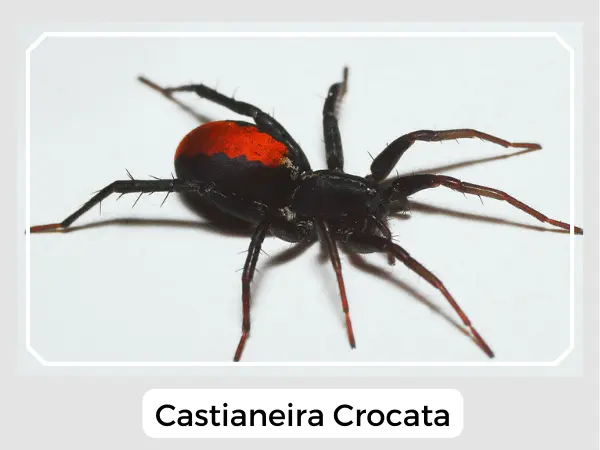
| Red-spotted ant mimic (C. descripta) | Same genus and same black base colour, but the red forms a patch or blotch on the front of the abdomen rather than a long stripe. |
| Castianeira amoena | Rusty orange-brown with dark banding instead of black with one stripe; the overall look recalls a velvet ant or wasp. |
| Castianeira longipalpa | Dark with pale transverse bands of white scales crossing the abdomen, and no red or orange markings at all. |
| Black widow (Latrodectus) | Round, glossy, bulbous abdomen; a red hourglass underneath; a permanent tangle web; hangs upside down. Medically significant, unlike this spider. |
| Broad-faced sac spider (Trachelas tranquillus) | Stockier, with a smooth reddish-brown carapace and a plain pale grey abdomen; no stripe, no ant posture. |
| Ant-mimicking jumping spiders | Also ant-shaped, but with two large forward-facing eyes and a hopping, stop-start movement that no Castianeira shows. |
Quick facts
| Scientific name | Castianeira crocata (Hentz, 1847), family Corinnidae. |
|---|---|
| Distribution | Eastern and central United States, north into southern Canada. |
| Habitat | Woodland edges and clearings, old fields, prairie remnants, hedgerows, parks and gardens; under stones, bark, logs and leaf litter. |
| Diet | Ants, flies, small beetles, springtails, leafhoppers, crickets and small spiders. |
| Web | No capture web; a flat silk retreat plus a dragline. |
| Lifespan | About one year, with winter passed as eggs or part-grown juveniles. |
| Predators | Birds, parasitoid wasps, lizards, toads, centipedes, ants and larger spiders. |
| IUCN status | Not evaluated. Widespread and locally common. |
Did you know?
- The species was described in 1847 by Nicholas Marcellus Hentz. He is often called a French arachnologist, which is only half right: he was born in France but emigrated to the United States as a young man and did all of his arachnological work there, which is why he is generally credited as the founder of American arachnology.
- The genus Castianeira was erected later, by Eugen von Keyserling in 1879, so the species was originally published under a different genus name and moved afterwards — a normal piece of taxonomic housekeeping.
- Holding the front legs up as imitation antennae costs a spider real running speed, since it is effectively travelling on six legs. The disguise is worth more than the speed.
- The stripe is made of pigmented hairs and scales rather than the cuticle itself, which is why it looks vivid in sunshine and can appear dull brown in a flash photograph.
In summary, the red stripe spider is a harmless, hard-working little predator that survives by pretending to be an ant. Look for the slim black body, the raised waving front legs and the single orange-red line down the back, and remember that no widow runs across open ground without a web.
Frequently asked questions about the red stripe spider
What does a red stripe spider look like?
It is a slim, glossy black spider about 5 to 10 mm long with a single orange to orange-red stripe running lengthwise along the top of the abdomen. The legs are dark and shiny, the eight eyes sit in two rows of four, and the front legs are usually held up and waving like antennae.
How big do red stripe spiders get?
Body length is roughly 5 to 10 mm, or about 0.2 to 0.4 inches, excluding the legs. Females are larger and broader than males, while males are narrower with longer legs and swollen pedipalp tips. Even a big female is smaller than a grain of rice is long.
Is the red stripe spider a kind of black widow?
No. They are unrelated and easy to separate. A widow has a round, bulbous abdomen, builds a messy tangle web and shows a red hourglass on its underside. A red stripe spider is narrow and ant-shaped, builds no web, runs in the open and carries its red stripe on top of the abdomen.
Are red stripe spiders venomous to humans?
They carry venom for subduing insects, but it is not medically significant to people or pets. No antivenom exists because none is needed and no serious bite has been documented for the species. Any effect of a bite is local and short-lived.
Do red stripe spiders build webs?
No capture web. They are active hunters that chase prey across soil, litter, logs and low plants. Silk is used only as a safety dragline and to build a flat sac-shaped retreat under a stone, board or piece of bark, where the spider rests, moults and keeps its egg sac.
What do red stripe spiders eat?
They hunt small ground-living arthropods: ants, flies, small beetles, springtails, leafhoppers, young crickets and other small spiders. A garden population removes a steady stream of insects across a season, which makes the species a quiet contributor to natural pest control.
Where do red stripe spiders lay their eggs?
The female wraps her eggs in a white, roughly circular silk sac and attaches it to a sheltered surface such as the underside of a rock, a slab, a board on the ground or a strip of loose bark. She does not carry the sac and the spiderlings are independent on emergence.
Are red stripe spiders active at night?
They are active in the warm months both in daylight and after dusk, taking shelter during the hottest hours. Describing them as strictly nocturnal is too simple: they are regularly seen hunting on sunlit ground, and males wander openly by day in summer while looking for mates.
Where are red stripe spiders found?
Across eastern and central North America, from New England and the Great Lakes south to the Gulf states, west into the prairies and north into southern Canada. Typical habitats are woodland edges, old fields, hedgerows, parks and gardens with stones, logs and leaf litter for cover.
What should I do if a red stripe spider bites me?
Wash the site with soap and water and apply a cold pack if it is sore. The usual result is a brief pinprick with mild redness that clears within a day. Seek medical advice only if redness spreads, a wound develops or you feel unwell, which would point to infection rather than venom.
References
- World Spider Catalog (2026). Castianeira crocata (Hentz, 1847). Natural History Museum Bern. wsc.nmbe.ch/spec-data/13254/taxon
- Cushing, P. E. (2012). Spider-ant associations: an updated review of myrmecomorphy, myrmecophily, and myrmecophagy in spiders. Psyche 2012: 151989. doi.org/10.1155/2012/151989